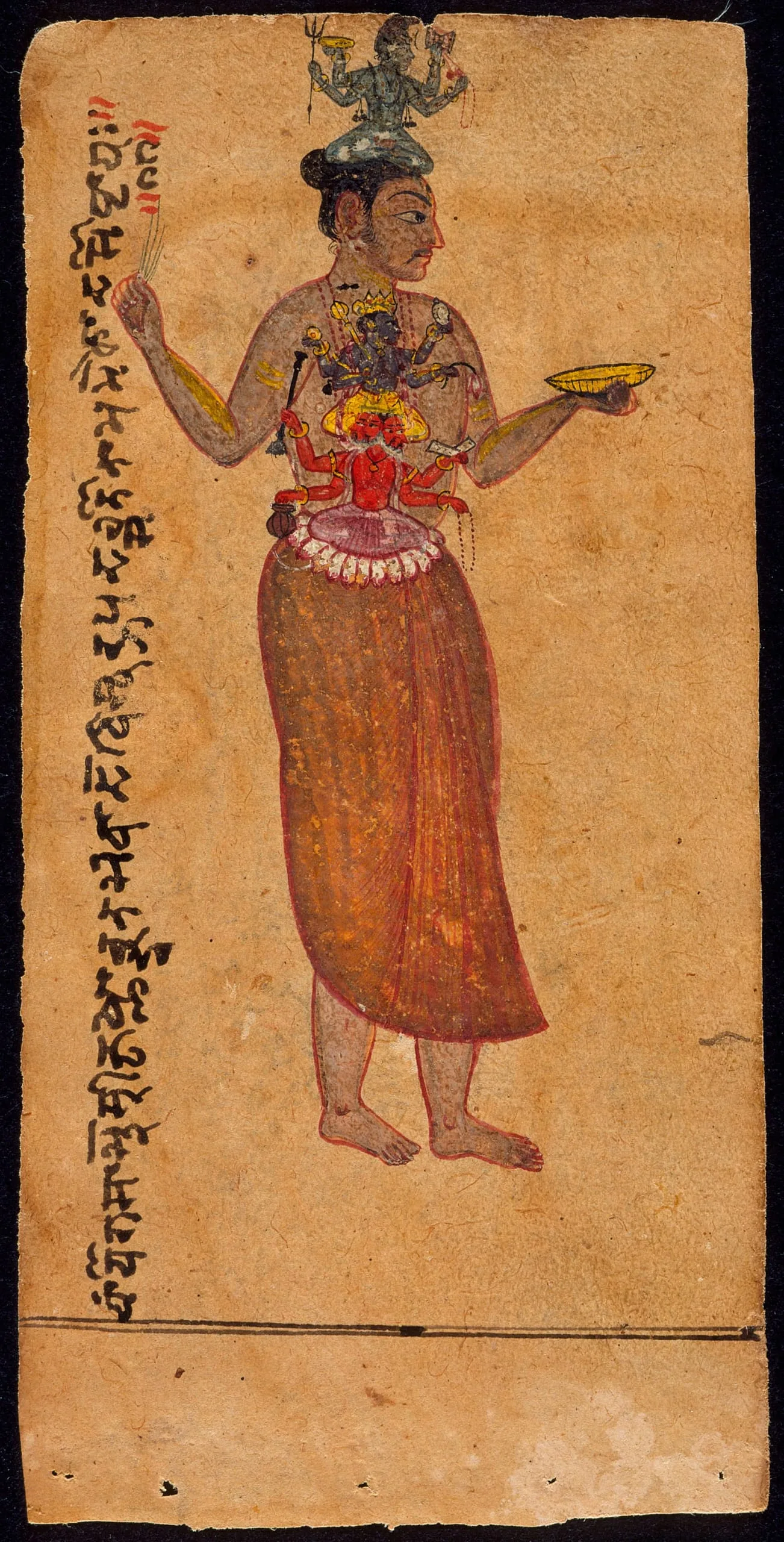
Used for meditational practices, this is a representation of a tantric Hindu cosmic deity that envisions the six primary macrocosmic chakra (energy) zones stacked vertically along the central axis of the figure to align the cosmo-theological planes of existence with specific bodily energy centers. The three primary gods of the Hindu pantheon (trimurti) are Brahma, the god of creation; Vishnu, the god of preservation; and Shiva, the god of destruction. Regarded as Cause-Deities (karana-devatas), they embody the six chakras grouped into three layers of reality:
The Lower Physical Band (Governed by Brahma):
Muladhara (Root) and
Svadhishthana (Sacral) Chakras.
The Preservation & Will Band (Governed by Vishnu):
Manipura (Solar Plexus) and
Anahata (Heart) Chakras.
The Consciousness Band (Governed by Shiva/Sadashiva):
Vishuddha (Throat) and
Ajña (Third Eye) Chakras.
The Sanskrit inscription along the left edge reads, Whichever (and) whichever Rama reigning in the earth circle [entire cosmic man (purusha)]: navel lotus [Brahma], inside the heart [Vishnu], head above, Sadashiva [Shiva]. May the spiritual merit manifest exactly as written. (Translation by Google. subject to verification.)
Brahma sits in the lotus posture (padma asana) on a lotus. He is red-skinned, crowned, and has four heads and four arms. He holds a manuscript of the Vedas (UL), rosary (LL), ascetic’s water vessel (LR), and club (UR).
Vishnu sits in the lotus posture and wears a yellow dhoti. He is blue-skinned, crowned, and has four arms. He holds a conch (UL), lotus (LL), mace (LR), and discus (UR).
Shiva sits in the lotus posture and has ashen-colored skin. He has the piled hair of a yogi that curves downward to represent the Descent of the Ganges. He wears a garland of severed skulls. In his four arms, he holds an hourglass-shaped pellet drum (UL), rosary (LL), trident (LR), and skull cup for offerings (UR).
The standing cosmic man wears an orange dhoti and has sectarian markings on his forehead. He holds an offering cup in his left hand and a sprig (?) in his right hand.