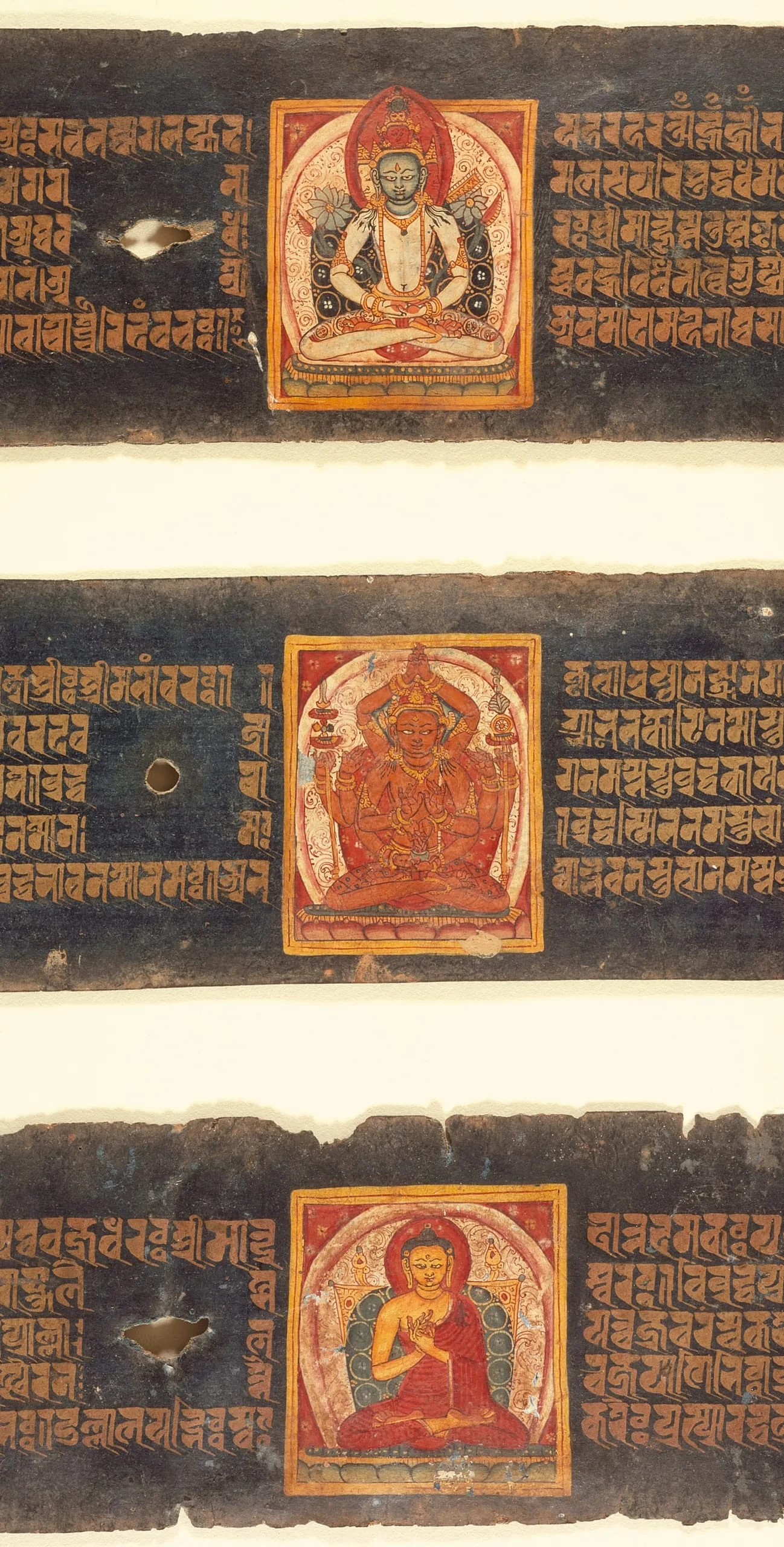
The Paramartha Namasangiti was a Mahayana Buddhist text composed around the 6th century. It consists of a laudatory hymn in honor of the Bodhisattva Manjushri. It was translated from Sanskrit into Chinese and Tibetan and was extremely popular with Nepalese Buddhists.
The text was written in gold ink on dark blue paper using the kutila (crooked) script that originated in eastern India, which is characterized by a deliberate hook at the bottom of each letter. By the 11th century the use of this hook was archaic and was only used in manuscripts produced at Buddhist monasteries. The distinctive blue paper was used because it was believed to be more resistant to termites. While manuscripts composed on dark blue paper are fairly common in Nepal from the 16th century onwards, only a few examples date from the early 13th century. As paper is more durable than palm leaf, only one hole was made for binding the text. See also its series mates M.83.7.2-.3 and M.82.153.1-.2.
Dedicatory inscription:
This is the pious gift of the merchant Kirtipala, the great devotee and follower of Mahayana. Whatever merit there in this gift may it accrue to his parents, teachers, ancestors, and all sentient beings.
(Translation by Ian Alsop, Dhanavajra Vajracharya, and Hemraj Shakya.)