- Title
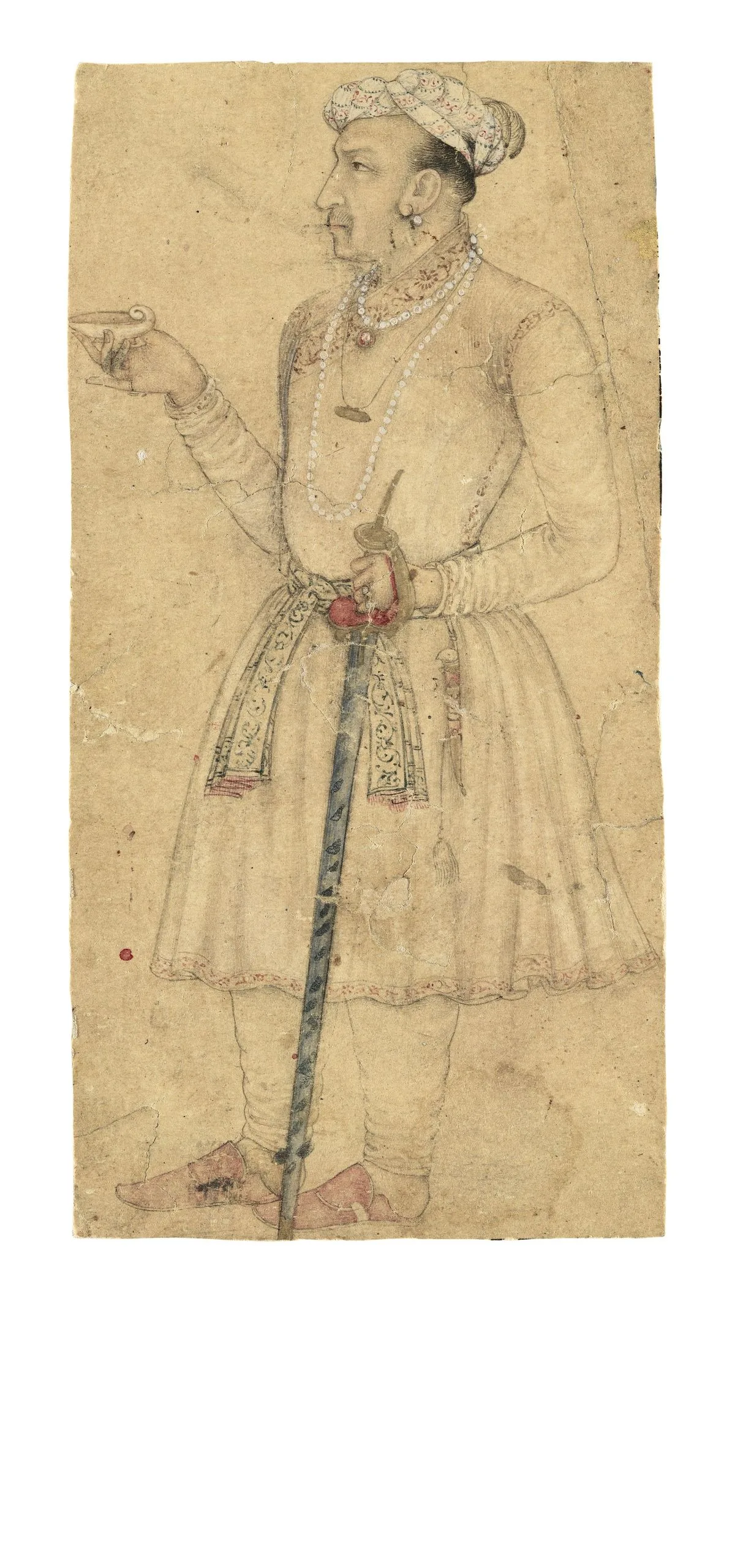
- Emperor Jahangir (r. 1605-1627)
- Date Made
- 1620-1625
- Medium
- Ink and opaque watercolor on paper
- Dimensions
- 4 1/8 x 2 1/8 in. (10.48 x 5.4 cm)
- Accession Number
- M.83.1.5
- Curatorial Notes
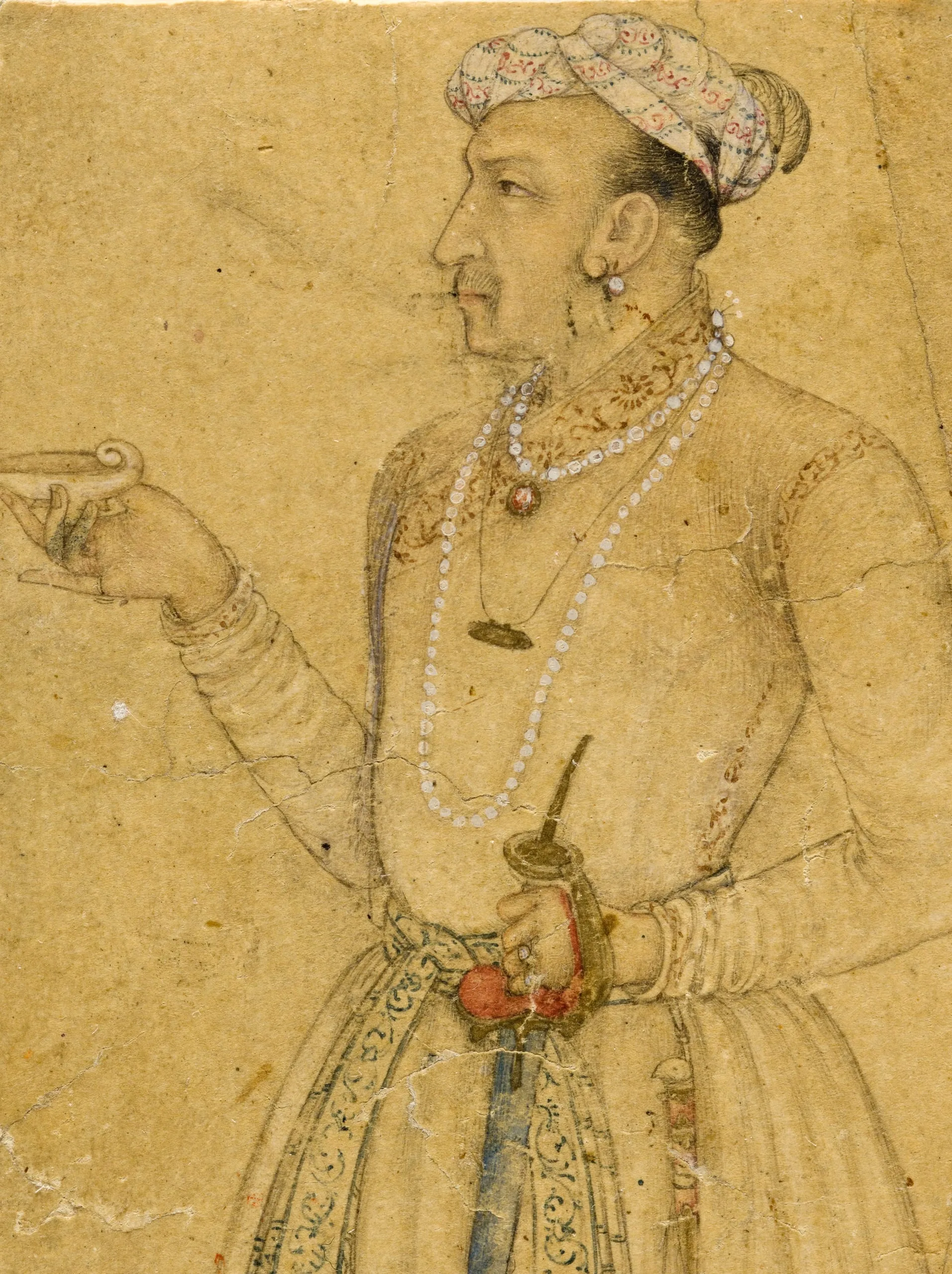
Emperor Jahangir (r. 1605-1627) was born in 1569. His birth name was Nur-ud-din Muhammad Salim. He was known as Shah Salim during his rebellion from his father Emperor Akbar (r. 1605-1627), when he established an independent court at Allahabad in 1600-1604. He had been given the name of Salim in honor of Shaikh Salim Chishti (1478–1572), a revered Sufi saint in whose abode he was born in Sikri, near Agra. In this sensitive nim qalam (half-pen) lightly tinted drawing, Jahangir wears a delicately colored cloth turban (pagri) topped with a feather plume (jigha). He wears a pierced pearl earring indicating that he is an ‘ear-bored slave’ or follower of the Sufi saint Khwaja Muin al-Din Chishti (1143–1236), which he began wearing in August 1614 after crediting the saint with his recovery from a severe illness. Around his neck he wears two strands of pearls, an amulet case (see M.76.2.25), and what may be a miniature portrait (shast). He wears a long white coat (jama) with a border matching his turban decoration and a waist sash with a bird-headed knife suspended from it. In his right hand he holds a white jade wine cup (see M.76.2.1). His left hand grasps the grip of a “Firangi” (European) straight sword with a basket hilt and pommel spike.
A closely similar drawing of Jahangir wearing a miniature portrait pendant and an archer’s thumb ring (see AC1995.168.1) instead of holding a wine cup, and grasping the same style sword is in the Rhode Island School of Design Museum (81.230).
- Selected Bibliography
- Thackston, Wheeler M. The Jahangirnama: Memoirs of Jahangir, Emperor of India. New York: Oxford University Press, 1999.
- Trabold, J. The Art of India, An Historical Profile. Northridge, CA: California State University Press, 1975.
Pal, Pratapaditya, Thomas W. Lentz, Sheila R. Canby, Edwin Binney, 3rd, Walter B. Denny, and Stephen Markel. "Arts from Islamic Cultures: Los Angeles County Museum of Art." Arts of Asia 17, no. 6 (November/December 1987): 73-130.
- Pal, Pratapaditya. Indian Painting, vol.1. Los Angeles: Los Angeles County Museum of Art, 1993.
- Heeramaneck, Alice N. Masterpieces of Indian Painting : From the Former Collections of Nasli M. Heeramaneck. New York: A.N. Heeramaneck, 1984.
- Rosenfield, John. The Arts of India and Nepal: The Nasli and Alice Heeramaneck Collection. Boston: Museum of Fine Arts, Boston, 1966.
- Spink, Michael, "Islamic Jewellery", London.Exhibition Catalog, 1986
- Markel, Stephen. Mughal and Early Modern Metalware from South Asia at LACMA: An Online Scholarly Catalogue. Los Angeles: Los Angeles County Museum of Art, 2020. https://archive.org/details/mughal-metalware (accessed September 7, 2021).
- Komaroff, Linda, editor. Dining with the Sultan: The Fine Art of Feasting. Los Angeles: Los Angeles County Museum of Art; New York: DelMonico Books, 2023.