LACMA

ShopMembershipMyLACMATickets
LACMA
Los Angeles County Museum of Art
5905 Wilshire Blvd.
Los Angeles, CA 90036
info@lacma.org
(323) 857-6000
Sign up to receive emails
Subscribe
© Museum Associates 2025

Museum Hours

Monday

11 am–6 pm

Tuesday

11 am–6 pm

Wednesday

Closed

Thursday

11 am–6 pm

Friday

11 am–8 pm

Saturday

10 am–7 pm

Sunday

10 am–7 pm


  • About LACMA
  • Jobs
  • Building LACMA
  • Host An Event
  • Unframed
  • Press
  • FAQs
  • Log in to MyLACMA
  • Privacy Policy
© Museum Associates 2025
Collections

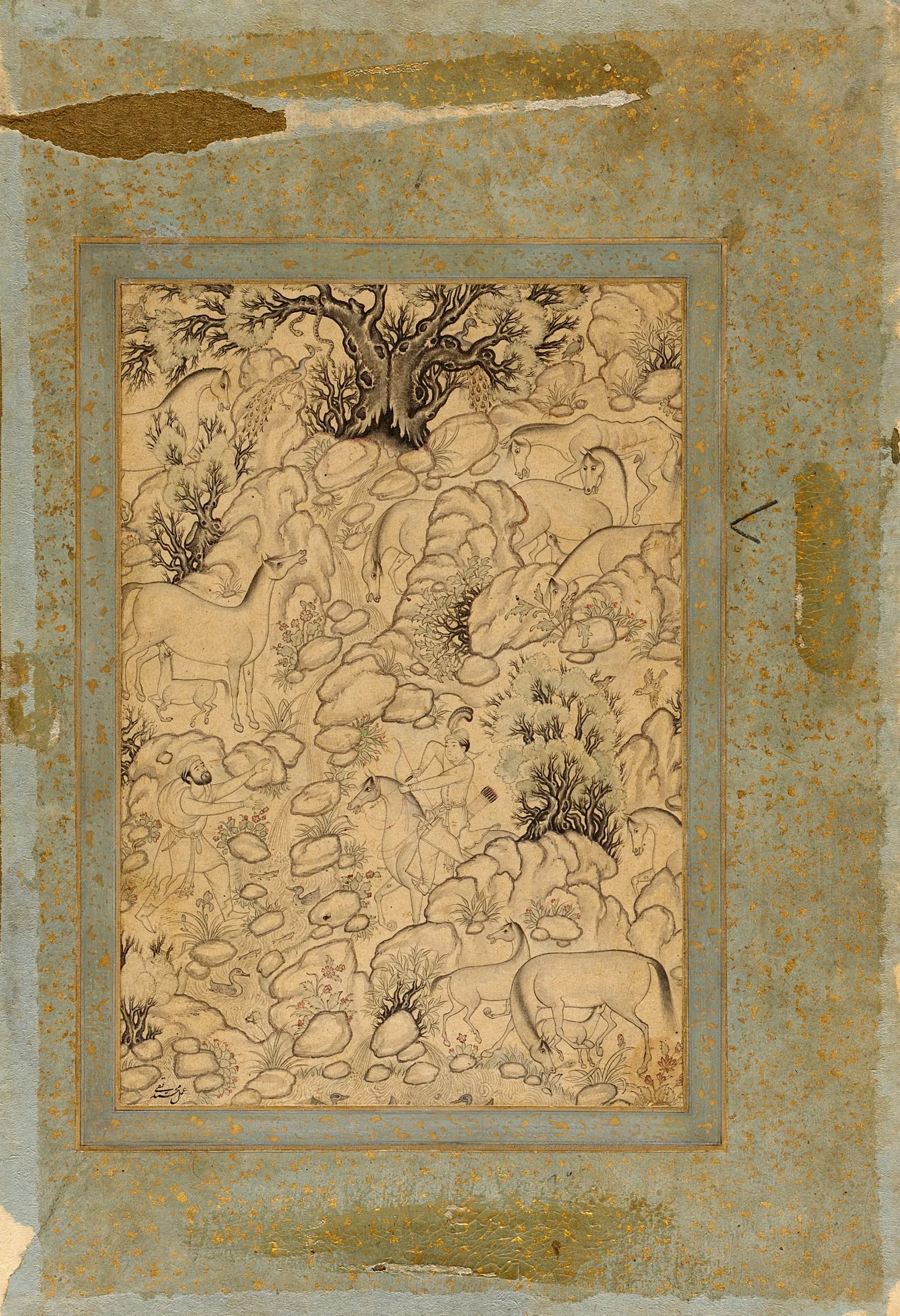
King Dara and the Herdsman19th century (?)

Not on view
Ink drawing on cream paper of a rocky hillside densely populated with deer, horses, goats, and other animals amid boulders and shrubs, with a gnarled tree at top center, mounted in a gold-flecked sage-green border
Title
King Dara and the Herdsman
Place Made
India, Mughal style
Date Made
19th century (?)
Medium
Ink and opaque watercolor on paper
Dimensions
Image: 9 x 6 1/8 in. (22.86 x 15.56 cm); Sheet: 14 1/2 x 10 1/2 in. (36.83 x 26.67 cm)
Credit Line
From the Nasli and Alice Heeramaneck Collection, Museum Associates Purchase
Accession Number
M.83.1.8
Classification
Drawings
Collecting Area
South and Southeast Asian Art
Curatorial Notes

This nim qalam (half-pen) lightly tinted drawing depicts the story of King Dara and the herdsman. The legendary King Dara (or Dara II) was the last king of the mythical Kayanian dynasty of ancient Iran. He is usually associated with Darius III (r. 336–330 BCE), the last king of the Achaemenid Empire (550-330 BCE). According to the moralistic tale related in Chapter 1 of the Bustan (Orchard) composed in 1257 by the celebrated Persian poet Sa’di (1210-1291), King Dara becomes separated from his hunting party. He is approached by an unfamiliar man and, assuming he is an enemy, draws his bow. The man identifies himself as the royal herdsman and reminds Dara of their previous encounters. The herdsman reproaches the king for being unable to distinguish friend from foe, whereas he can tell one horse out of thousands. The moral of the story is that the kingdom will suffer when the wisdom of the shepherd exceeds that of its king.

Illustrations of King Dara and the herdsman appear in 15th- and 16th-century manuscripts of the Bustan, including a work of circa 1489 signed by the great Persian painter Bihzad (circa 1460-1535), now in the Egyptian National Library, Cairo. They are also found in early Mughal painting, such as in a manuscript produced in Agra in circa 1604, now in the Aga Khan Museum, Toronto (AKM284.3).


This folio is likely a 19th-century copy. It has an apocryphal signature: amal-i Muhammad Taqi (work of Muhammad Taqi), an artist who worked for Emperor Akbar (r. 1556-1605).
Selected Bibliography
  • Pal, Pratapaditya. Indian Painting, vol.1. Los Angeles: Los Angeles County Museum of Art, 1993.
  • Rosenfield, John. The Arts of India and Nepal: The Nasli and Alice Heeramaneck Collection. Boston: Museum of Fine Arts, Boston, 1966.