- Title
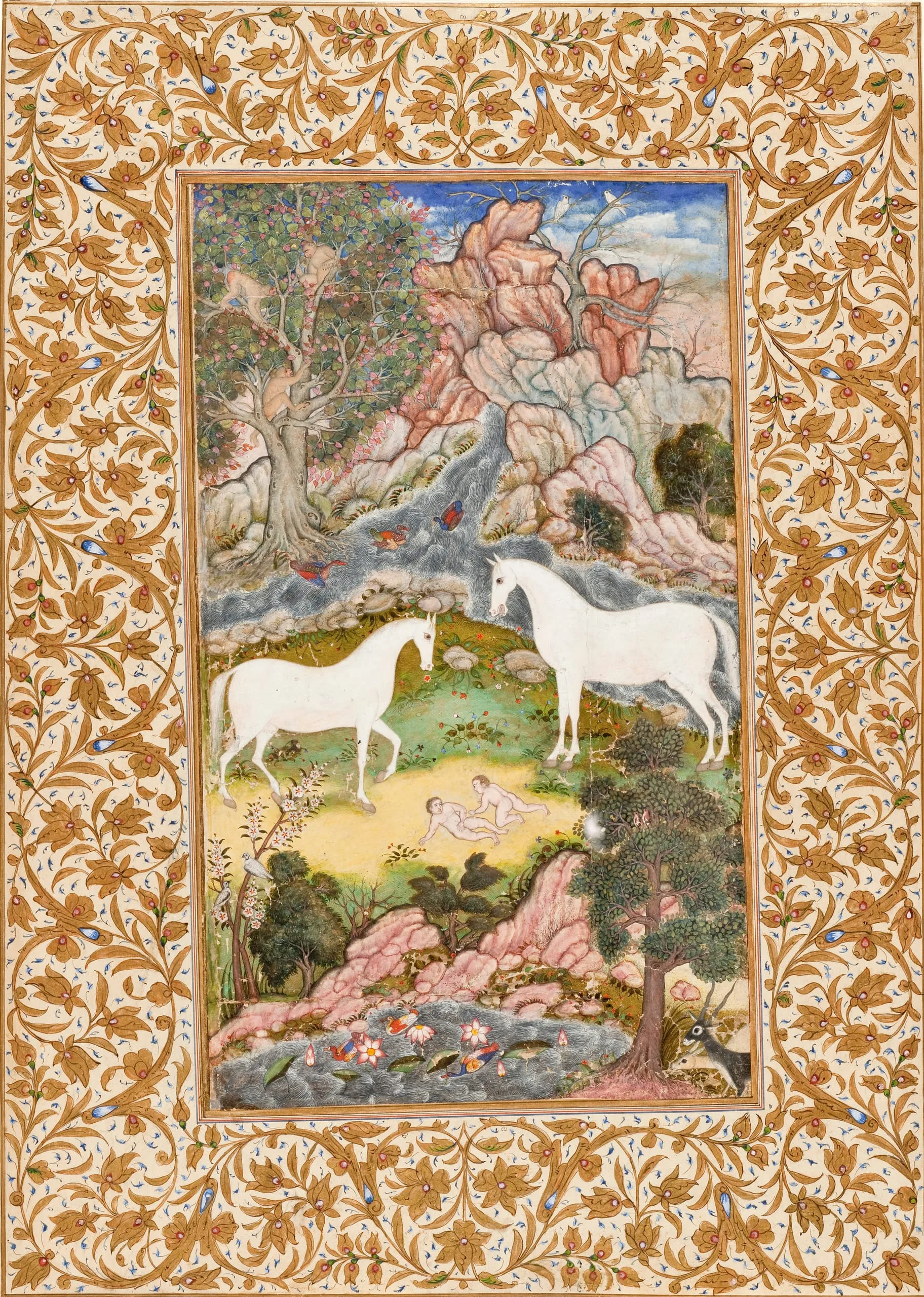
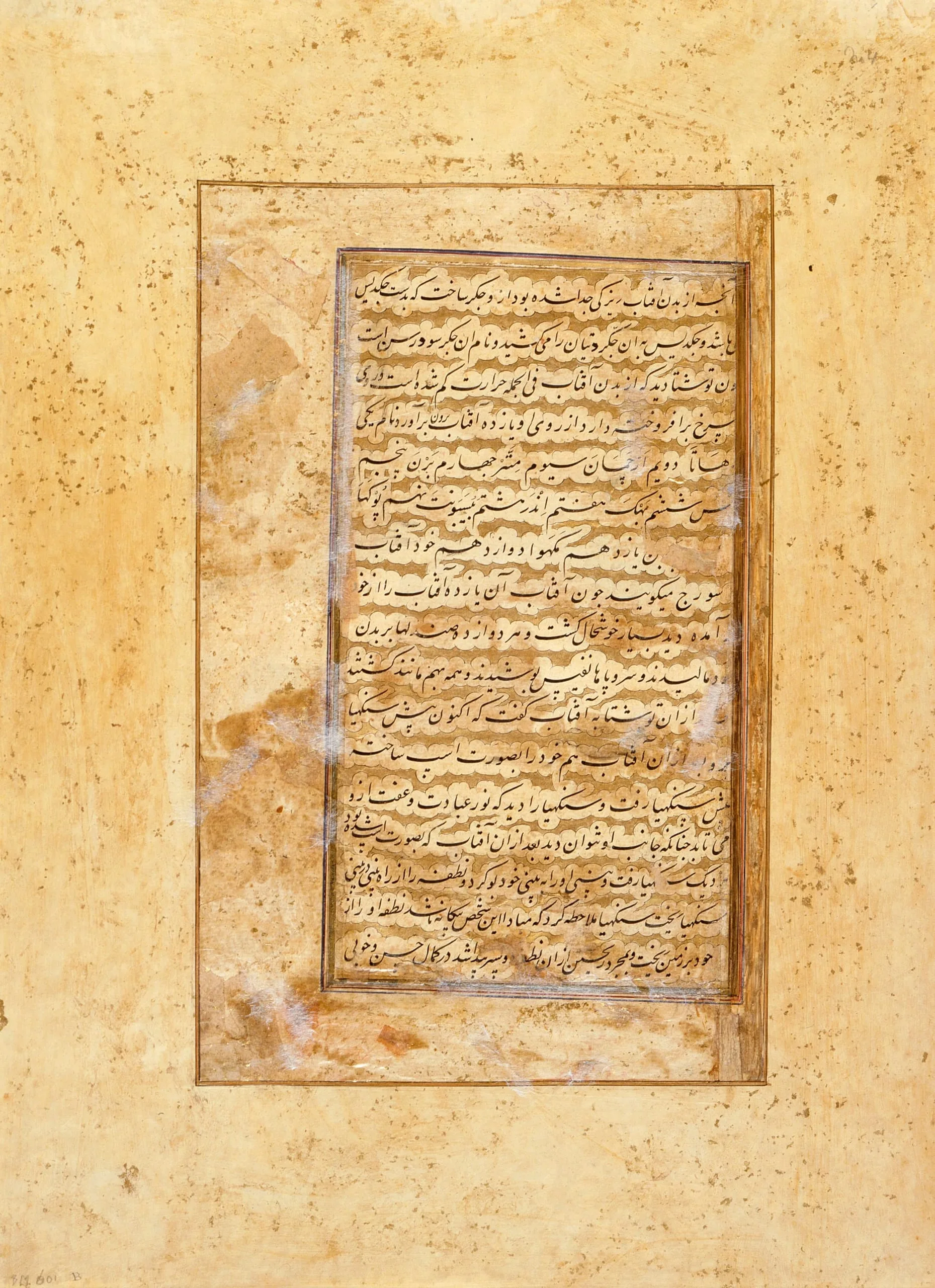
- Birth of the Celestial Twins (recto), Calligraphy (verso), Folio from a Harivamsha (Lineage of Hari [Vishnu])
- Date Made
- circa 1585 (border: circa 1700)
- Medium
- Opaque watercolor, gold, and ink on paper
- Dimensions
- Sheet: 16 1/8 x 11 3/4 in. (40.96 x 29.85 cm); Image: 11 3/4 x 7 in. (29.85 x 17.78 cm)
- Accession Number
- M.83.1.7
- Curatorial Notes
The Harivamsha (Lineage of Hari [Vishnu]) is an appendix to the great Indian Sanskrit epic, the Mahabharata ([War of the] Great Bharatas), which is traditionally believed to have been composed by the revered sage Vyasa by the 1st century CE. It was translated into Persian for the Mughal Emperor Akbar (r. 1556-1605) by Mullah (or Mawlana) Sheri, who was killed in Kashmir in February 1586. This folio, M.78.9.10, and M.83.105.4 are from a widely dispersed Harivamsha manuscript that was a second copy of Akbar’s original volume. The folios were remounted into later borders in circa 1700. Verses from the text are on the obverse.
This folio illustrates the birth of the celestial twins described in Chapter 9 of the text. The story recounts that Samjna (or Sanjna), the wife of the sun god Surya, was unable to bear his heavenly effulgence and assumed the form of a mare to flee to a northern region called Uttarakuru. Surya discovered her location and transformed himself into a stallion to mate with her. Their twin sons, known as the Ashvinikumara (the mare’s boys), were divine physicians associated with the dawn. Here, in a sunlit glade in a lush mountainous forest, the newborn celestial twins are watched over by their equine parents, who are painted white symbolic of their luminosity. The landscape teems with monkeys and pairs of birds in the trees, several brightly colored waterfowl in the streams by the clearing, and two antelopes in the lower right corner.
- Selected Bibliography
- Pal, Pratapaditya. Indian Painting, vol.1. Los Angeles: Los Angeles County Museum of Art, 1993.
- Heeramaneck, Alice N. Masterpieces of Indian Painting : From the Former Collections of Nasli M. Heeramaneck. New York: A.N. Heeramaneck, 1984.
- Rosenfield, John. The Arts of India and Nepal: The Nasli and Alice Heeramaneck Collection. Boston: Museum of Fine Arts, Boston, 1966.