Dating from circa 550 CE, the Devimahatmya (Glory of the Goddess) is a devotional text of 700 Sanskrit verses that extol the Goddess (Devi) as the supreme power and creator of the universe. The verses were interpolations to the earlier Markandeya Purana dating from circa 250 CE and then extracted as a stand-alone text. The Devimahatmya describes the Goddess in her various aspects triumphing over the demons Madhu and Kaitabha, Mahishasura, Dhumralochana, Chanda and Munda, Raktabija, and Shumbha and Nishumbha.
Recto: In this bipartite composition, the left-side scene is a four-armed Vaishnavi holding her upper right hand in the ‘fear-not’ gesture (abhaya mudra) and carrying a dagger, sword, and discus. She rides Garuda, the half-avian, half-man Vaishnava vehicle. She fights an elderly warrior. The right-side scene is a two-armed Varahi shooting an arrow. She rides a buffalo (right) and fights three demon warriors (asuras).
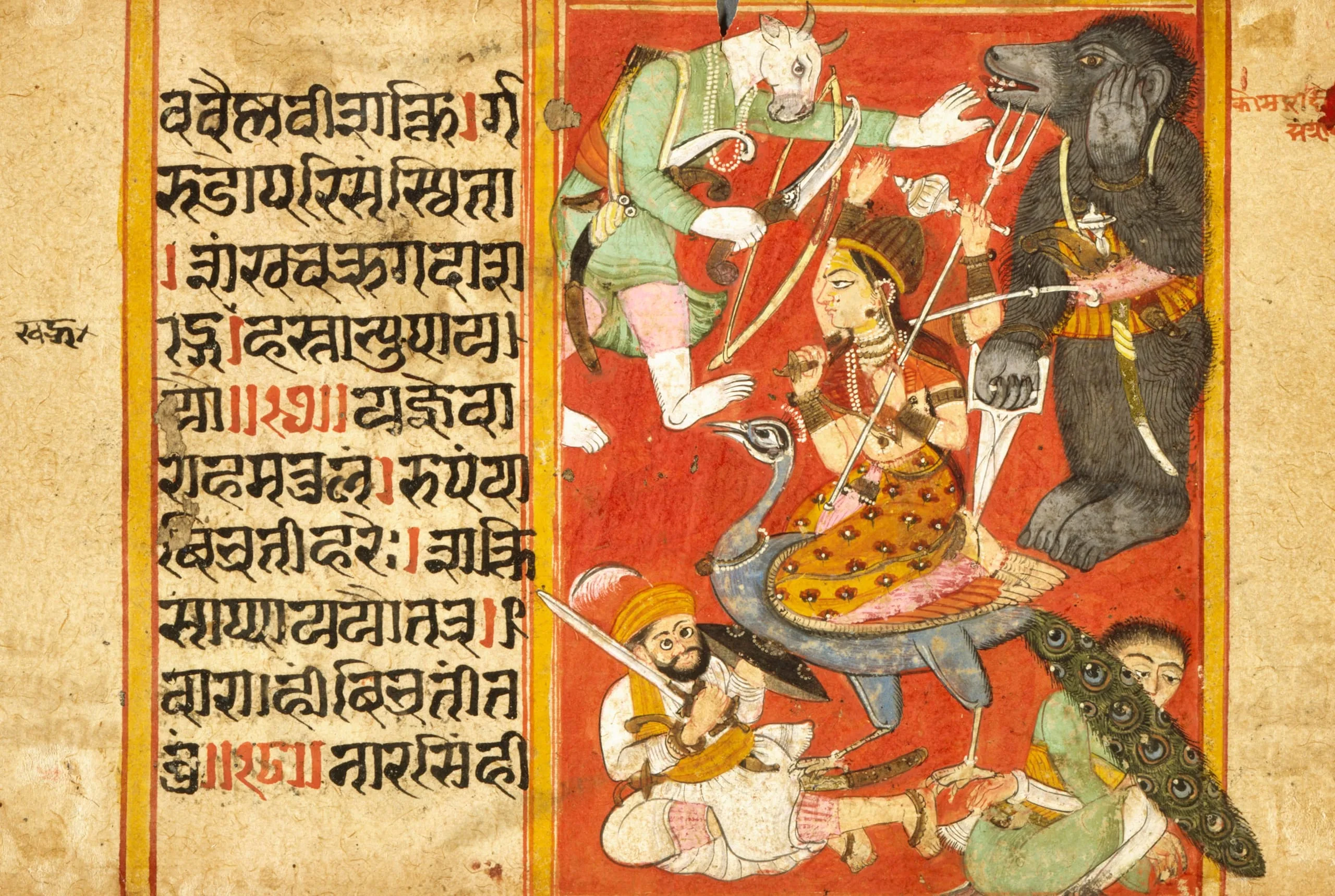
Verso: A four-armed Kaumari holds her upper right hand in the ‘fear-not’ gesture (abhaya mudra) and carries a sword, mace, and trident. She rides a peacock and fights four demon warriors: a buffalo, bear, fallen soldier with a sword and shield, and weaponless squatting man.
See their series mates M.81.280.4b and M.2001.229.1a-b. Additional folios from this dispersed series are in the San Diego Museum of Art (1990.896-.897) and a private collection.