- Artist or Maker
- Dana
India, active circa 1810-1850 - Title
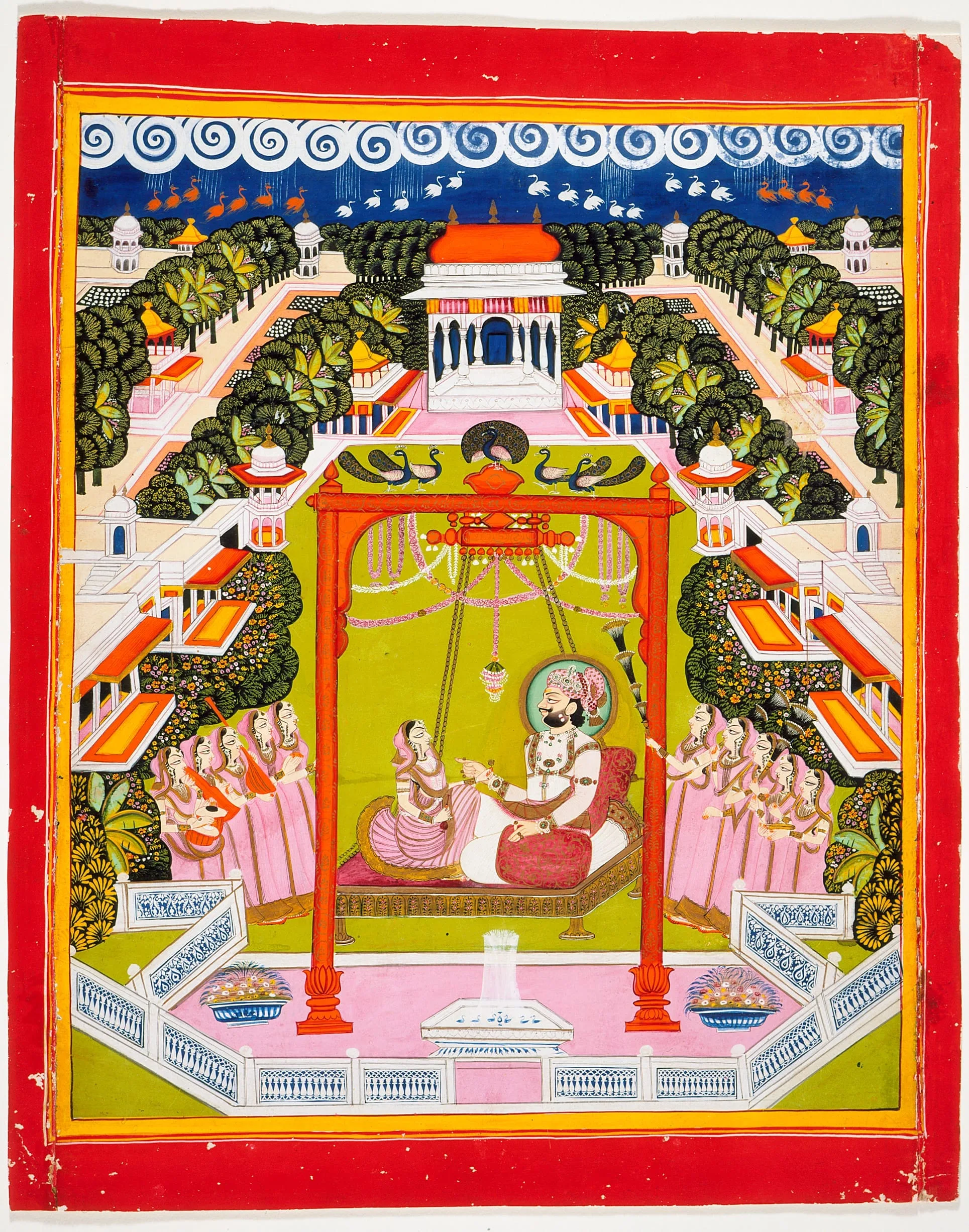
- Maharaja Takhat Singh II of Marwar (r. 1843-73) and Women Celebrating the Teej Monsoon Festival
- Date Made
- circa 1850
- Medium
- Opaque watercolor and gold on paper
- Dimensions
- Image: 14 3/4 x 12 1/8 in. (37.4 x 30.8 cm); Sheet: 17 1/2 x 14 in. (44.4 x 35.5 cm)
- Accession Number
- M.81.280.6
- Curatorial Notes
Maharaja Takhat Singh II of Marwar (r. 1843-1873) was born in 1819 in Himmatnagar, Gujarat (formerly Ahmednagar) and died in 1873. He was the regent (1839-1841) and then the Maharaja of Ahmednagar (r. 1841-1843). In 1843 he ascended the empty Marwar throne through his patrilineal lineage in the Rathore Dynasty of Marwar (1226-1949). Takhat Singh II had thirty wives and is often shown surrounded by women of the palace. See also M.72.88.6.
Takhat Singh II is portrayed here on a swing in a palace garden with a group of women celebrating the Teej monsoon festival held in the Hindu month of Shravana (July-August) to commemorate the onset of the monsoons and to honor the marriage of Shiva and Parvati. The rainy season is indicated by the scrolling cumulus clouds with raindrops falling on the red and white herons flying in formation and by the peacocks dancing on top of the swing’s crossbar. The used of linear perspective to render the lush garden was adopted from Western artistic traditions. A Hindi inscription on the reverse identifies the subject as Takhat Singh [II] wearing a white garment and gives the artist’s name, Dana (active circa 1810-1850).
- Selected Bibliography
- Pal, Pratapaditya. The Classical Tradition in Rajput Painting. New York: The Gallery Association of New York State, 1978.