LACMA

ShopMembershipMyLACMATickets
LACMA
Los Angeles County Museum of Art
5905 Wilshire Blvd.
Los Angeles, CA 90036
info@lacma.org
(323) 857-6000
Sign up to receive emails
Subscribe
© Museum Associates 2025

Museum Hours

Monday

11 am–6 pm

Tuesday

11 am–6 pm

Wednesday

Closed

Thursday

11 am–6 pm

Friday

11 am–8 pm

Saturday

10 am–7 pm

Sunday

10 am–7 pm


  • About LACMA
  • Jobs
  • Building LACMA
  • Host An Event
  • Unframed
  • Press
  • FAQs
  • Log in to MyLACMA
  • Privacy Policy
© Museum Associates 2025
Collections

Unknown
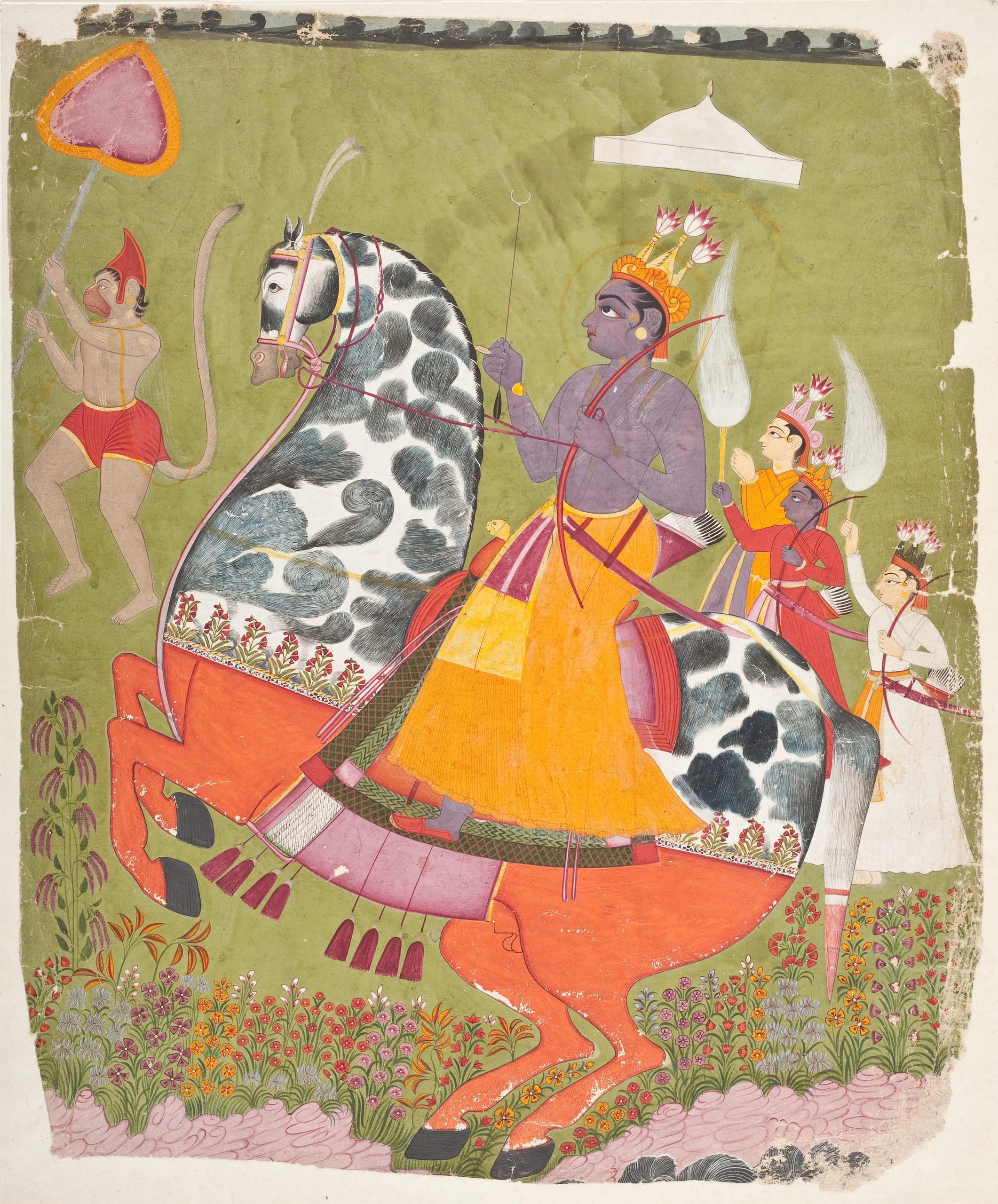
Rama on Horseback, Folio from a Ramayana (Adventures of Rama)circa 1775-1800

Not on view
Indian opaque watercolor painting of a blue-skinned crowned figure on a dappled gray horse, accompanied by attendants and a monkey-like figure, with flowering plants below
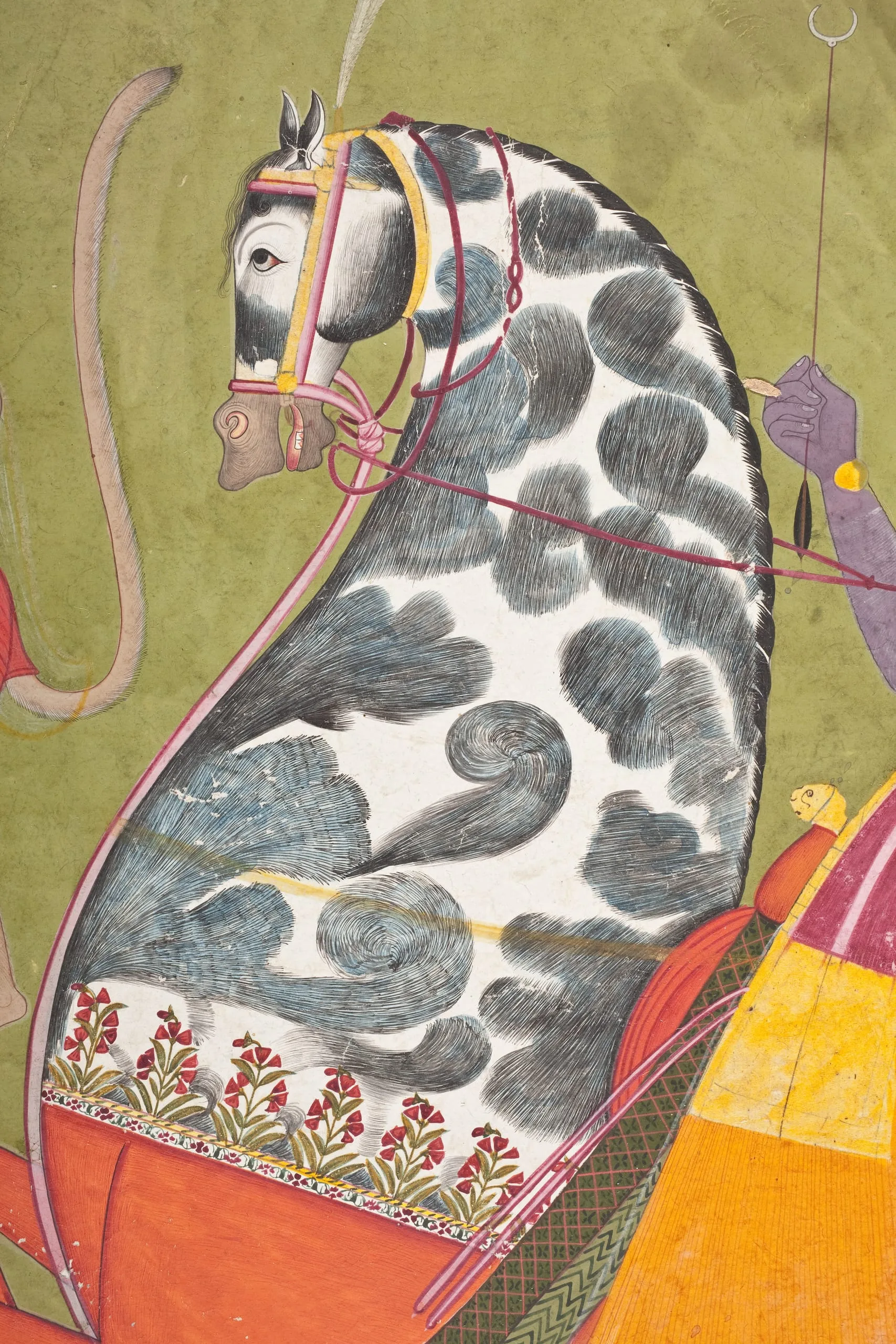
Indian opaque watercolor painting, close-up of a dapple-gray horse with elaborately rendered swirling coat markings in dark gray and white; yellow and red bridle with decorative knots; floral-patterned caparison border at lower edge; olive green background with partial figures visible at sides.
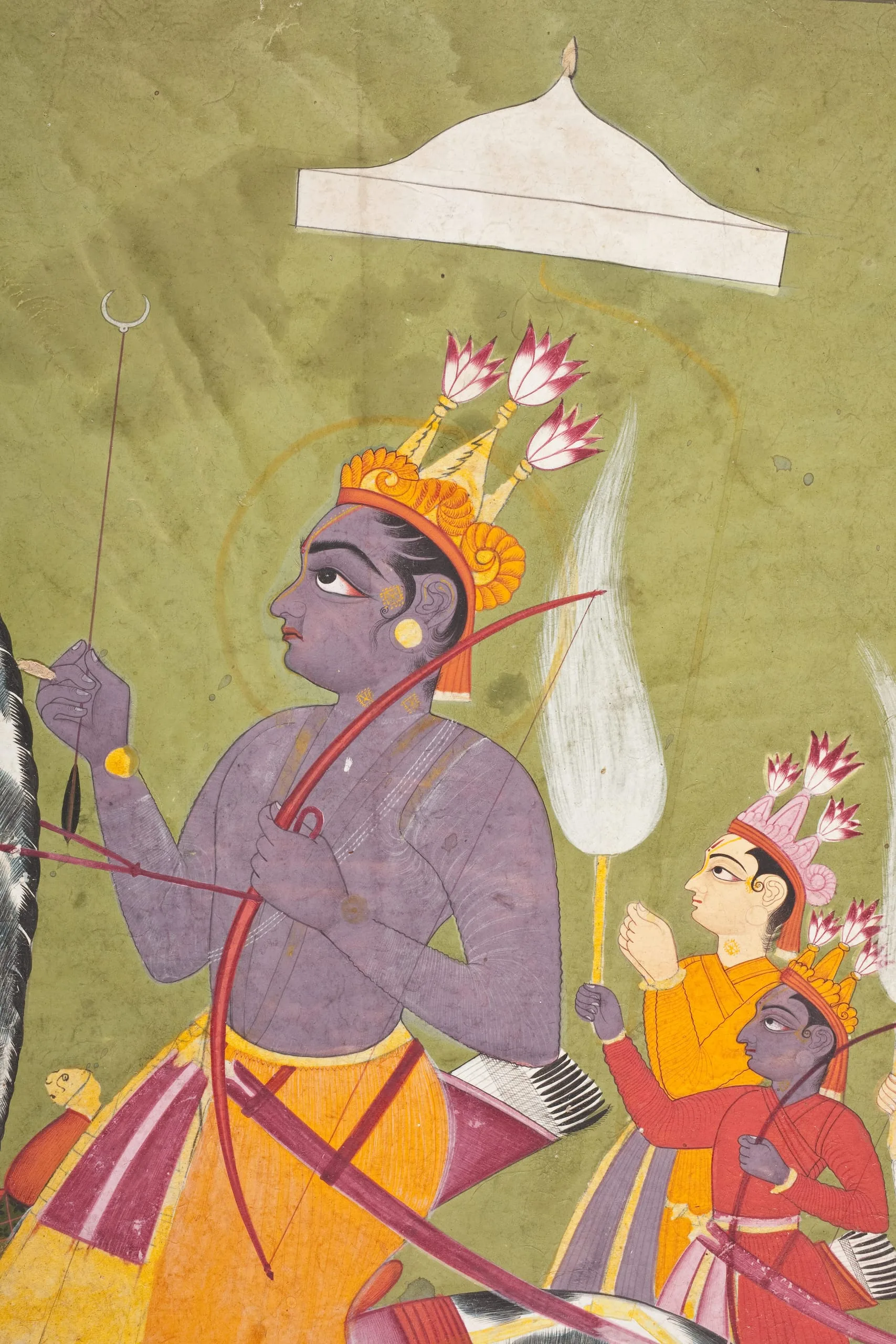
Indian opaque watercolor painting on paper; a blue-skinned male figure in profile wearing a gold crown adorned with pink lotus blossoms, holding a red bow and arrow, attended by two smaller figures beneath a white ceremonial parasol, against a muted olive-green ground with fine detailed brushwork.
Artist or Maker
Unknown
Title
Rama on Horseback, Folio from a Ramayana (Adventures of Rama)
Place Made
India, Madhya Pradesh, Raghogarh
Date Made
circa 1775-1800
Period
18th century
Medium
Opaque watercolor on paper
Dimensions
17 1/8 x 14 1/4 in. (43.5 x 36.2 cm)
Credit Line
Gift of Paul F. Walter
Accession Number
M.81.280.5
Classification
Drawings
Collecting Area
South and Southeast Asian Art
Curatorial Notes

Rama is the seventh avatar (incarnation) of Vishnu, the Hindu god of preservation. He epitomizes righteousness and caste duty (dharma). He is the protagonist of the epic Ramayana (Adventures of Rama), which dates from the 4th century BCE to the 2nd century CE and is traditionally ascribed to the celebrated poet-sage Valmiki. It recounts the story of Prince Rama, who was unjustly exiled with his wife, Sita, and brother, Lakshmana, for fourteen years. During his exile, the demon king Ravana kidnaps Sita. Rama eventually vanquishes Ravana, rescues Sita, and returns to rule his kingdom of Kosala in Ayodhya, Uttar Pradesh.

This exuberant portrayal of Rama on a spectacular rearing dappled horse is from a series of Rama’s triumphal journey back to Ayodhya. Another folio from this series depicting Rama and Lakshmana on a white elephant is in the San Diego Museum of Art (1990.703). Here, the blue-skinned Rama has a golden nimbus and wears a tripartite crown with pink lotuses. He carries a bow and an arrow with a crescent arrowhead. He wears a saffron colored lower garment and has a sword and quiver suspended from his waist sash. Behind Rama are his three siblings: Lakshmana, holding an honorific parasol; Bharata, Rama’s half-brother holding a fly whisk made with the white tail hairs of a yak (cauri or chowri), symbolic of royalty; and Shatrughna, the twin brother of Lakshmana also holding a chowri. In front of Rama, the monkey-general Hanuman is holding a sunshade (kiraniya).
Selected Bibliography
  • El Universo de la India: Obras Maestras del Museo de Arte del Condado de Los Angeles. Santiago: Centro Cultural Palacio La Moneda, 2012.