- Title
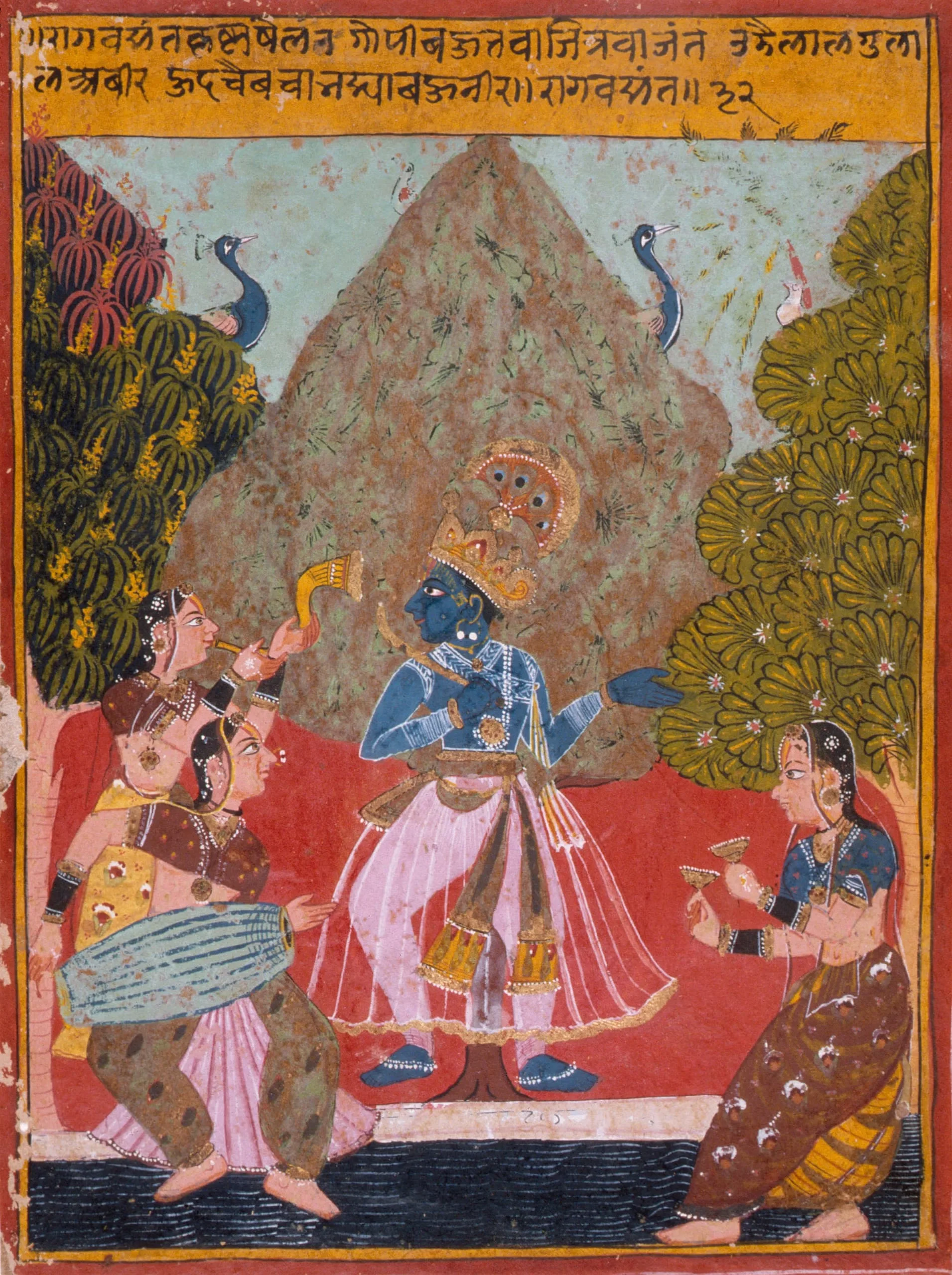
- Vasant Ragini, Second Wife of Dipak Raga, Folio from a Ragamala (Garland of Melodies)
- Date Made
- circa 1675-1700
- Medium
- Opaque watercolor, gold, and ink on paper
- Dimensions
- Image: 7 1/16 x 5 5/8 in. (17.93 x 14.28 cm); Sheet: 8 1/8 x 6 1/16 in. (20.63 x 15.39 cm)
- Accession Number
- M.81.280.3
- Curatorial Notes
The devanagari inscription in the header describes Vasant Ragini as Krishna dancing to music provided by the gopis (herdswomen), while the surrounding air is filled with the red powder sprinkled during the springtime Holi festival. The verse is inscribed as number thirty-two.
Vasant Ragini is the second wife of Dipak Raga in the predominant ragamala (garland of melodies) classification system generally known as the Rajasthani system. It is a morning melody celebrating the arrival of Spring (March–May). It is envisioned as Krishna or a prince dancing under mango blossoms in the spring.
Here, the dancing hero is Krishna, who is identified by his distinctive peacock feather crown and blue skin. He is accompanied by three female musicians. One is blowing a horn, the second is beating a mridangam drum, and the third is playing hand cymbals. See its series mate M.71.1.22. See also M.79.191.28.
- Selected Bibliography
- Pal, Pratapaditya. The Classical Tradition in Rajput Painting. New York: The Gallery Association of New York State, 1978.
- McGill, Forrest, editor. Beyond Bollywood: 2000 Years of Dance in the Arts of South Asia, Southeast Asia, and the Himalayan Region. San Francisco, CA: Asian Art Museum, 2022.