- Title
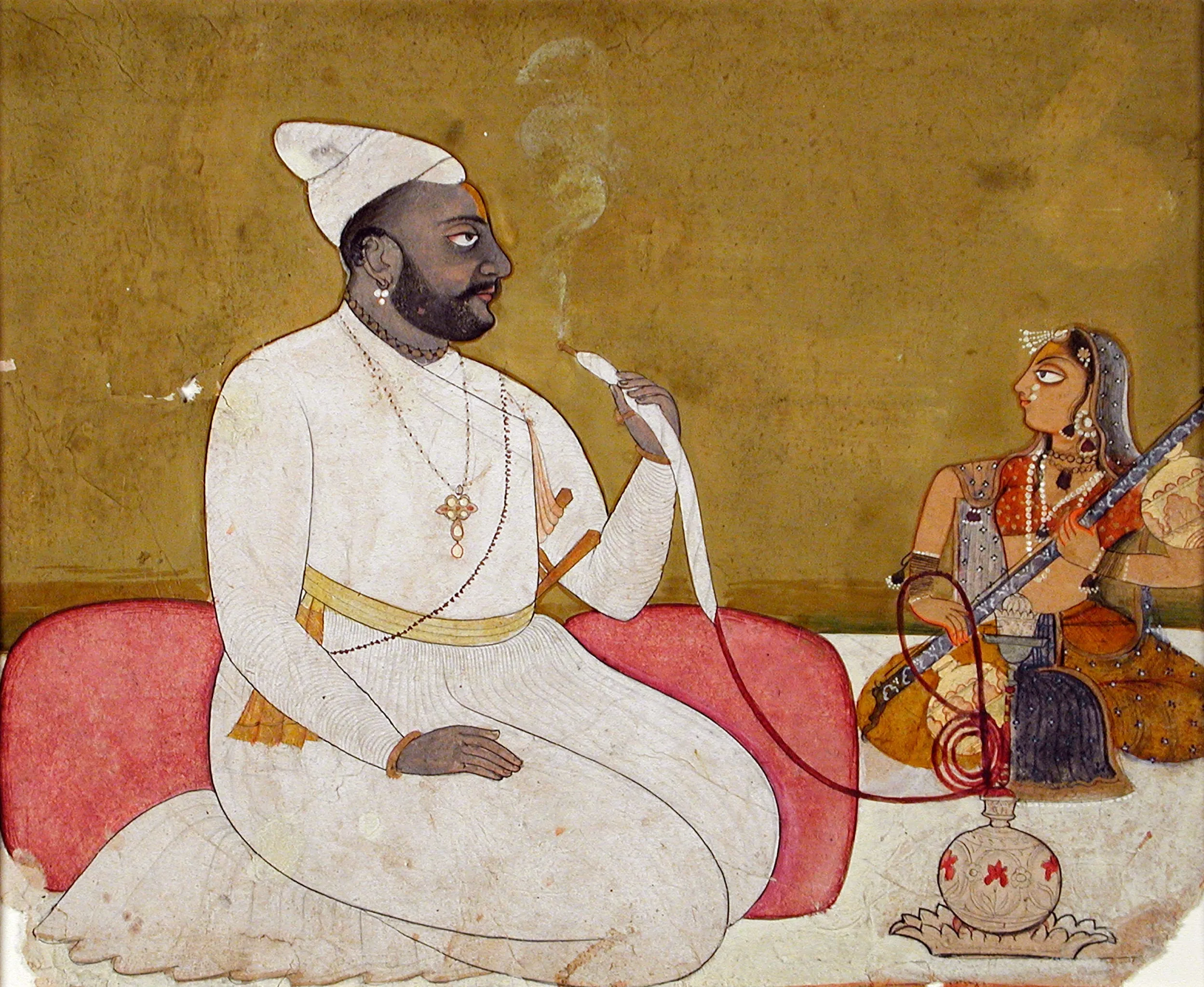
- A Basohli Noble Being Entertained by a Musician
- Date Made
- circa 1700
- Medium
- Opaque watercolor and gold on paper
- Dimensions
- Sheet: 7 5/8 x 8 7/8 in. (19.37 x 22.54 cm); Image: 6 7/8 x 8 5/8 in. (17.46 x 21.91 cm)
- Accession Number
- M.81.271.8
- Curatorial Notes
Although the subject of this portrait is not identified by an accompanying inscription, he is presumably a prince or nobleman from the Pahari court of Basohli, Himachal Pradesh, as he is wearing a pearl necklace with the idiosyncratic quatrefoil-shaped pendant worn by Basohli royalty for regal identification and proclamatory purposes (see also M.83.105.8). The absence of turban jewels in his headwear indicates that he is not a raja. He has Vaishnava sectarian markings on his forehead. He wears a gold choker and a long bead chain across the left shoulder of his white coat (jama). A punch dagger (katar) is tucked into the waist sash on his left side (see also M.74.101a-b). He is smoking a hookah decorated with cartouches inset with enameled red lilies. Atypically, a plume of smoke is depicted issuing from the mouthpiece (mukhnal) of the hookah tube (see also M.83.26.1and M.86.340). The hookah is supported by a tray with a raised crenulated rim adorned with flame-like designs (see also M.73.5.160). Beside him a female musician plays a northern Indian rudra vina (a stick zither with two resonator gourds). Portraits such as this formulaic representation conveyed the sitter’s wealth and social status by showing them enjoying music and other pleasures at court.
- Selected Bibliography
- Meller, Susan. Labels of Empire: Textile Trademarks: Windows into India in the Time of the Raj. Novato, CA: Goff Books, 2023.