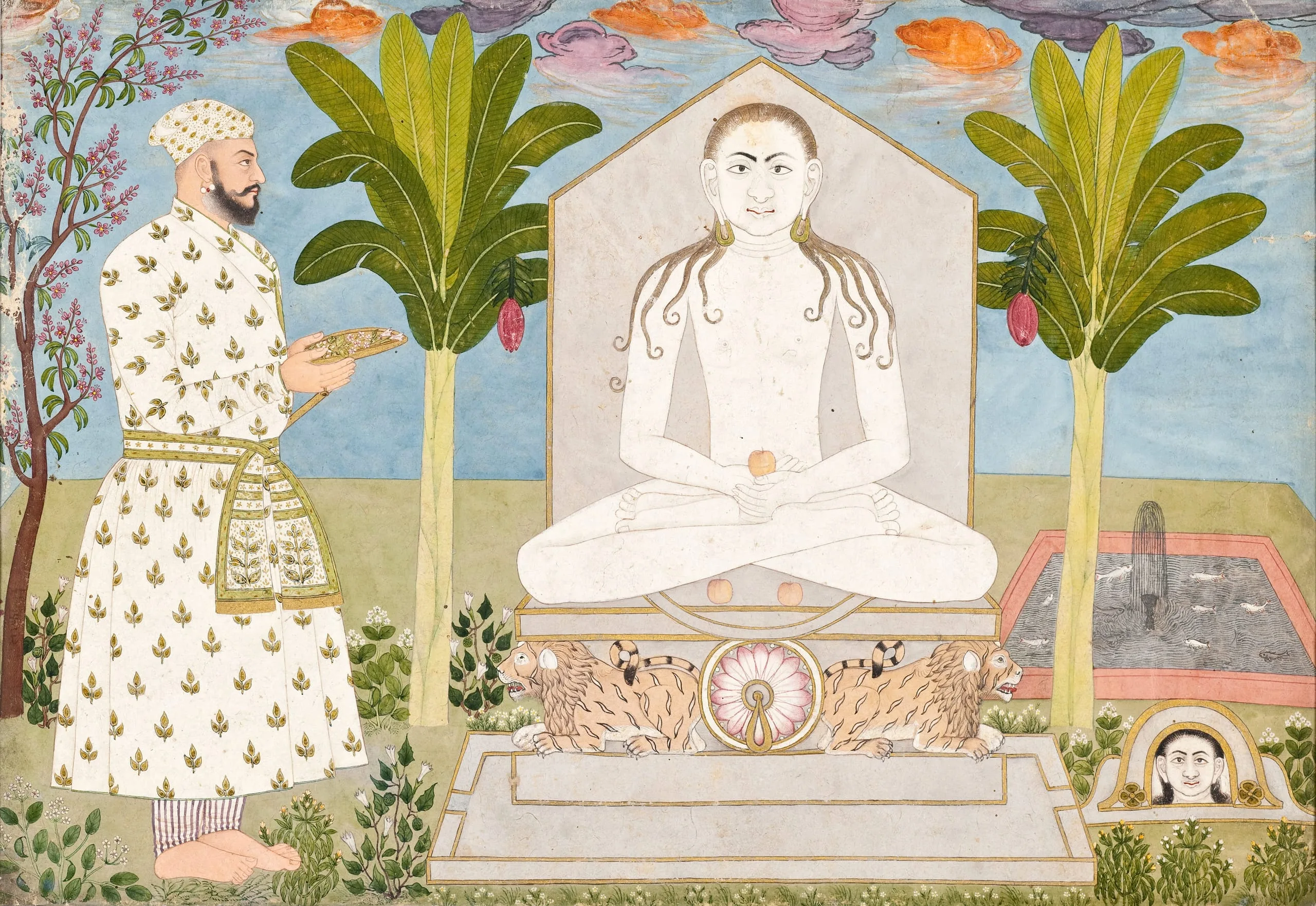
An Arabic inscription on the back of this work states that, “Standing in front of the picture [or image] of the deity (devata) is Rai Sabha [or Jabha] Chand.” (Translated by Simon Digby and B. N. Goswamy.) He is shown making an offering of a plate of flowers to an enthroned marble image of Jina Rishabhanatha. Devotional subjects are relatively rare in Deccani court painting, especially those involving Jains. Rai Sabha Chand is unknown in the historical record but may have been a Deccani nobleman or a Jain merchant. A closely similar version of this painting in the Goenka collection, Mumbai is published in George Michell, ed., In the Image of Man: The Indian Perception of the Universe through 2000 Years of Painting and Sculpture (London: Hayward Gallery, 1982), p. 179, no. 291.
Certain details of the painting are intriguing. The offering of apples is atypically placed: one in the right hand of Rishabhanatha and the other two on the pedestal. The leonine creatures supporting the throne are hybrid lions/tigers, which are known as ligers or tigons depending on the gender and species of the parents. They are occasionally represented in Indian paintings, furniture, and furniture designs. The horseshoe arch with an inset human head, known as a gavaksha (cow’s eye), chandrashala (moon window), or chaitya (type of temple) arch, is a common architectural element of both northern and southern Indian temples. It may be a fragment of the original temple that housed the Jina image.