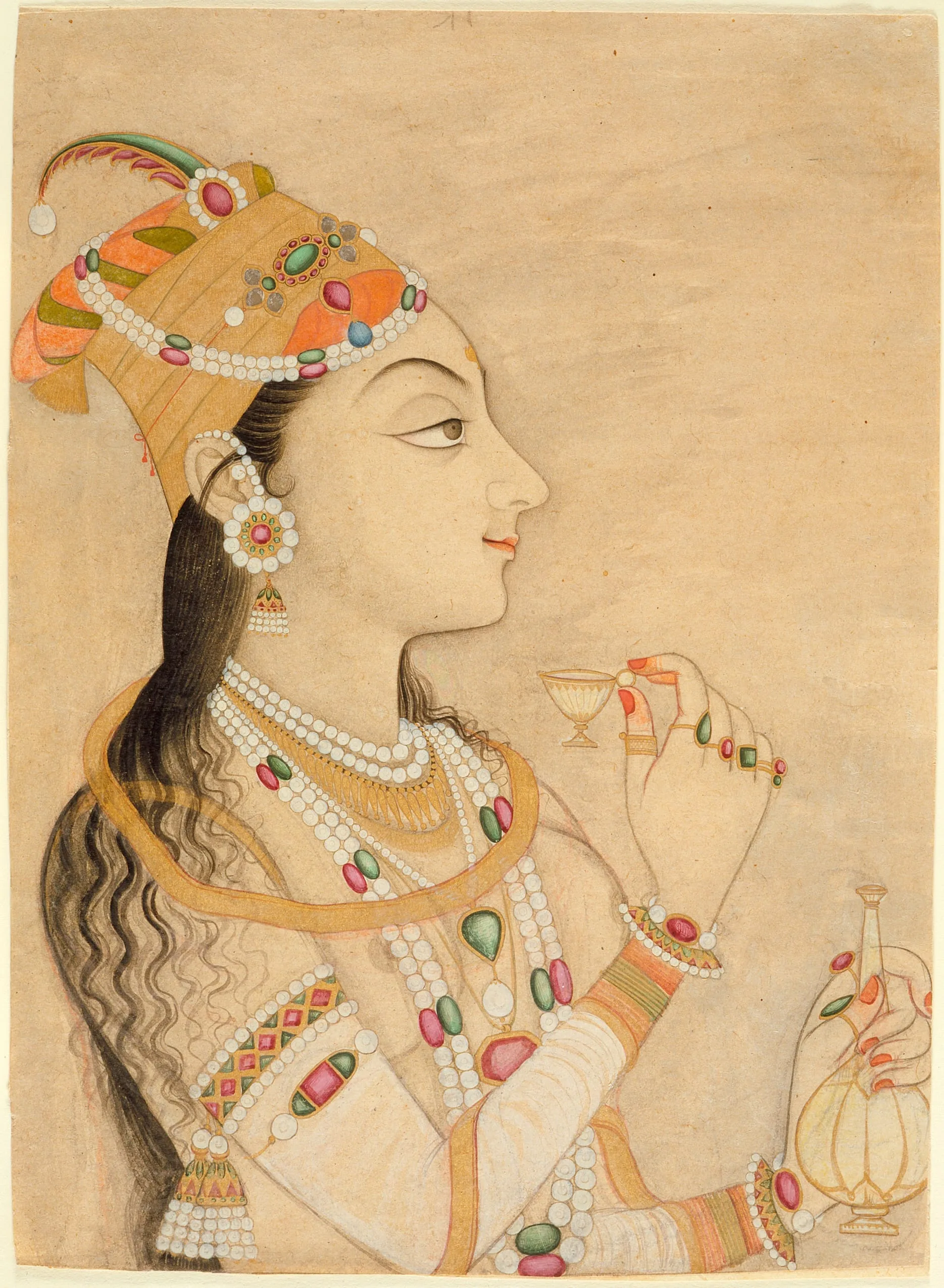
The Mughal Empress Nur Jahan (birthname: Mihrunissa) was born in 1577 in Kandahar, Afghanistan. Nur Jahan was the favorite wife of the Mughal Emperor Jahangir (r. 1605-1627). She was the daughter of the Persian noble Mirza Ghiyas Beg (later known as Itimaduddaula (Pillar of the State), Prime Minister of the Mughal Empire, 1611–1622) and his wife Asmat Begum. She was married at the age of seventeen to the Iranian Sher Afgan Khan (or Ali Quli Istajlu, d. 1607), who subsequently killed Jahangir’s foster brother Qutbuddin Khan Koka (1569-1607). In 1607, after her husband was slain in retaliation, Nur Jahan was brought to Agra and served as a handmaiden to Jahangir’s mother, Ruqaiya Sultan Begum (circa 1542-1626). In 1611, she met Jahangir at a bazaar during the Nowruz festival and was wed shortly thereafter. Due to her husband’s frequent incapacitation due to alcohol and opium, she became the power behind the throne. She conducted trade with foreign merchants, managed court finances, minted coins in her own name, and designed Mughal gardens. After Jahangir’s death in 1627, Nur Jahan spent the remainder of her life confined in Lahore with her widowed daughter and granddaughter. Nur Jahan maintained a legendary appeal long after her death in 1645. Representations of a beautiful princess, such as this painting, are traditionally identified as idealized images of the Mughal Empress. A comparable portrait of Nur Jahan is in the Victoria and Albert Museum, London (IM.37-1912).