- Title
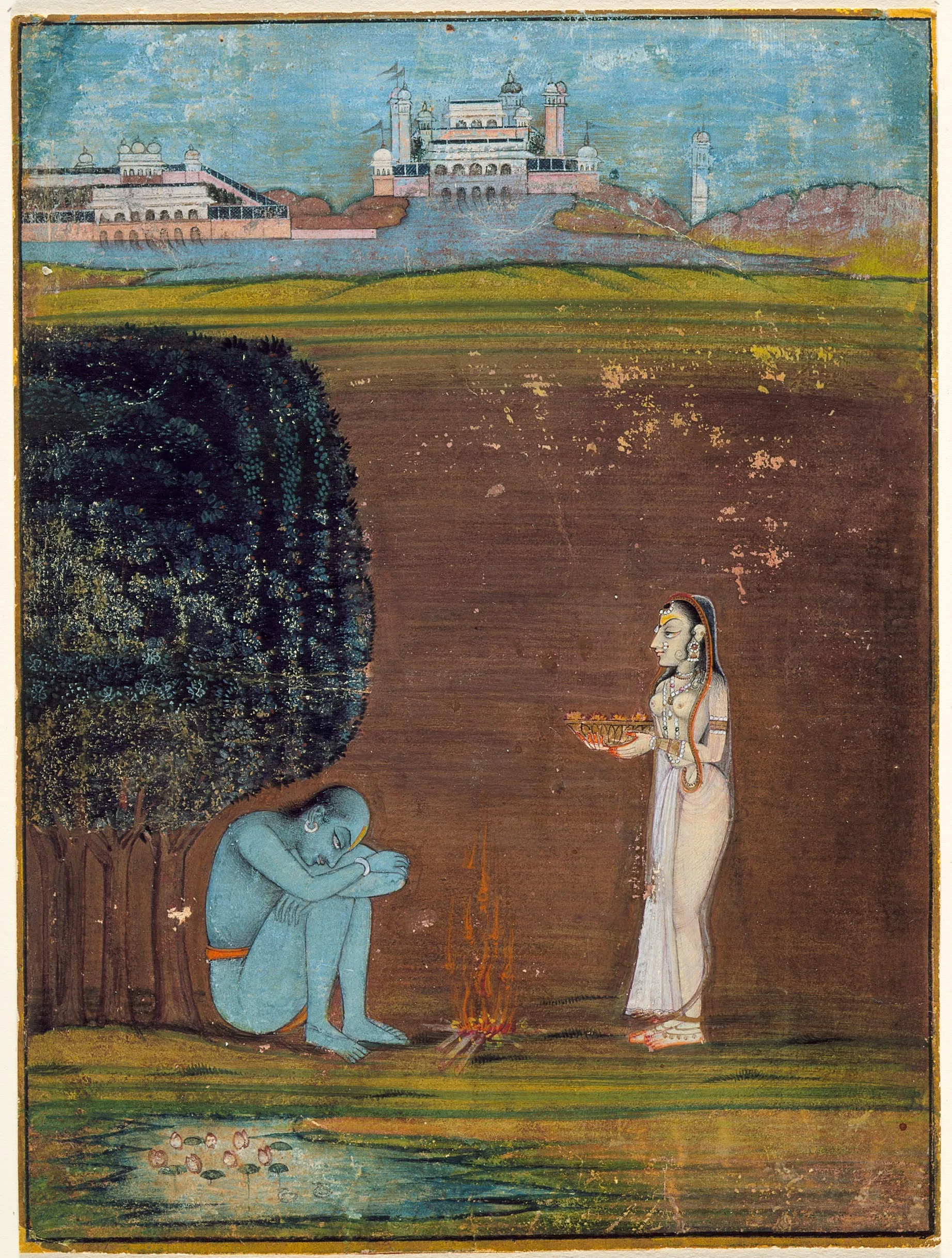
- An Ascetic Receiving an Offering from a Courtly Woman
- Date Made
- circa 1750-1775
- Medium
- Opaque watercolor and gold on paper
- Dimensions
- Sheet: 8 x 5 7/8 in. (20.32 x 14.92 cm); Image: 7 7/8 x 5 13/16 in. (20.0 x 14.76 cm)
- Accession Number
- M.81.271.10
- Curatorial Notes
Hindu ascetics adept in yogic and tantric practices have been performing austerities in South Asia for millennia. Male ascetics (yogis or sadhus) are often members of a Shaiva sect worshipping the god Shiva. Female ascetics (yoginis) are often theologically affiliated with Parvati, Durga, or other Shaiva goddesses. Painted and sculpted images of male and female ascetics were common as both primary and ancillary subjects, including representations of royal supplicants seeking their guidance or blessings (see M.2011.156.4 and M.87.20.2). During the 18th century in particular, numerous northern Indian paintings depicted scenes of a princess or courtly woman visiting and venerating ascetics (see M.72.88.2 and AC1997.30.1).
In this painting, an elegantly attired princess wearing profuse pearl and gold jewelry offers a bowl of floral garlands to an ascetic seated under a grove of trees in front of a campfire. His ascetic nature is indicated by his ashen-gray skin (covered with ashes from a sacrificial fire), sectarian forehead markings, and nudity save for a loincloth. His distinctive large round earring (probably intended as ivory) is the special insignia of the kanphata [ear-split] ascetics, a tantric Shaiva sect founded by the great Hindu saint and teacher Gorakhnath who most likely lived in eastern Bengal in the early 11th century. In the distance is a lakeside palace complex.