- Title
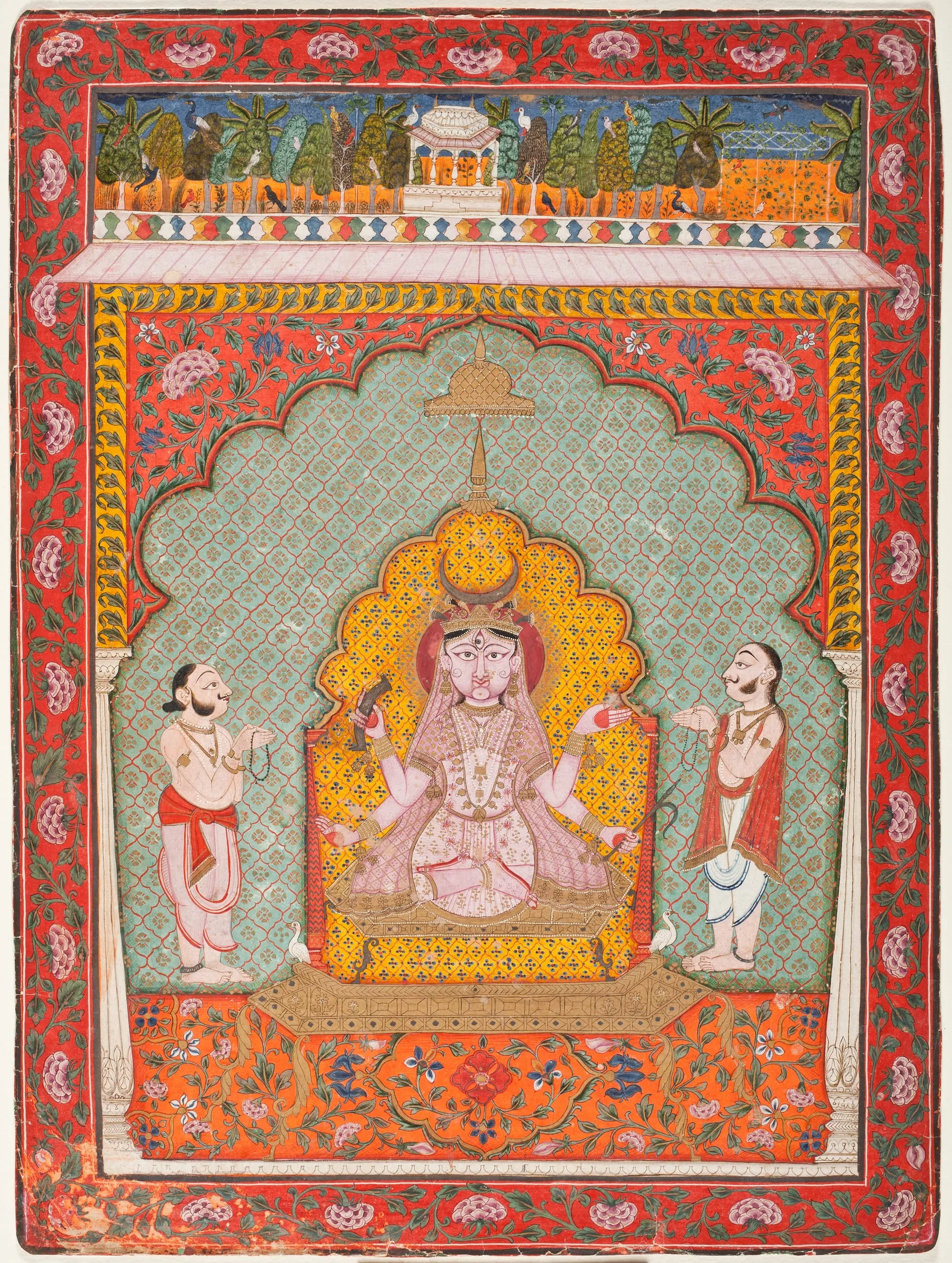
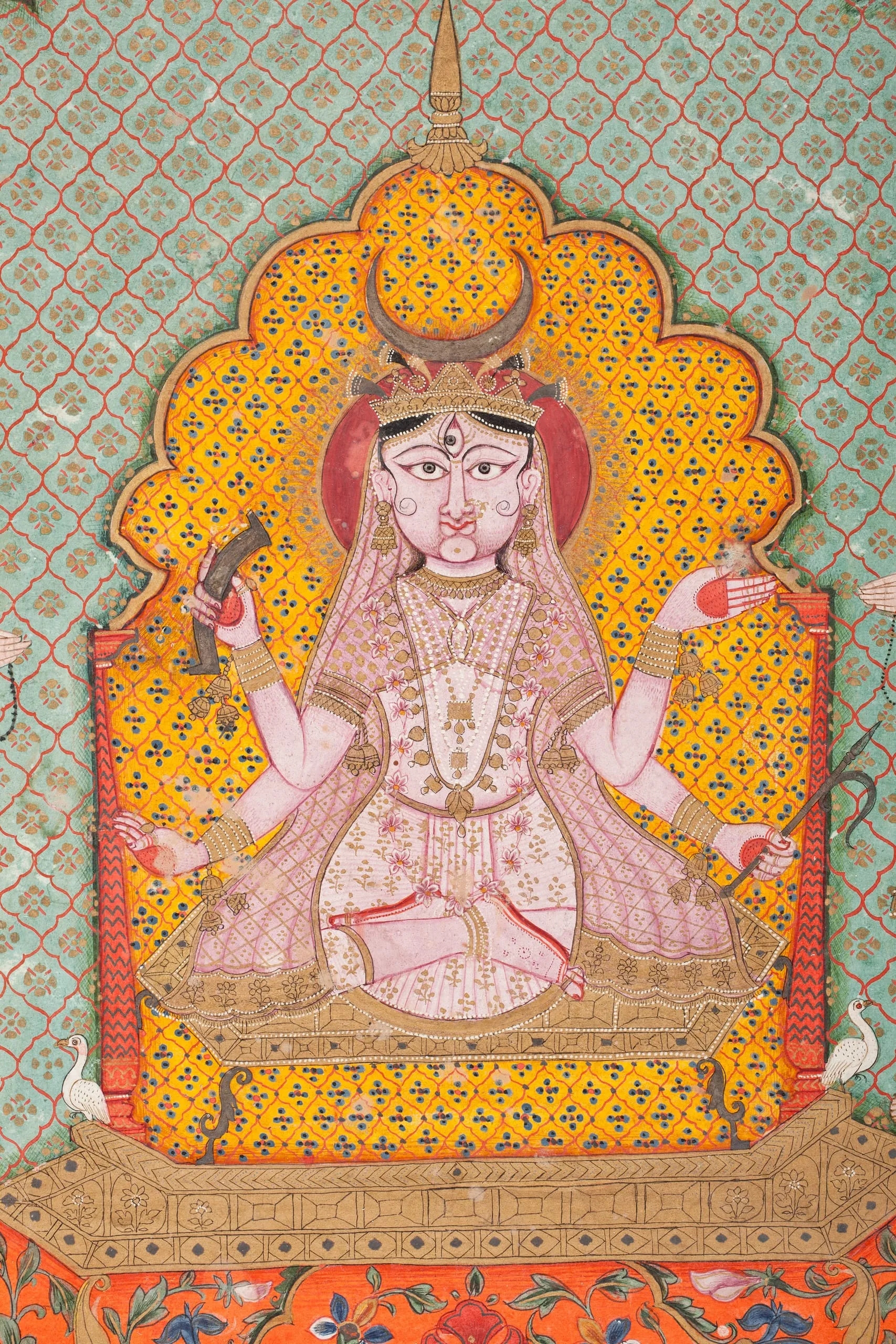
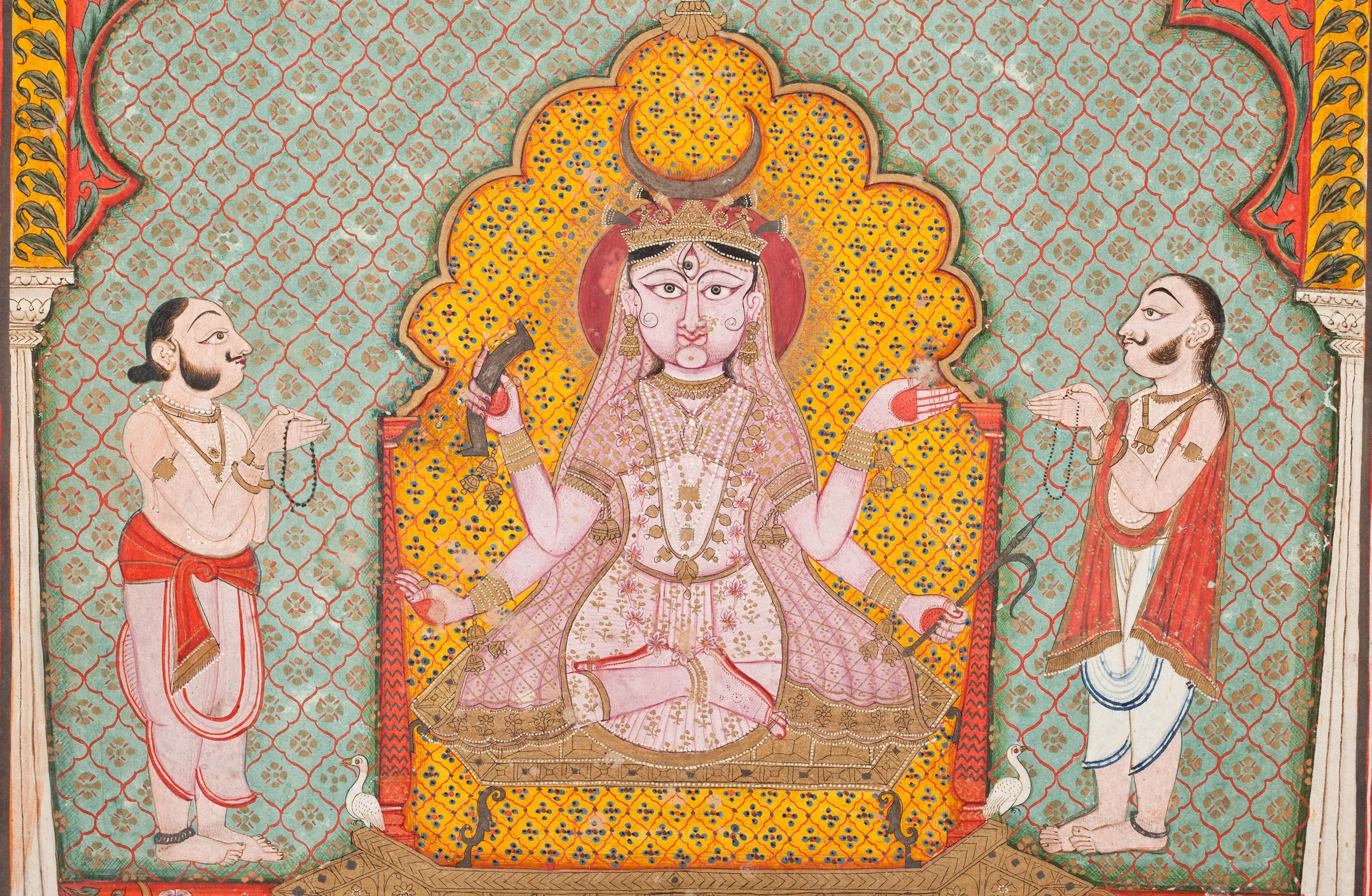
- The Hindu Goddess Tripurasundari Being Worshipped by Devotees
- Date Made
- circa 1850
- Medium
- Opaque watercolor, gold, and silver on paper
- Dimensions
- Image: 12 1/8 x 9 5/8 in. (30.79 x 24.44 cm); Sheet: 14 x 10 3/8 in. (35.56 x 26.35 cm)
- Accession Number
- M.81.271.9
- Curatorial Notes
Tripurasundari (Beautiful Woman of the Three Cities), also known as Rajarajeshvari (Queen of all Kings and Rulers), is a Shaiva form of the goddess Parvati as the Shakti (divine feminine power) of the Hindu god Shiva in his manifestation as Tripurantaka (Destroyer of the Three Cities of the Demons). The nimbate goddess is crowned with Shiva’s crescent moon (ardha-chandra) and third eye of wisdom (jñana netra). She is richly ornamented with exquisite floral textiles, golden jewelry, pearls, and a long floral garland (vanamala). This type of floral garland is more commonly associated with the Hindu god Vishnu, but its use by Tripurasundari is appropriate since she is the sister of Vishnu (Padmanabha Sahodari) and is regarded as the supreme cosmic power and ultimate source of life and creation (Adi Parashakti). The goddess is four-armed. In her lower proper left hand, she holds her primary attribute of the elephant goad (ankusha). In her upper proper right hand, she holds a convex silver mirror (darpana). Her upper proper left hand displays the gesture of charity (varada mudra), while her lower proper right hand displays the gesture of reassurance (abhaya mudra). She is seated with her legs crossed in the lotus position (padma asana) on a hexagonal throne with a finial in the form of an honorific parasol (chhatra) and golden European-style acanthus leaf-carved cabriole legs. The enthroned goddess is being worshipped by flanking officiating priests or ascetic devotees each holding a rosary (akshamala) in prayerful adoration. The veneration of the great goddess is occurring in an ornate shrine with white marble columns topped with spandrels ornamented with scrolling peony flowers that match the painting’s outer border design. The shrine interior has a background wall pattern of an ogival lattice diaper enclosing geometric floral sprigs. The floor has a lush floral carpet with irises, peonies, and a stylized red poppy in the center. Above the shrine roof is a dense forest landscape with diverse trees, peafowl, birds, a garden tunnel framework with flowering vines called an arbor or pergola, and an ornate pavilion. See also M.87.181 and M.2003.213.