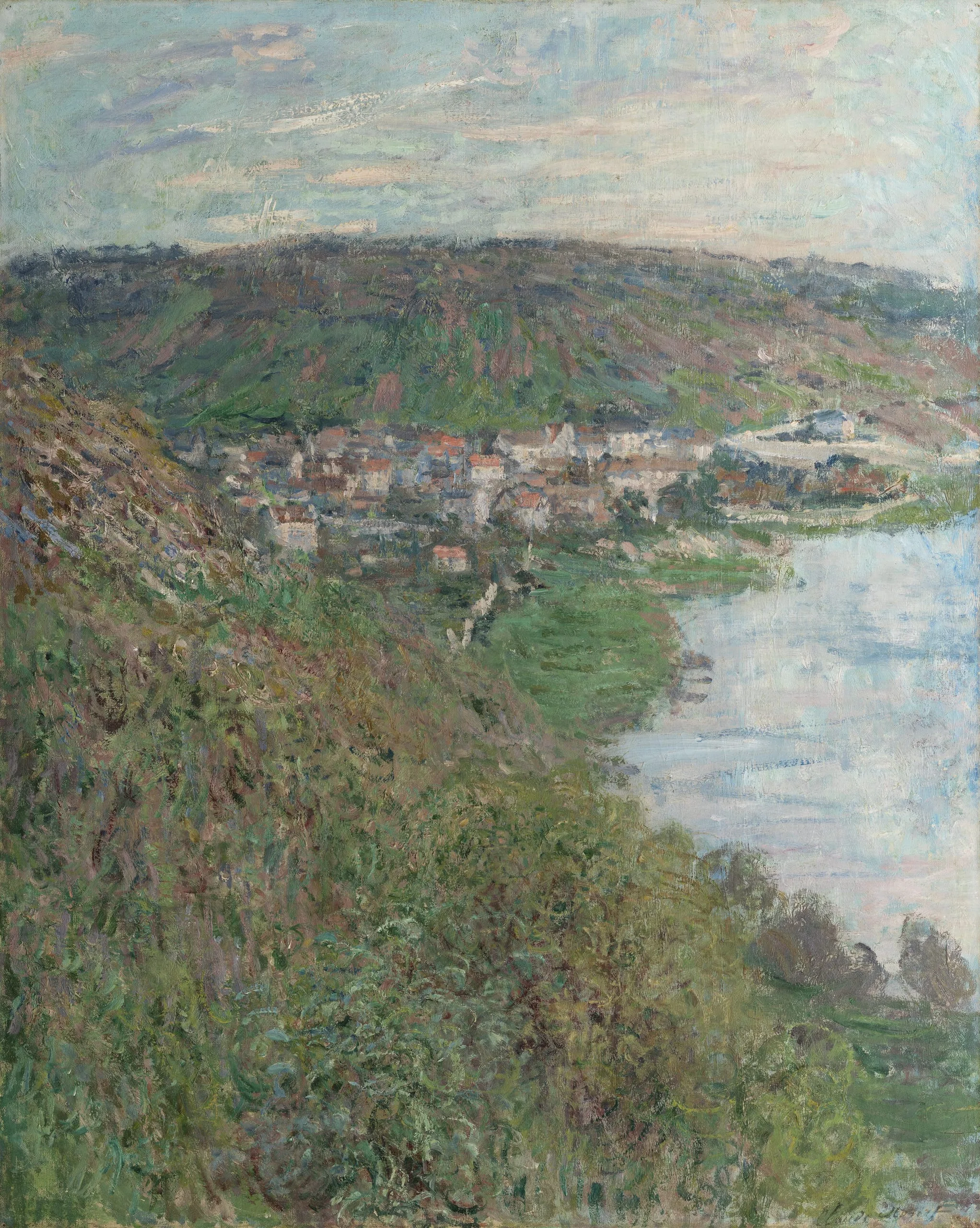
Situated in a valley along the Seine, northwest of Paris, Vétheuil’s quiet environs with a Romanesque church dominating the town offered fruitful sources of material for an artist committed to plein air painting. View of Vétheuil, painted from a hilltop overlooking the town, contains many hallmarks of Monet’s style—the loose and dappled brushwork also seen in In the Woods at Giverny (M.46.3.4), and the manipulation of perspective and depth found in Nympheas (M.62.8.13). However, here, the experiment with verticality and the elimination of a middle ground may have been inspired by Japanese prints, which captivated the French art scene after the Universal Exposition of 1878. By the time of Monet’s death, he had amassed over 200 Japanese prints. In particular, Hiroshige’s prints of Yui and the Satta Pass share formal qualities with View of Vétheuil, with its vertical orientation, rigid foreground diagonal, lack of a middle ground, and placement of the sky and hills in the far distance.
Monet moved to the village in 1878, during a time of personal tragedy and professional struggle. The market for his paintings had bottomed out after his good friend and patron, Ernest Hoschedé, faced bankruptcy. Then, in 1879, Monet’s wife died, leaving him a widow with two young children. The Hoschedé and Monet families shared a home at Vétheuil, weathering the tumultuous times together. While LACMA’s early springtime view marks a finite end to one of the worst winters on record, it would be two more years before Monet’s financial and personal life thawed. In 1880, rather than participate with his colleagues in the Fifth Impressionist Exhibition, he showed at the annual Salon, suggesting, along with his concerted effort to work with dealers, that he was actively concerned with his marketability. By 1881, Monet’s financial worries began to ease, but this particular painting remained in his studio, later inherited by his son.
2024