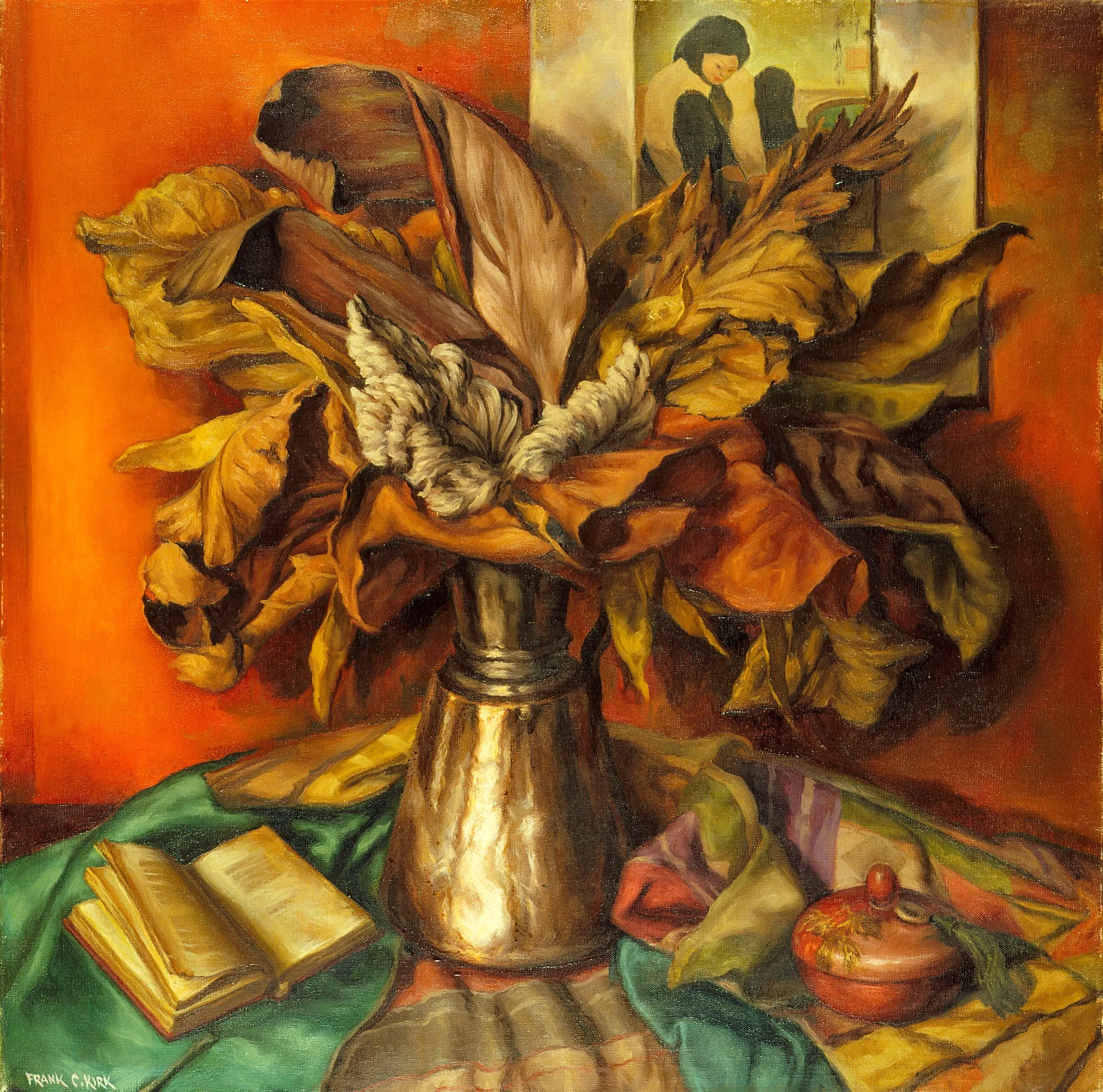
Although his figure paintings often focused on the common laborer, Kirk’s still lifes presented a more refined world, usually depicting works of art, oriental porcelains, and textiles arranged around large floral bouquets. In Rhapsody the artist included a print, a covered lacquer dish, a book, and a large arrangement of dried flowers and leaves in a gleaming copper pitcher.
The highly varied palette of deep hues contributes to the painting’s rich elegance. Kirk’s tabletop arrangements were in the tradition of the work of Paul Cézanne (1839-1906) but took on a rigidly standardized format. He repeatedly used the same objects, viewed them from an elevated viewpoint, and only slightly varied their positions within a triangular arrangement before a wall. For example, the same arrangement and bouquet in Rhapsody are found in Tropical Leaves, n.d. (unlocated, reproduced in Weinper, Kirk, p. 59). It is primarily his use of texture and color that distinguishes one still-life painting from another.
According to labels on the back of the canvas and stretchers, the painting was widely exhibited under the titles Rhapsody and Tropical Leaves, but attempts to verify these exhibitions have been futile or resulted in contradictory information.