LACMA

ShopMembershipMyLACMATickets
LACMA
Los Angeles County Museum of Art
5905 Wilshire Blvd.
Los Angeles, CA 90036
info@lacma.org
(323) 857-6000
Sign up to receive emails
Subscribe
© Museum Associates 2025

Museum Hours

Monday

11 am–6 pm

Tuesday

11 am–6 pm

Wednesday

Closed

Thursday

11 am–6 pm

Friday

11 am–8 pm

Saturday

10 am–7 pm

Sunday

10 am–7 pm


  • About LACMA
  • Jobs
  • Building LACMA
  • Host An Event
  • Unframed
  • Press
  • FAQs
  • Log in to MyLACMA
  • Privacy Policy
© Museum Associates 2025
Collections

Unknown
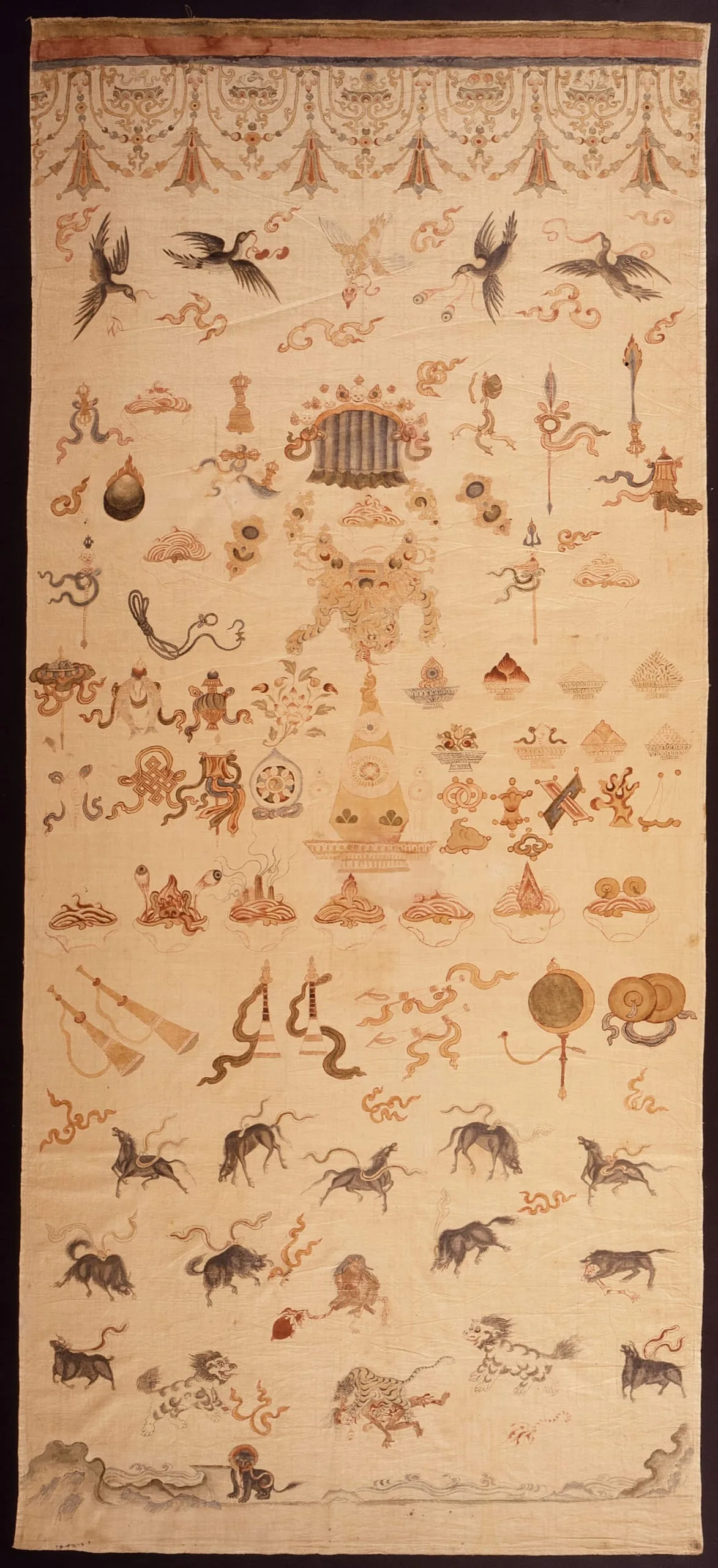
Ceremonial Offerings to the Dharmapalacirca 1785

Not on view
Vertical painted textile panel on cream fabric with Himalayan Buddhist symbolic motifs arranged in registers, including auspicious emblems, flying birds, animals, and ceremonial objects in rust, gray, and gold
Artist or Maker
Unknown
Title
Ceremonial Offerings to the Dharmapala
Place Made
Eastern Tibet, Kham region
Date Made
circa 1785
Medium
Mineral pigments on cotton cloth
Dimensions
89 × 45 1/8 × 2 3/16 in. (226.06 × 114.62 × 5.56 cm)
Credit Line
Gift of Mr. George C. Zachary
Accession Number
M.81.211a-b
Classification
Paintings
Collecting Area
South and Southeast Asian Art
Curatorial Notes

This type of painting belongs to a specific iconographic genre that is referred to in Tibet as either "sets of ornaments" (gyan tshog) or "material for the banquet" (skang das). Paintings of this type represent the different offerings made to one or more wrathful deities during special ceremonies designed to appease and propitiate them. In some monasteries, these paintings were part of rituals that were periodically performed to renew the local malevolent spirits’ oath of submission to Buddhism. The deities are never physically represented in this type of painting, rather their presence is symbolized by their empty garments and ornaments.

At least four wrathful deities are symbolically portrayed in the painting, the presence of each represented by a skull-cup. In the center of the composition are the skull-crown, veil, tiger-skin robe, and large earrings of the principal deity to whom this set of offerings was dedicated. Attributes such as these would normally identify the particular deity. Here, however, their isolated rendering precludes an association with a specific deity.

Below the tiger skin robe is a sacrificial cake (torma) flanked on the left by auspicious symbols, and on the right by trays of food and scents to delight the senses. Below the torma is a row of offerings symbolizing the parts of the human body, beneath them are musical instruments and animals that serve as the messengers of the gods.

A Tibetan inscription on the back of the painting reads: "Given as an act of faith by Lobsang Samten, the retired jangdren of Gungru in the female wood-snake year." (Translation by H. E. Richardson.) Lobsang Samten was a senior monk who had retired from the post of leading the prayers in the assembly hall of the monastery or religious college of Gungru. The female wood-snake year referred to is most likely equivalent to 1785.

Selected Bibliography
  • Pal, Pratapaditya. Art of Tibet. Los Angeles; Berkeley, CA: Los Angeles County Museum of Art; University of California Press, 1983.
  • Pal, Pratapaditya. "Art and Ritual in Buddhism." Asian Art vol. II, no. 3 (Summer 1989): 33-55.
  • Phil Freshman. Los Angeles County Museum of Art Report, July 1, 1981-June 30, 1983. Los Angeles: Los Angeles County Museum of Art, 1984.
  • Pal, Pratapaditya. Art of Tibet. Expanded edition. Los Angeles: Los Angeles County Museum of Art, 1990.
Selected Exhibition History
  • Ritual Offerings in Tibetan Art. Saturday, September 13, 2014 - Sunday, October 25, 2015
  • Ritual Offerings in Tibetan Art. Saturday, September 13, 2014 - Sunday, October 25, 2015