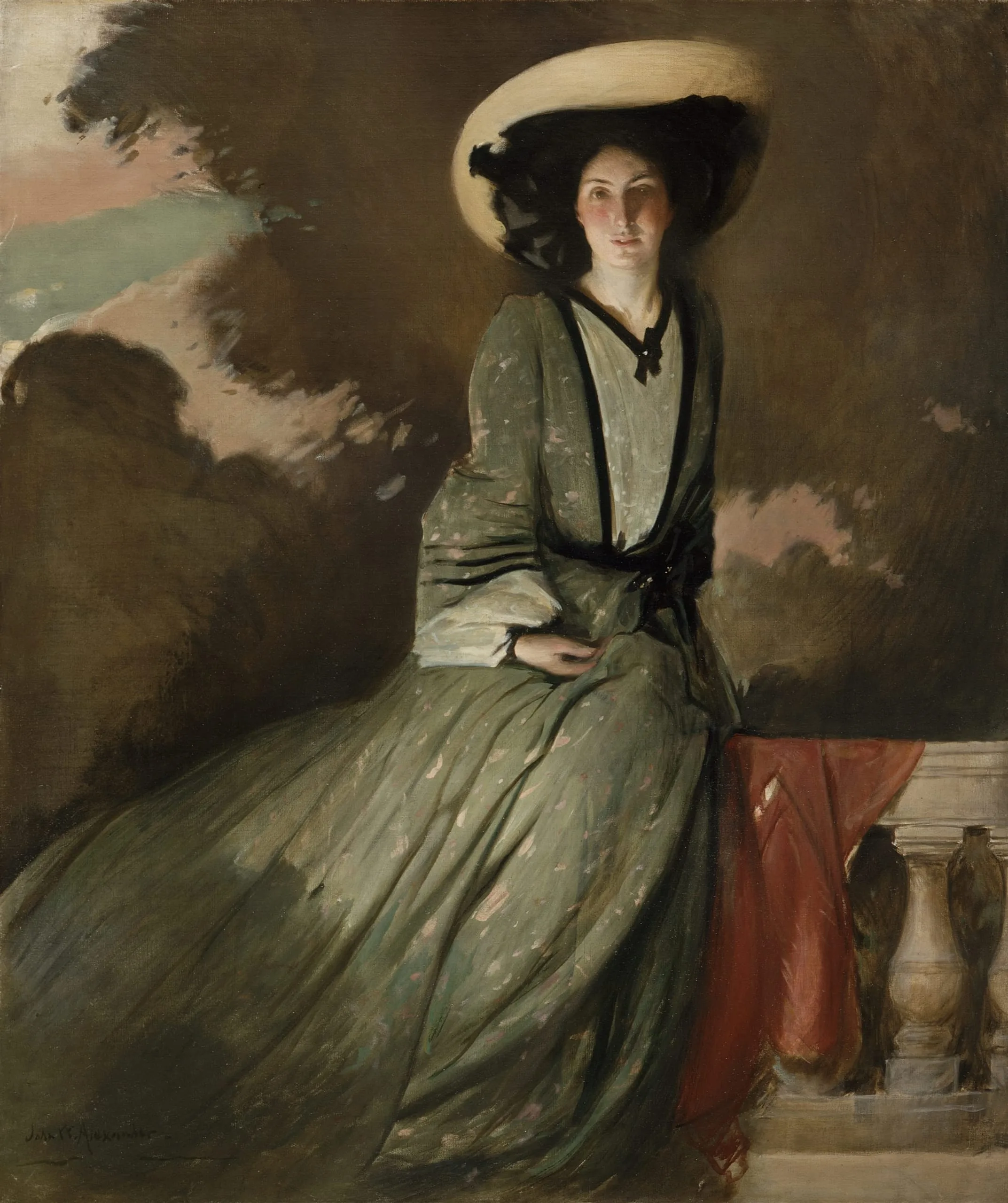
Elizabeth Alexander (1867-1947) was the daughter of James W. Alexander, who was introduced to John White Alexander by Joseph Harper because of the similarity of their names. Elizabeth and John were married in 1887, and the following year their only child, James, was born. Elizabeth was an educated woman who enjoyed the company of her husband’s circle of painters and writers. This portrait was painted in Alexander’s New York studio late in 1902 and immediately included in the artist's exhibition at Durand-Ruel’s galleries held in late November. It was one of the favorites of the exhibition, commended for its subdued color, flowing line, and grace.
This full-length portrait demonstrates Alexander’s mature style: it is an evocative figure study in which mood and atmosphere take precedence over likeness. The portrait was painted in a palette of muted pinks and moss green -- the artist’s favorite colors -- on a coarse, loosely woven, absorbent canvas to produce a soft, hazy effect. Alexander cast his wife in a somewhat ambiguous, shadowy outdoor setting with dramatic spotlighting on her face and right hand. The strong light shining from below, which first appeared in Alexander’s early theatrical portraits of the 1880s, reappeared in his paintings of the late 1890s. Such lighting seems quite appropriate for a portrait of Elizabeth Alexander, for she not only shared her husband’s interest in the theater, but also collaborated closely with him on costume and lighting designs and, after his death, had a distinguished career in the theatrical arts. The shadowy illumination also heightens the quiet sense of mystery that often pervades Alexander’s figure paintings.
Despite her independent nature -- in the 1910s she became active in the women’s suffrage movement -- Elizabeth Alexander was portrayed by her husband as a fragile beauty. Her billowing gown forms a gentle flowing line, echoing the curves of her hat and the shadowy trees and clouds in the background. Alexander was deeply interested in late-nineteenth-century theories regarding the psychology of line, and in the 1890s he began to compose paintings of elegant women using sensuous, curving shapes. The artist's fascination with emotive line led him to be increasingly bold and, by the early twentieth century, he was creating paintings in which the figures and their dresses form daringly abstract compositions.
Elizabeth Alexander often posed for her husband; between 1893 and 1902 he painted at least five portraits of her. This is one of the largest compositions and the full length of the figure, as well as the presence of a balustrade place the painting within the tradition of eighteenth-century grand manner portraiture. When the painting was first publicly displayed, critics commented on its English landscape setting and Elizabeth Alexander’s old fashioned gown, noting that it recalled the work of British painter Thomas Gainsborough (1727-1788).