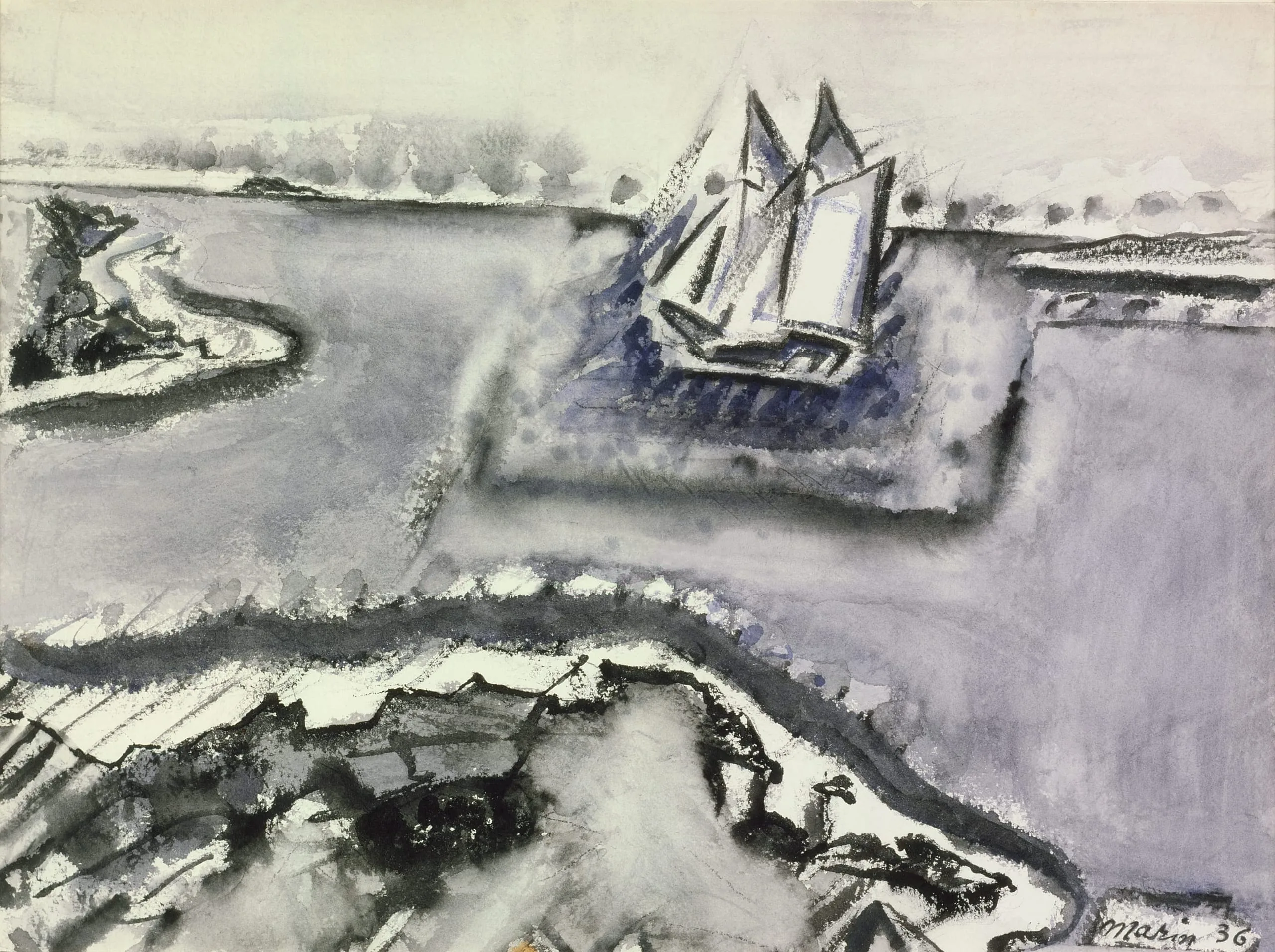
In 1933 Marin discovered Cape Split and the next year purchased property and a house overlooking Pleasant Bay, where he would summer for the rest of his life. The artist loved Maine, and its hills and shoreline became one of the main themes of his work. Cape Split, between Mount Desert and Eastport, was at that time not well known. Its isolation and rugged terrain may have been what initially attracted the artist to the site. Marin frequently painted the craggy shoreline of the Cape Split area during the mid-1930s, often, as in this scene, including a view of the bay and a sailboat.
During the 1930s Marin’s palette changed from the bright primary hues he used during the 1920s to somber tones. The almost monochromatic black and blue-gray palette in this watercolor brings to mind the cold and dampness of a storm at sea. Marin’s brushwork conveys the power of nature. While the thick line around the boat describes the force and movement of a wave, the equally thick, but crisper, black line of the shore establishes the barrier between land and sea. Marin utilized different techniques for different effects: the water was painted very wet, but the shoreline was described with a greater variety of dry brush strokes.