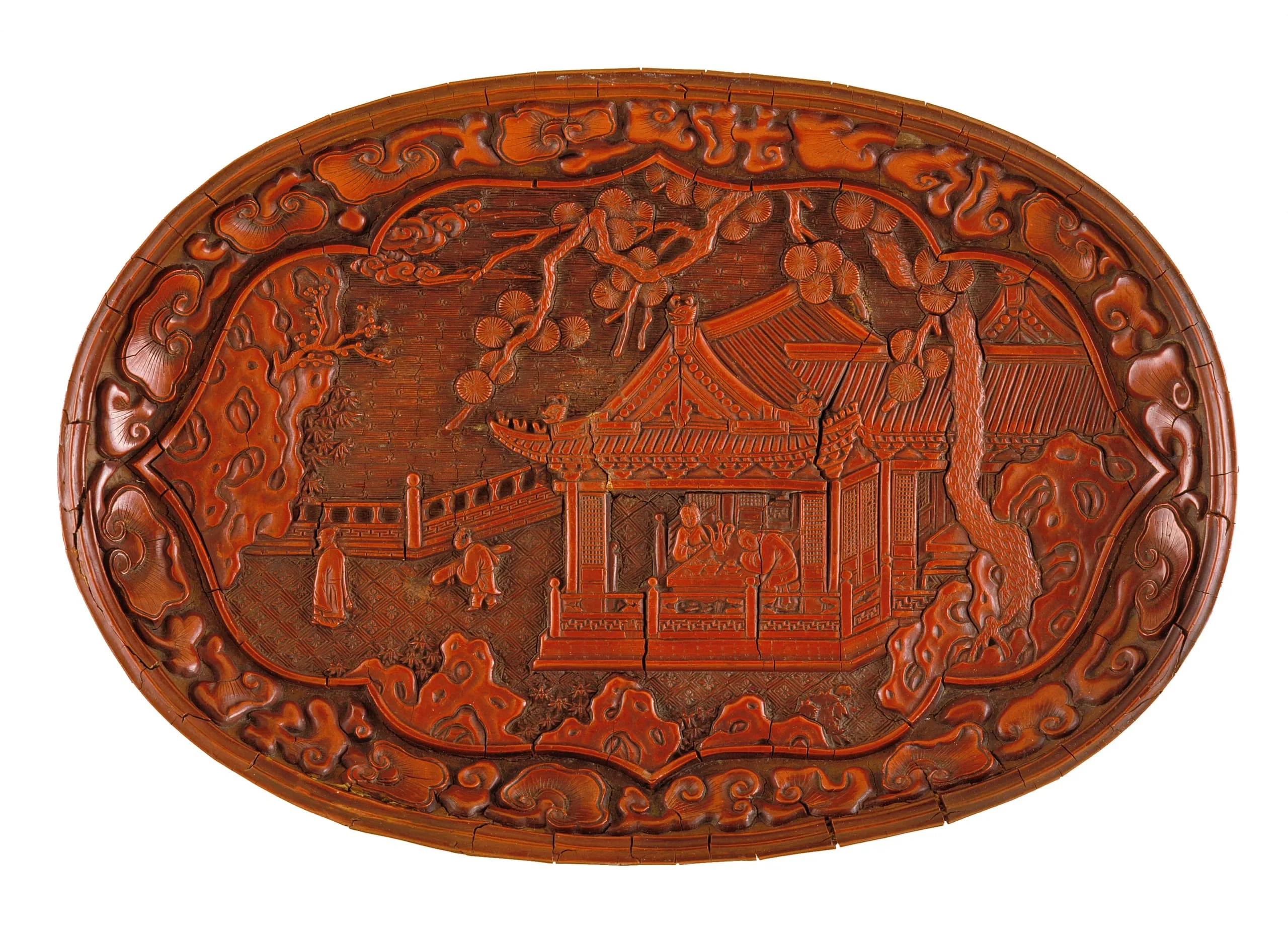
The elaborate scene on this small tray depicts a conventional gathering of literati who have just finished a sociable banquet. Within the pavilion a guest nods over the laden table; at left, another departs, followed by a servant bearing a qin, a Chinese stringed instrument. The artist delighted in natural forms, as seen in the pine, flowers, planes, and contortions of the rockery, in the perspective of the pavilion's facade and the furnishings within (the remains of food are shown in the dishes), and in the band of lingzhi mushrooms on the border. His skill in carving and pleasure in patterning pervade the entire plate. The background diaperwork of rosettes and meanders represents earth and sky.
Lacquer objects were made in China , Japan , and Korea from before recorded history; Chinese palace walls dating to the fourteenth century B.C. bore lacquer decorations. Laboriously purified from the sap of a sumac (Rhus verniciflua), lacquer can carry several pigments, but red, black, or a combination were used most frequently. Techniques for ornamenting the surface of lacquerwork are numerous and complex, but most often the lacquer is applied over a plain or carved wood core, each coat requiring a long period of careful curing, until the wood is completely covered. The built-up lacquer surface can also be carved. Lacquer has extraordinary adhesive qualities; once cured, it is virtually impervious to moisture, alcohol, food acids, or decay.