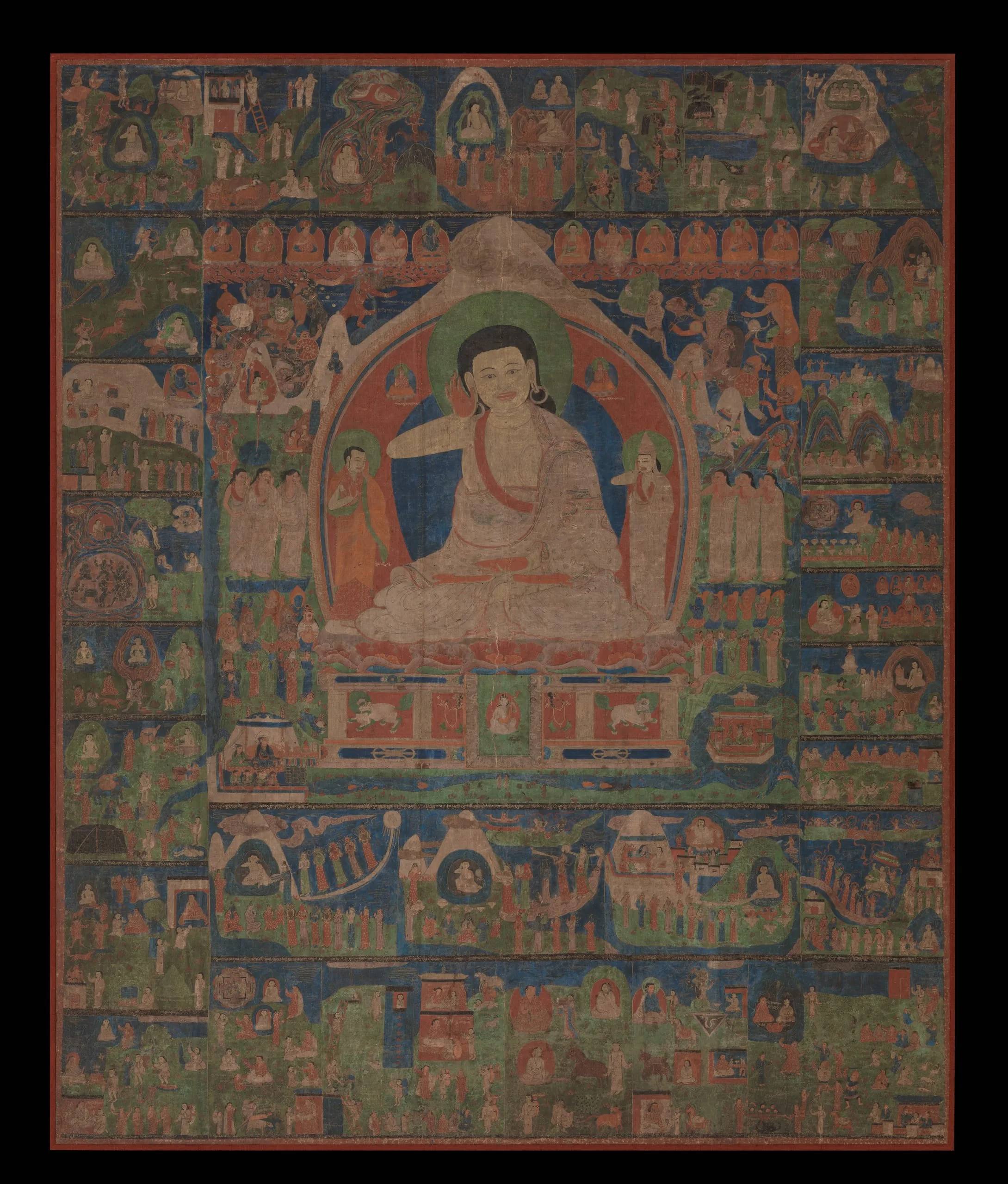
This painting depicts the great yogi Milarepa (1040-1123) seated in a mountain cave, flanked by his two great disciples, Rechungpa in white on his right and Gampopa in red on his left. Scenes from the major events of his life surround the mountain. Milarepa wears the simple white cotton robes that he reportedly wore even during the coldest winters. His right hand is raised to his ear in a characteristic gesture that has several interpretations: some devotees believe that it signifies his listening to the sounds of nature; while others believe that it might refer to his knowledge of secret oral traditions that were not written down, but passed verbally from master to disciple.
Milarepa’s spiritual lineage is represented in the row of figures above his head. Above and to either side demons seek to distract him, an allusion to the attack by Mara’s armies on the Buddha at the moment of his enlightenment. The donor of the painting, possibly a king, and his family sit under a tent at the lower left corner of Milarepa’s throne.
Milarepa was born into a wealthy family, but a wicked aunt and uncle stole their property. He studied black magic and cast a destructive spell on the evil doers (lower right corner). Many people were killed and stricken with remorse, Milarepa sought the great teacher Marpa to teach him how to overcome his vengeful desires. As part of the teaching process, Marpa had Milarepa perform many arduous tasks such as building several towers by hand (depicted at the bottom center). In time Marpa imparted his teachings to Milarepa, who then withdrew from human company to devote himself to meditation in solitude. After meditating in a cave for a number of years he became enlightened. Despite his withdrawal from human company, numerous monks sought his instruction and guidance in their religious studies.
The expressive freedom with which this thangka was painted and its muted colors, elongated figures and naive execution of the biographical scenes and landscape elements is typical of many paintings from Western Tibet during the second half of the 15th century. The hats worn by the lamas in the register flanking the mountain peak suggest that they belong to the Drukpa subsect of the Kagyupa order which was very active in Western Tibet and Ladakh.