- Title
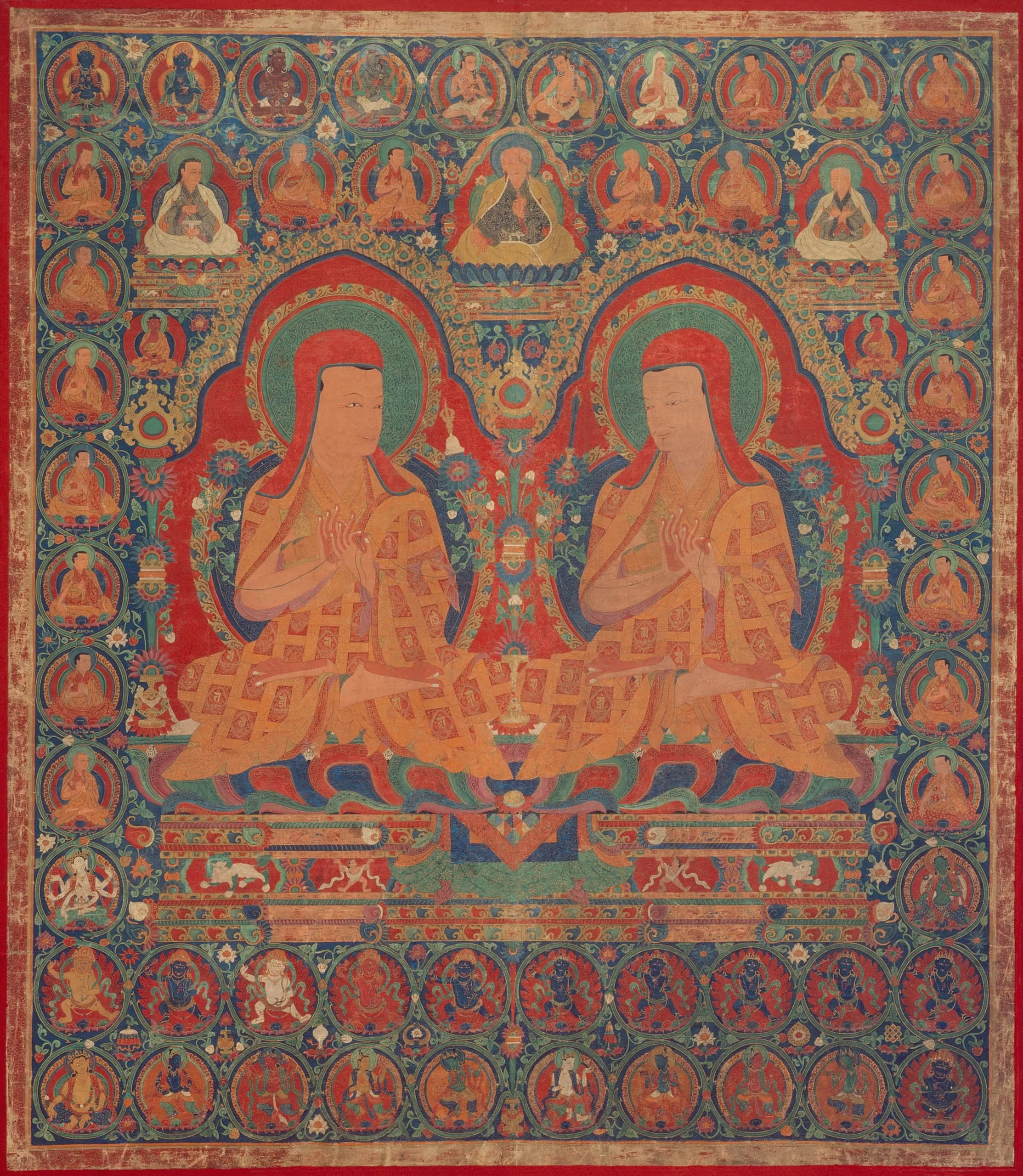
- Kunga Wangcuk (1424-1478) (left) and Sonam Senge (1429-1489) (right), The Fourth and Sixth Abbots of Ngor Monastery
- Date Made
- circa 1475-1500
- Medium
- Mineral pigments and gold on cotton cloth
- Dimensions
- 53 x 46 in. (134.62 x 116.8 cm)
- Accession Number
- M.81.90.1
- Curatorial Notes
This 15th-century Sakyapa painting continues the tradition of Tibetan lineage painting established in the 13th century. The eminent monks Kunga Wangcuk (left) and Sonam Senge (right) are depicted as large figures in the center, with the lineage representing the transmission of the sect's esoteric teachings depicted by the much smaller images above and to the sides. However, where the 13th-century Taklung artists used stylized "mountain staves" derived from eastern Indian painting to form the space enclosing each figure (see AC1994.47.1), beginning in the early 14th century, the Ngor artists enclosed the lineage figures with loops formed by a continuously intertwining "vine of life." This is the same technique used to enclose each of the figures in the early 15th-century sculpture of the Lord of the Planets, Rahu, from the renowned Densatil Monastery (AC1999.58.1).
As is common with Sakyapa lineage paintings, each figure is identified by an inscribed name. Kunga Wangcuk was a disciple of Kunga Zangpo (1382-1457), who founded the now-destroyed Ngor Monastery in 1429. His importance is emphasized by his being given the attributes of the Buddha Vajradhara: the thunderbolt and the bell on blue lotuses at his shoulders. Sonam Senge founded the famous monastery of Thubten Namgyel in 1478. He is graced by the presence of the emblems of the Bodhisattva of Wisdom, Manjushri: the manuscript and the sword.
- Selected Bibliography
- Pal, Pratapaditya. Art of Tibet. Los Angeles; Berkeley, CA: Los Angeles County Museum of Art; University of California Press, 1983.
- Pal, Pratapaditya. Art of Tibet. Expanded edition. Los Angeles: Los Angeles County Museum of Art, 1990.
- Beguin, Gilles. Dieux et Demons de l'Himalaya: Art du Bouddhisme Lamaique. Paris: Grand Palais, 1977.
- Chakraverty, Anjan. Sacred Buddhist Painting. New Delhi: Lustre Press Pvt. Ltd., 1998.
- Pal, Pratapaditya; Dehejia, Vidya; Slusser, Mary Shepherd; Fisher, Robert E.; Brown, Robert L. Arts of Asia 15 (6): 68-125 (November- December 1985).
- Little, Stephen, and Tushara Bindu Gude. Realms of the Dharma: Buddhist Art across Asia. Los Angeles: Los Angeles County Museum of Art, 2025.