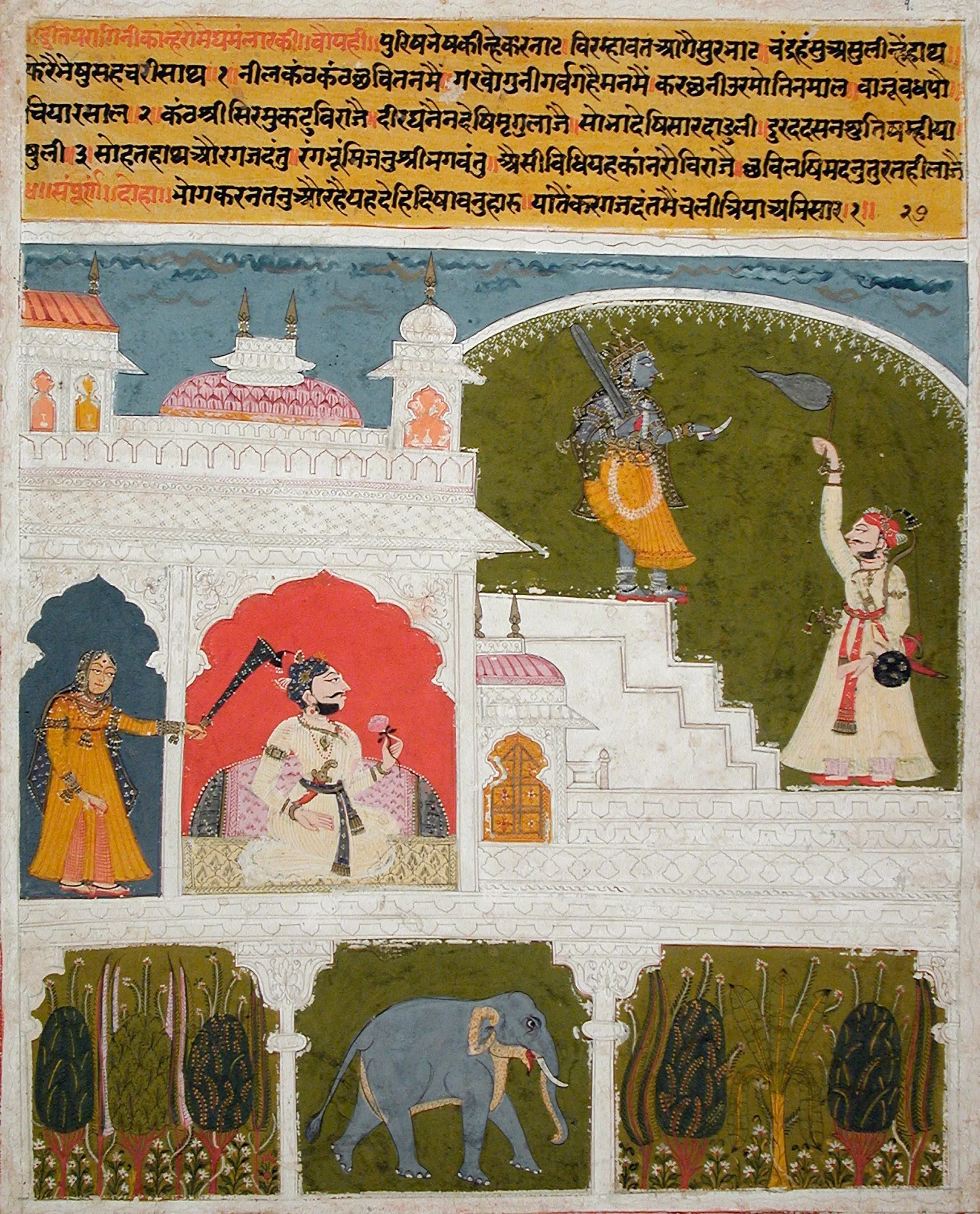
The Braj verses read:
Kanada puts on the dress of a man, standing on sandals, picks up the scimitar in hand; the attendant also helps her to dress. Brandishing the sword, she raises the arm. An attendant plies the fly whisk. Having quelled Cupid (Kamadeva), she has attained victory; she is pale by separation from the beloved. Carrying shield in hand, she is a veritable hero. She carries the crown of many victories, and as a prize she has taken possession of love. No other lady is equal to her.
Kanhra Ragini (also known as Kanada Ragini, from Karnataka) is the second wife of Dipak Raga in the variant ragamala (garland of melodies) classification system known as Hanuman’s system (developed by the ancient musical theorist Hanuman), which was sometimes followed in Central Indian ragamalas. This is corroborated by the folio being inscribed as number twenty-one in the series, which corresponds to Kanhra Ragini’s sequence in Hanuman’s system. In the more widespread Rajasthani system, it is Dipak Raga’s third wife. Here, it is alternatively inscribed as the second wife of Megha Mallar Raga. It is an emotional melody associated with the night and a successful elephant hunt. Later it was assimilated with the blue-skinned Krishna’s killing of the elephant-demon, Gajasura. Thus, an elephant is shown, and the heroine dressed in Krishna’s clothes holds an elephant tusk. See also AC1999.127.43. Another folio from this dispersed series is in the Virginia Museum of Fine Arts, Richmond (68.8.107).