- Title
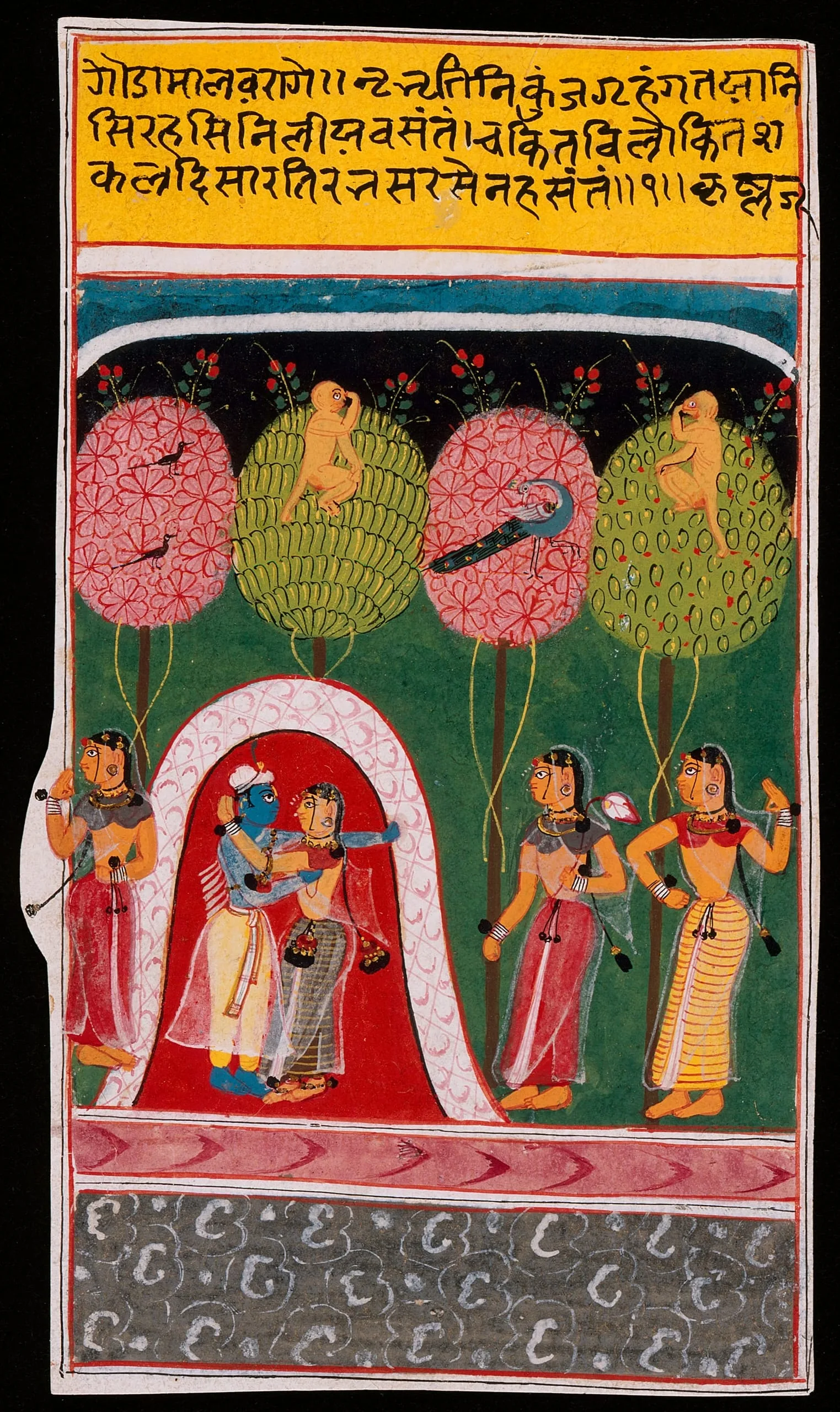
- Radha and Krishna Embracing in a Forest Hut, Folio from a Gita Govinda (Song of the Cowherd)
- Date Made
- circa 1630-1640
- Medium
- Opaque watercolor, gold, silver, and ink on paper
- Dimensions
- Sheet: 8 1/4 x 4 7/8 in. (20.96 x 12.38 cm) (cropped); Image: 6 5/8 x 4 11/16 in. (16.83 x 11.91 cm)
- Accession Number
- M.81.27
- Curatorial Notes
The Gita Govinda (Song of the Cowherd) was composed by the Sanskrit poet Jayadeva (eastern India, circa 1170-1245). The celebrated poem marks the debut of Krishna’s paramour Radha. Previously, she was known only from sporadic literary and epigraphical references beginning in the 7th century. She is absent from the major early texts in which the life of Krishna is related: the Harivamsha (Lineage of Hari [Vishnu]), 1st century; Vishnu Purana (Ancient Stories of Vishnu), circa 450; and Bhagavata Purana (Ancient Stories of the Lord), 8th-10th century. It describes the initial passion of Radha and Krishna, their temporary estrangement over Radha's jealousy of Krishna sharing his love with other cow-herdswomen, and their ecstatic reconciliation in Krishna's nocturnal bower of delight.
The folio illustrates the Sanskrit verses to be sung with Raga Malava that are inscribed in the header: “I reach the lonely forest hut where he secretly lies at night. My trembling eyes search for him as he laughs in a mood of passion.” (Gita Govinda 2:6:11) The blue-skinned Krishna and Radha are embracing in a thatch hut in the forest beside a river. Three gopis (cow-herdswomen) are nearby. The folio has been cropped.
An additional folio from this dispersed series is in the Metropolitan Museum of Art, New York (2003.165).