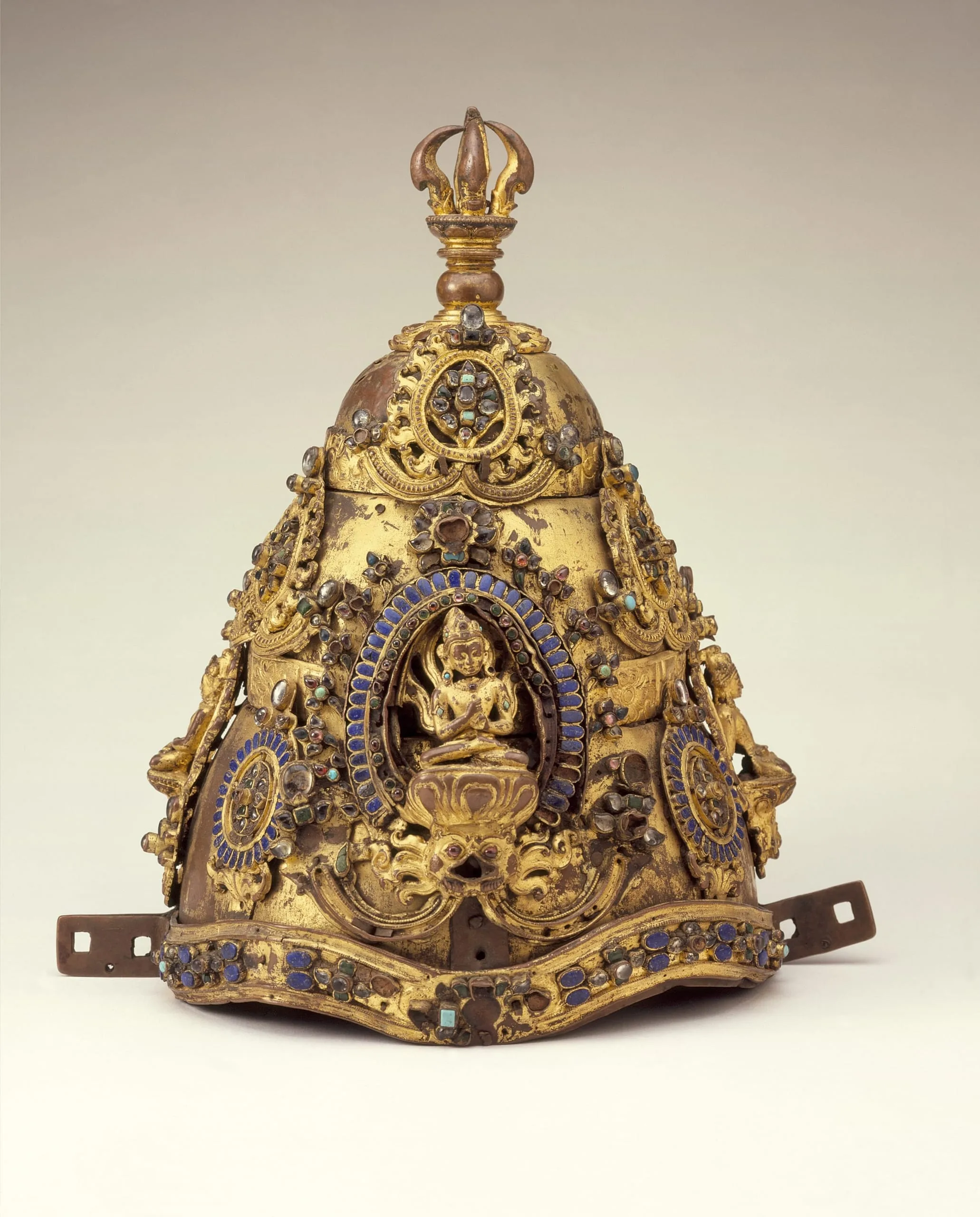
This elaborate crown was worn by a Nepalese Buddhist priest known as the Vajracharya (Master of the Thunderbolt) during public ceremonies to identify him or her ritually as the primordial teacher Vajrasattva (Adamantine Being). The crown is adorned with images of the five transcendental Jina Buddhas: Vairochana (front), Ratnasambhava (proper right), Amitabha (rear), Amoghasiddhi (proper left), and Akshobhya (symbolized by the thunderbolt (vajra) surmounting the crown). These five Buddhas, who are emanations of Adi Buddha (Primordial Enlightened One), represent the state and qualities of Buddhahood and the essence of Buddhist Dharma. Each Buddha has a specific insight, symbol, color, vehicle, and rules a cardinal direction or the zenith. They each sit on a lotus base in a gemstone-bordered cartouche above an apotropaic “face of glory” (kirttimukha).
Comparable Vajracharya Priest’s Crowns are in Metropolitan Museum of Art, New York (2016.408), Virginia Museum of Fine Arts, Richmond (84.41), and the Musée Guimet, Paris (MA 4929). The Paris crown has a Newar inscription identifying the commissioner, monastery, and monk-goldsmith who made the crown in 1145.