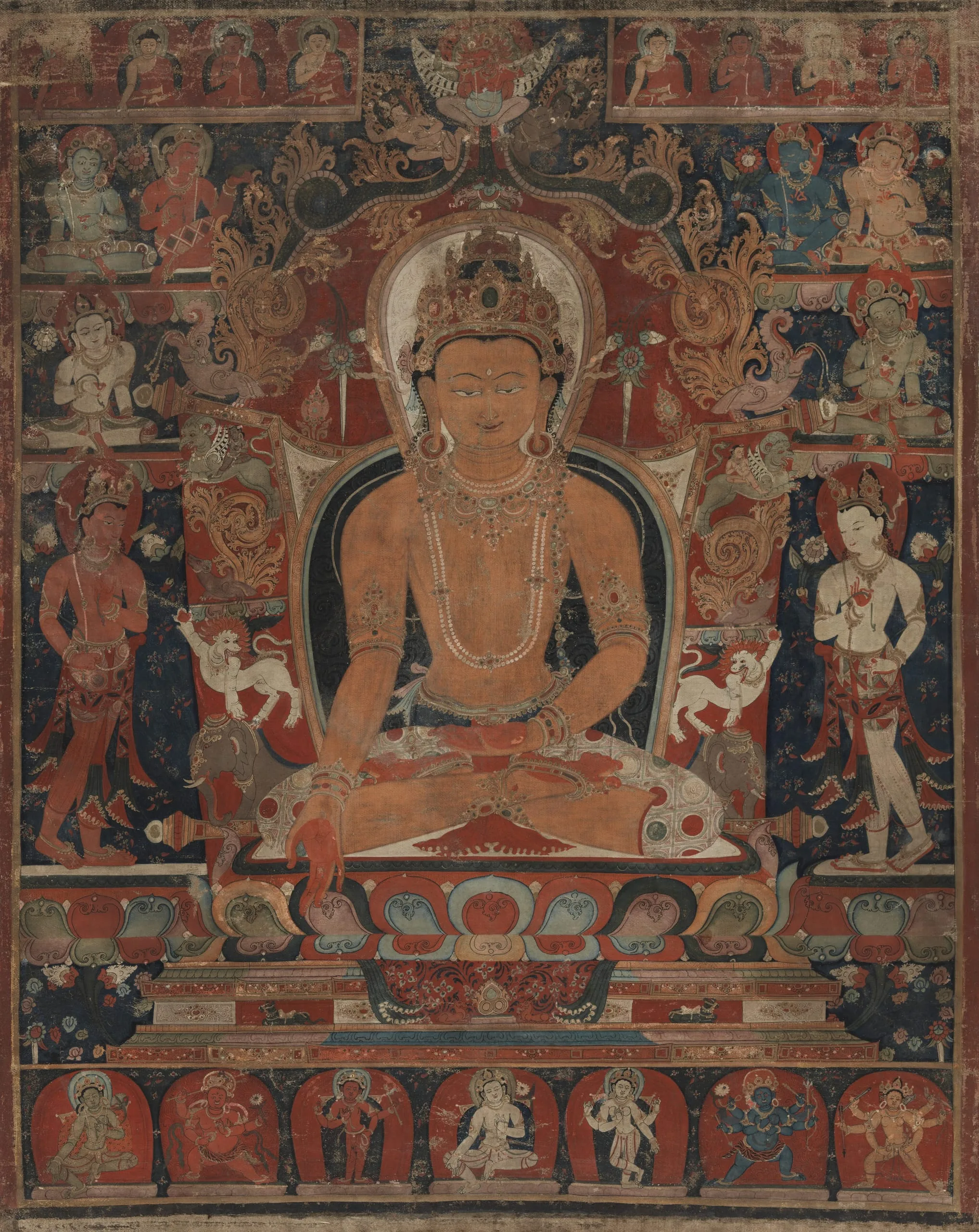
Mahayana Buddhism began to formulate notions of multiple Buddhas associated with the cardinal directions, cosmic eras, heavens, emanations, practitioners, texts, etc. These classifications became extremely important in Vajrayana Buddhism. They were greatly elaborated and given visual expression in a variety of artworks. Ratnasambhava—associated with the South—is one of the five Jina (Conqueror) Buddhas who each preside over a different Buddha family. The Jina Buddhas collectively represent the insights constituting enlightenment, and painting sets depicting all five were prominently displayed in Himalayan Buddhist shrines and monasteries.
Ratnasambhava, enthroned in the center of the painting, has a yellow complexion and holds his right hand in the gesture of charity (varada mudra). He is further identified by his two horse mounts on the throne base, and the three jewels of Buddhism representing the Buddha, the Dharma (Buddhist teachings), and the Sangha (community of Buddhist monks and nuns) that are displayed on the overhanging carpet between the recumbent horses. Ratnasambhava is flanked by two bodhisattvas and three more bodhisattvas on either side of the upper throneback. And two panels at the top of the painting are eight Buddhas, four yellow and four red. They display either the gesture of charity or the gesture of Turning the Wheel of the Law (dharmachakra mudra). In the bottom registrar are eight deities, including Shyama (Green) Tara on the far left and Avalokiteshvara in the center.
Another painting from this same series depicting the Jina Buddha Amitayus is in the Museum of Fine Arts, Boston (67.818).