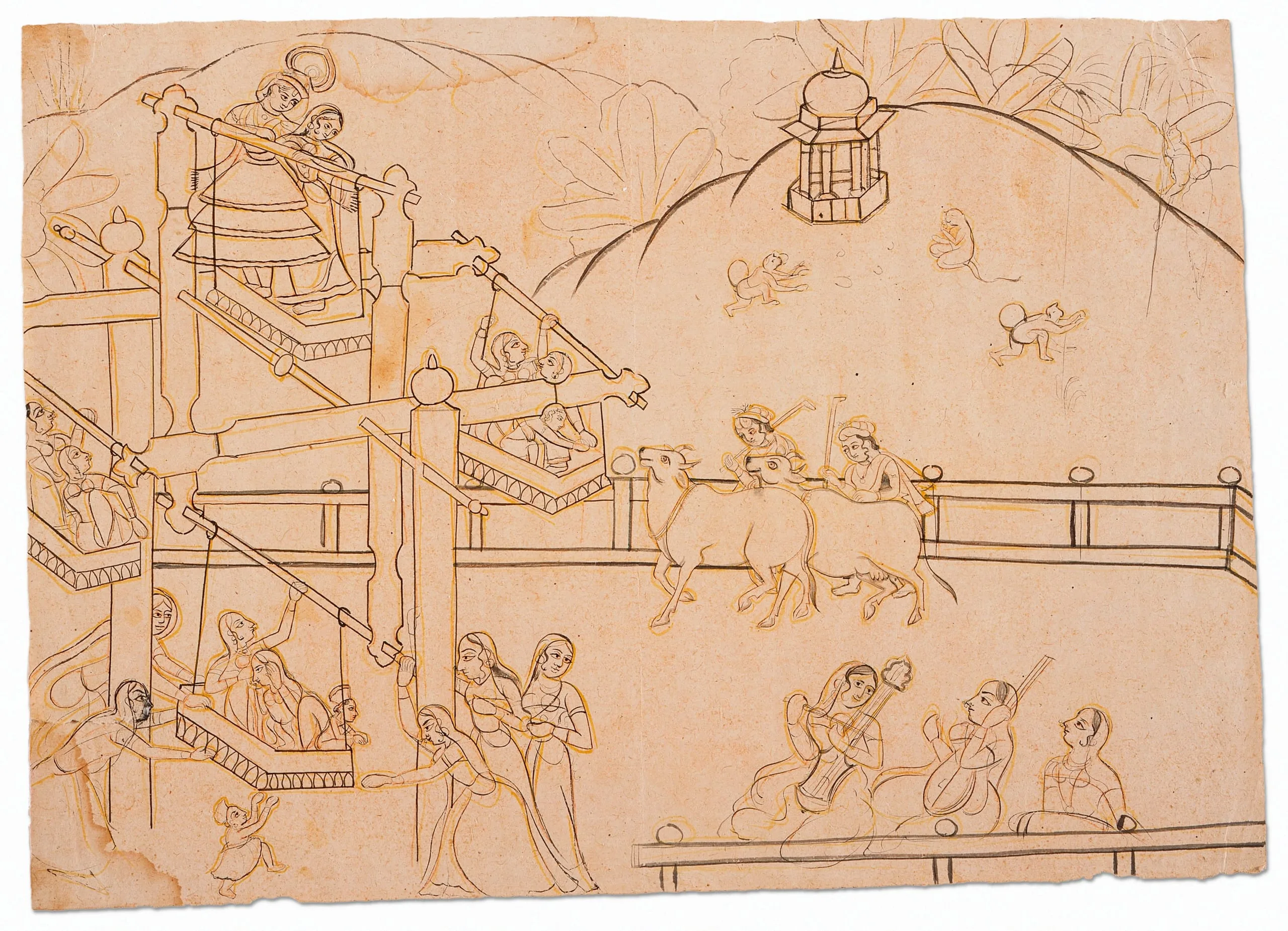
The Swing Monsoon Festival (Teej Utsava) is observed on the third day of the bright fortnight (Shukla Paksha) in the month of Shravana (July–August). The festival commemorates nature’s bounty and its renewal through the onset of the monsoon rains. It is celebrated by singing, dancing, worship (puja), spiritual fasting, and swinging on tree swings (see M.77.154.11). While tree swings were commonplace, a complementary form of enjoyment were hand-cranked Ferris wheels, or Great Wheels, the use of which during festivals in Asia and Asiatic Turkey were recorded as early as 1600. This representation of a village Ferris wheel (chakri or jhula) is embellished with the Hindu god of devotion, Krishna, dallying with his cowherdesses (gopis). Krishna and his adulterous consort Radha are often invoked during the Teej Festival, particularly in Mathura and Vrindavan when it coincides with the Swing Festival of Radha and Krishna (Jhulan Utsav).
Here, Krishna (identifiable by his peacock feather crest) and Radha are embracing and enjoying the ride in the top passenger car or gondola. All the other riders and the manual operators on the Ferris wheel are gopis, except for a few small girls. The Ferris wheel is set up in a fenced-in playard that also contains two cowherds (gopas) and their cows, again in a visual reference to pastoral Vrindavan, as well as three female musicians providing entertainment. Beyond the compound is a landscape with plantain trees or banana trees, a hexagonal pavilion, and monkeys cavorting on the hillside.
See also M.74.102.3, M.74.102.3, and AC1993.191.2.