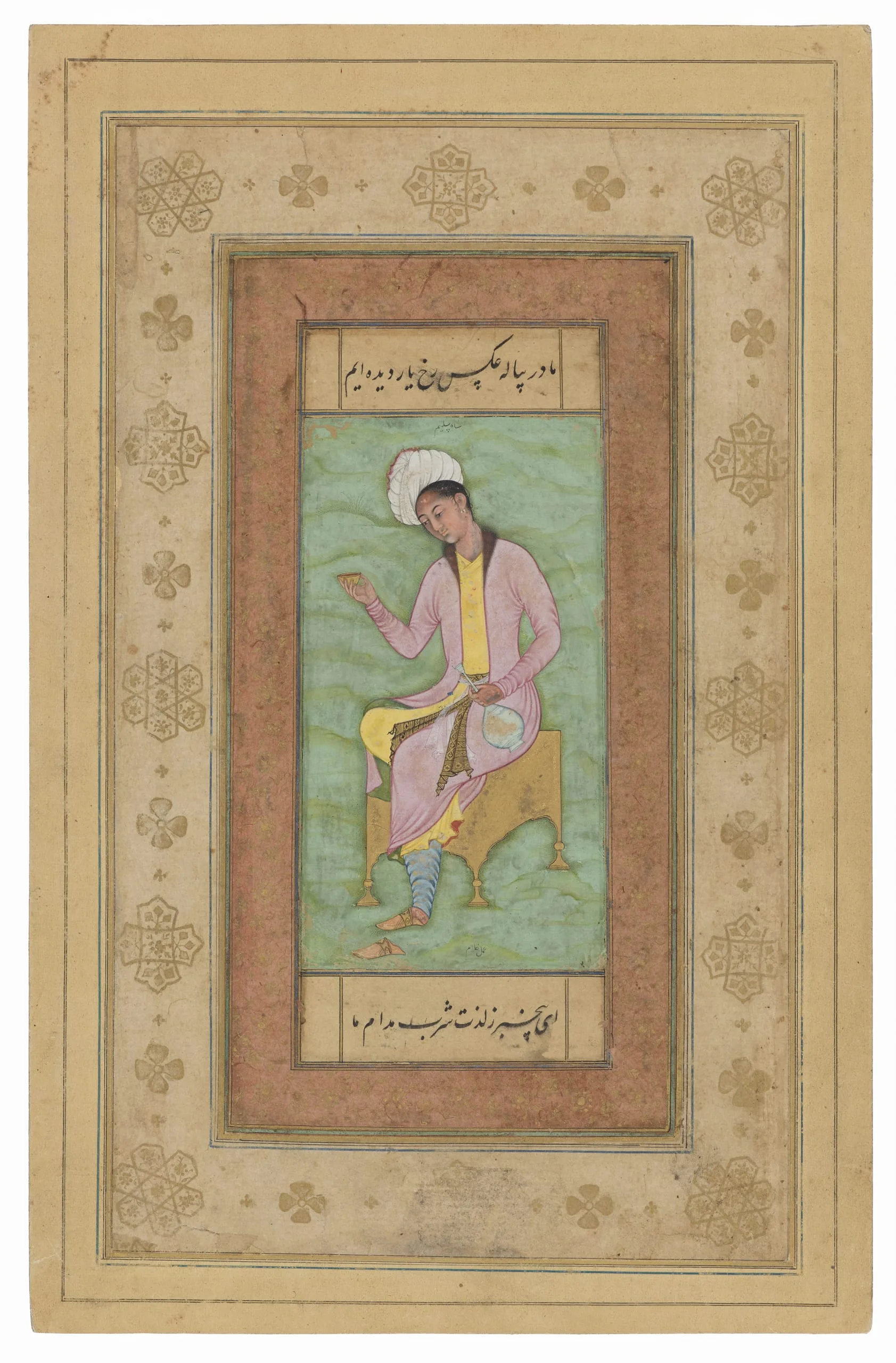
This painting once belonged to a now dispersed album (muraqq‘a) known as the Salim Album. The muraqq‘a, which flourished from the fifteenth to the seventeenth century in Iranian lands, was adopted in Mughal India by the early seventeenth century. Many of these albums, which were typically composed of alternating facing pages of paintings and calligraphy, were later disassembled and their folios disseminated on the art market, as was the case with the Salim Album. Clues within the paintings themselves, however, help us to at least partially reassemble albums. In this case, the folios that once constituted the muraqq‘a all feature distinctive decorative borders of geometric patterns, cartouches, and floral designs painted in gold. Thirty folios share this type of border and help us to see that the album consisted of calligraphy and paintings, including those of courtiers, religious figures, and scenes based on European prints. Furthermore, this painting plus two others in different collections are inscribed with a reference to “Shah Salim,” the name that Prince Salim, the future Mughal emperor Jahangir (r. 1605−27), took when he established a rogue court at Allahabad between 1600 and 1604, helping us to date and locate the album to this period and patron.
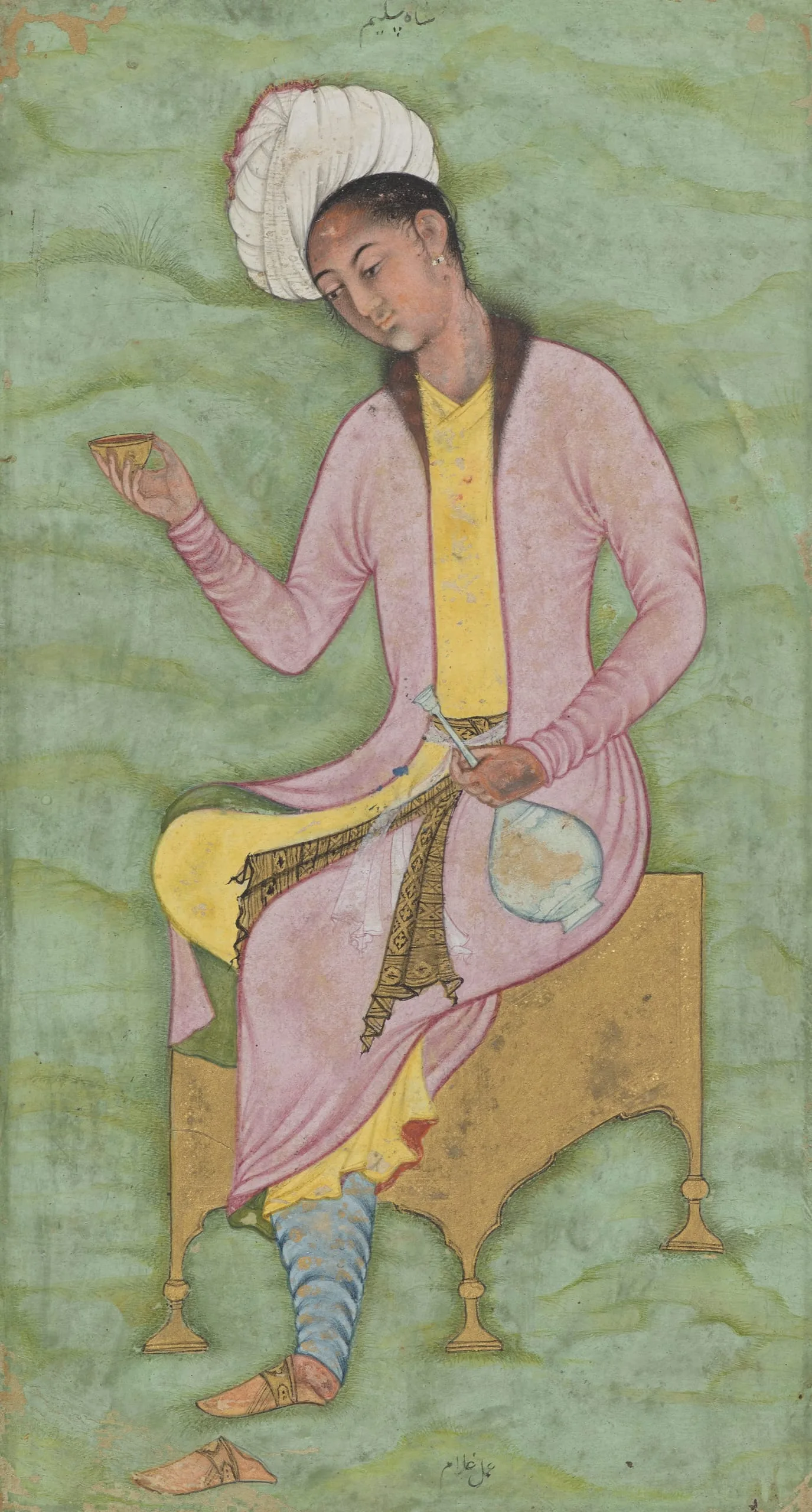
While some of the paintings in this album are meant to depict specific individuals based on their inscriptions, others represent courtly and poetic types, such as this drunken lover. The man is shown with a slightly askew turban, raising a cup of wine he has just poured for himself. His inebriated condition is contextualized by the Persian verses of the poet Hafiz (c. 1315−1390) that frame the painting: “I have seen my beloved’s reflection in the cup/ O, ignorant man, you do not understand why/ I am constantly intoxicated.” His state can thus be read on several levels, including literally and metaphorically, in his pining for a lover, or spiritually, as earthly love was used as an analogy for divine love.
Scholars have long debated the artist of this work. A second inscription in the painting, below the seated figure, reads amal-i-ghulam (“work of the slave” or “work of Ghulam”), which led one scholar to attribute the work to the painter Mirza Ghulam. Others ascribe it to Aqa Riza or his son Abu’l Hasan. Though the composition and subject closely relate to Persian painting, the shading of the man’s face, coloration, and execution of the background confirm that it is a Mughal painting.