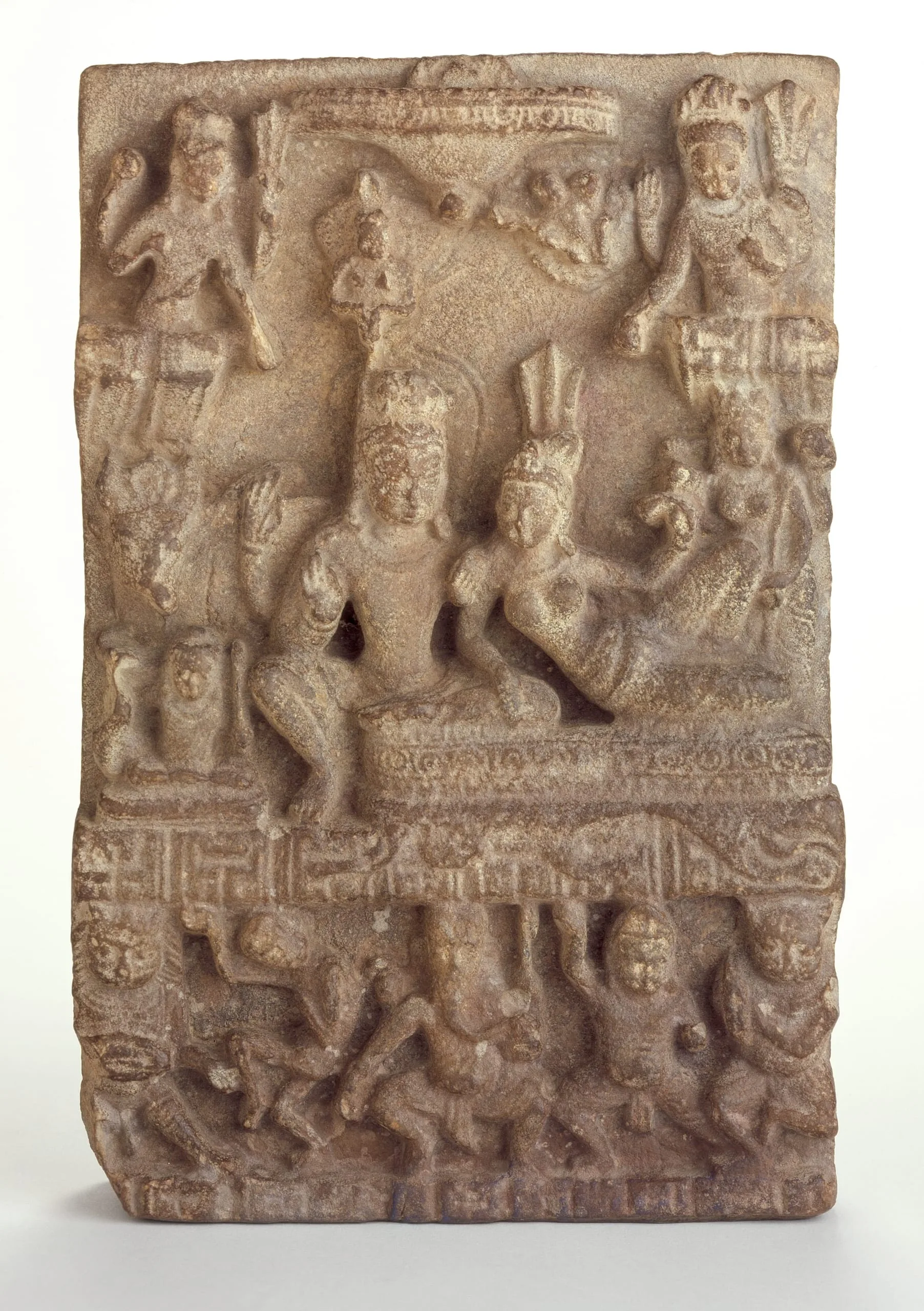
Family portraits of the Hindu god Shiva and his spouse Uma (or Parvati) are generally known in Sanskrit texts as Uma-Maheshvara ("Uma and the Great Lord" [Shiva]). Their children Ganesha and Kumara typically accompany them in family portraits. Here, the nimbate Shiva sits in a relaxed posture (lalita asana) with his right leg pendant. He has four arms. In his upper right hand, he holds a rosary. In his upper left hand behind Uma’s head, he carries a trident. His lower right hand displays the gesture of reassurance (abhaya mudra). His lower left hand rests on the shoulder of Uma, who reclines languidly beside Shiva with her right arm resting on his thigh. Kumara, Shiva and Uma’s son, sits beside Shiva holding a spear and accompanied by his peacock mount. Shiva’s bull mount Nandi sits behind Kumara. The holy family is accompanied by three attendants. Above Shiva’s head, the river goddess Ganga (Ganges) descends into Shiva’s piled hair of an ascetic. At the top of the relief, a flying celestial bears an honorific parasol (chattra). At the bottom of the relief above a band of stylized rock formations indicating that the location is Shiva’s Himalayan home on Mount Kailasha, the dancing elephant-headed Ganesha (also Shiva and Uma’s son), the skeletal devotee Bhringi, their adopted son Virabhadra, and two leonine-headed musicians entertain the divine couple.
See also M.70.42.10, M.72.1.11, M.75.4.8, M.75.11, M.79.9.3, M.88.51, and AC1999.127.38.