- Artist or Maker
- Sarvan
active 1580s - Title
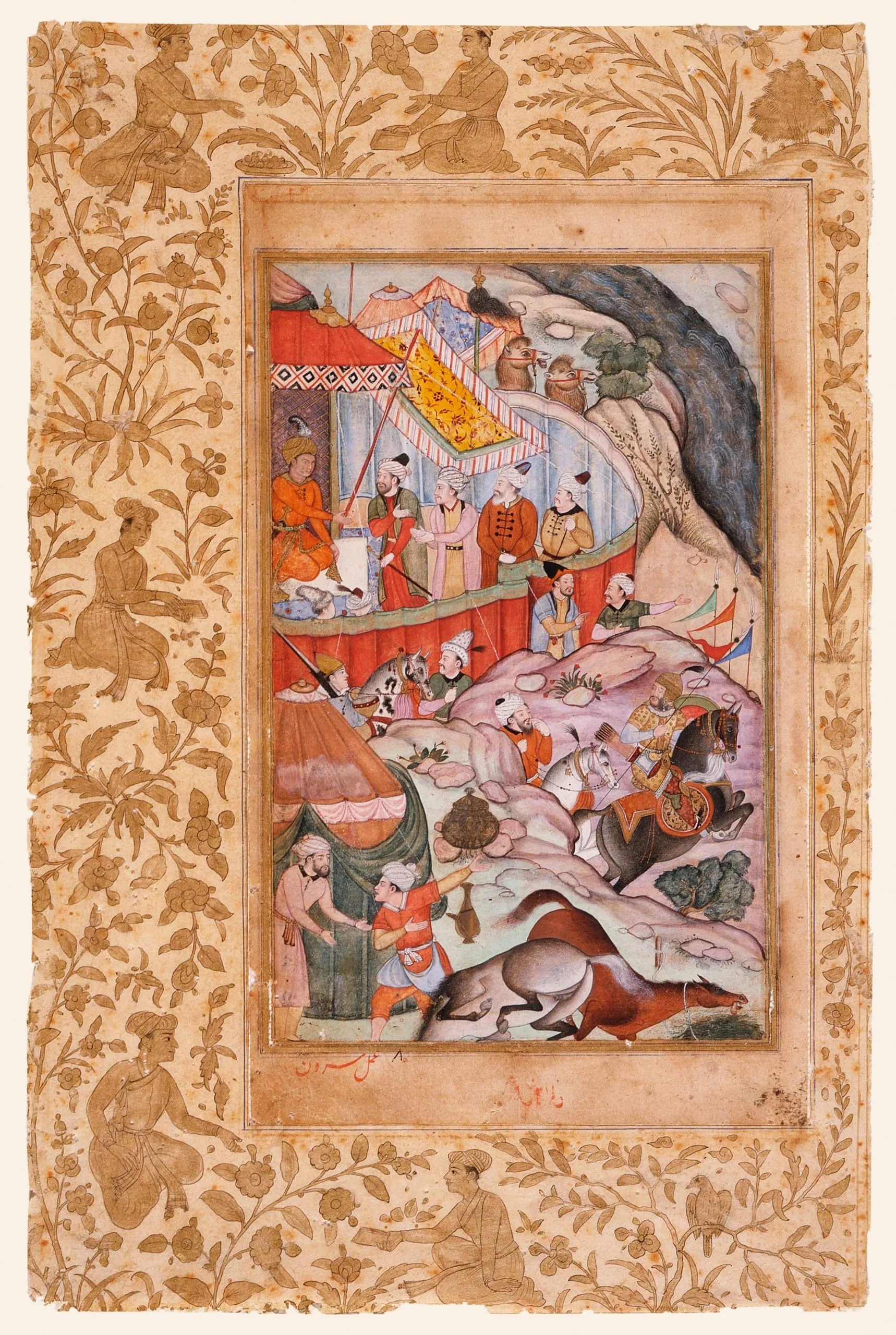
- Disease at Kuva Disables the Horses in 1494, Folio from a Baburnama (Memoirs of Babur)
- Date Made
- 1589-1590
- Medium
- Opaque watercolor, gold, and ink on paper
- Dimensions
- Sheet: 13 1/2 x 8 3/4 in. (34.3 x 22.2 cm); Image: 8 1/4 x 5 1/8 in. (20.96 x 13.02 cm)
- Accession Number
- M.81.8.7
- Curatorial Notes
The Baburnama (Memoirs of Babur) is an autobiography written in Chagatai Turkish by the Mughal Emperor Babur (r. 1526 30). Several translations into Persian were produced for Babur’s grandson, Emperor Akbar (r. 1556-1605). This folio and M.91.348.1 are from the earliest Baburnama, which was supervised by Abd al-Rahim, Khan Khanan and presented to Akbar in November 1589. The manuscript was dispersed in 1913, with twenty of the original 191 illustrations now held by the Victoria and Albert Museum, London.
This folio is the left half of a double-page illumination. The facing composition on the right-hand page cannot now be traced. The episode illustrated occurred in June 1494 in Kuva (or Qaba) in Fergana province, which is in present-day eastern Uzbekistan. While crossing an overcrowded bridge many horses and camels were pushed over the side and perished in the water. At the same time an epidemic of distemper, possibly Strangles, broke out among the thronged horses, who fell in masses and died. Two of the dead horses are depicted at the bottom of the painting. Beside the horses is a small kitchen tent with a covered pot on a campfire and a wine or water flask. In the middle ground a armored warrior on a charging steed and a perplexed man on horseback are heading towards the river shown in the upper right corner. In the upper left corner is a luxurious tent encampment likely portraying Babur’s mother’s half-brother, Sultan Ahmad Mirza (1451-1494), receiving visitors.
- Selected Bibliography
- Pal, Pratapaditya. Indian Painting, vol.1. Los Angeles: Los Angeles County Museum of Art, 1993.
- Heeramaneck, Alice N. Masterpieces of Indian Painting : From the Former Collections of Nasli M. Heeramaneck. New York: A.N. Heeramaneck, 1984.
- Rosenfield, John. The Arts of India and Nepal: The Nasli and Alice Heeramaneck Collection. Boston: Museum of Fine Arts, Boston, 1966.