- Title
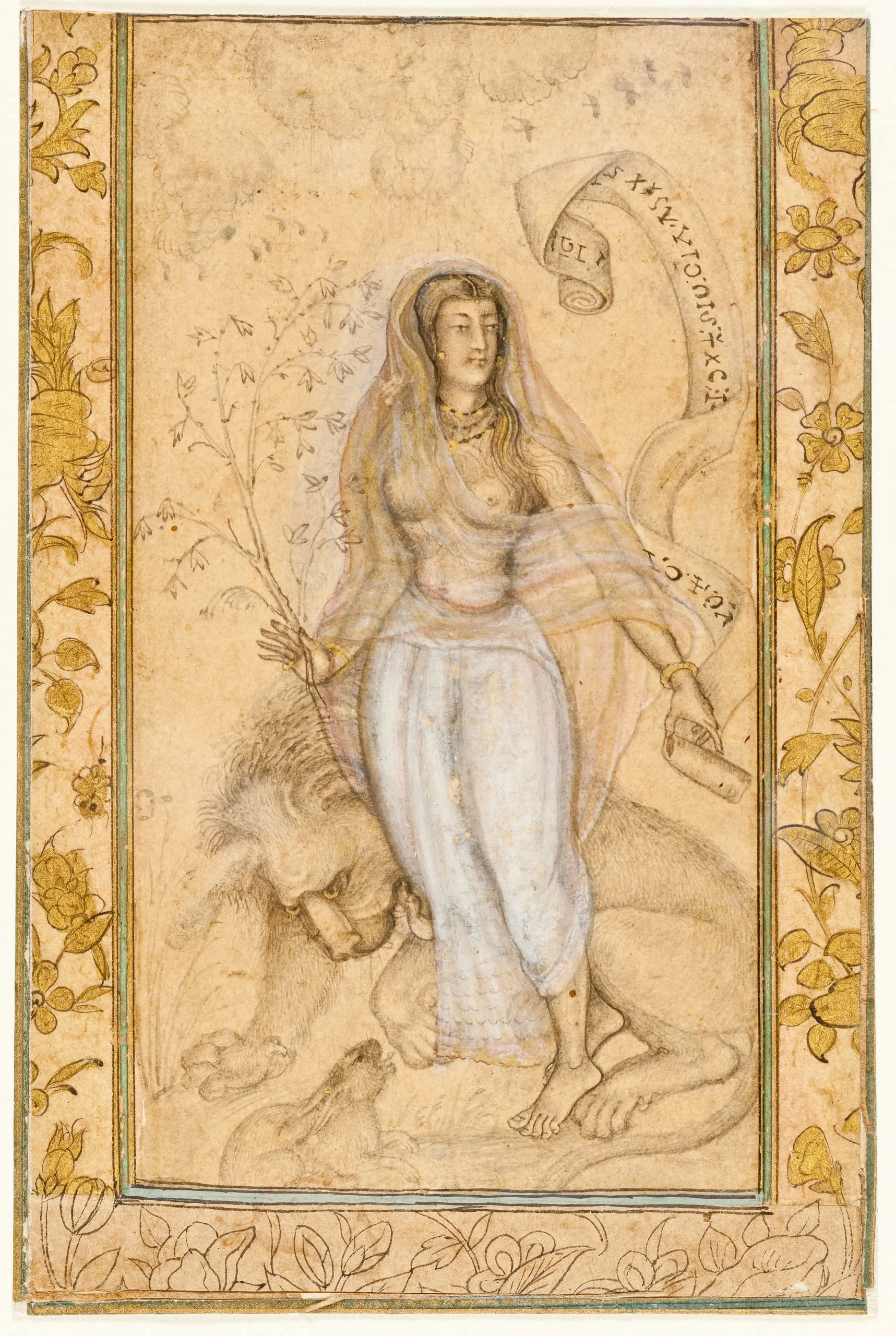
- Allegorical Figure of Fortitude (?)
- Date Made
- circa 1590
- Medium
- Ink, opaque watercolor, and gold on paper
- Dimensions
- Sheet: 4 3/4 x 3 1/8 in. (12.07 x 7.94 cm); Image: 4 1/4 x 2 1/4 in. (10.8 x 5.72 cm)
- Accession Number
- M.81.8.8
- Curatorial Notes
The Mughal interest in figural studies adapted from Western prints is well documented. This allegorical figure was likely inspired by European prints personifying various virtues. Milo C. Beach and Pratapaditya Pal have suggested that it was modelled on an engraving of Eve by the German artist Jacob Binck (1500-1569). Additional iconographic models may be even more apropos, such as The Personification of Fortitude by Marco da Ravenna (1475-1527) or Fortitude by Hans Sebald Beham (1500-1550). Regardless of its ultimate source(s), this diminutive drawing and a few related images by Basawan and/or his son Manohar represent a creative combination of diverse iconographic elements rather than a straight copying of foreign works. Landscapes and accompanying figures are often reworked, and handheld attributes are mixed-and-matched between the hybrid compositions.
Here, Fortitude holds in her right hand an oak branch symbolizing fortezza (strength or fortitude). In her left hand she holds an undulating scroll bearing a pseudo-Greek inscription in order to convey the subject’s classical antiquity. She leans against a lion, symbolic of courage, which is snarling and batting his paw at a truculent hare. The recalcitrant hare may be emblematic of Fortitude’s arch-vice Cowardice or was perhaps assimilated from images of the Virgin’s triumph over Lust symbolized by a hare or rabbit. See also 39.12.76, M.75.113.1, and M.83.105.5.
- Selected Bibliography
- Pal, Pratapaditya. Indian Painting, vol.1. Los Angeles: Los Angeles County Museum of Art, 1993.
- Rosenfield, John. The Arts of India and Nepal: The Nasli and Alice Heeramaneck Collection. Boston: Museum of Fine Arts, Boston, 1966.
- Pal, Pratapaditya; Vidya Dehejia. From Merchants to Emperors: British Artists and India, 1757-1930. Ithaca and London: Cornell University Press, 1986.
Markel, Stephen. "The Enigmatic Image: Curious Subjects in Indian Art." Asianart.com, July 28, 2015. http://asianart.com/articles/enigmatic.