LACMA

ShopMembershipMyLACMATickets
LACMA
Los Angeles County Museum of Art
5905 Wilshire Blvd.
Los Angeles, CA 90036
info@lacma.org
(323) 857-6000
Sign up to receive emails
Subscribe
© Museum Associates 2026
  • About LACMA
  • Jobs
  • Host An Event
  • Unframed
  • Press
  • FAQs
  • Log in to MyLACMA
  • Privacy Policy
© Museum Associates 2026
Collections

Unknown
The Bodhisattva Avalokiteshvara12th century

Not on view
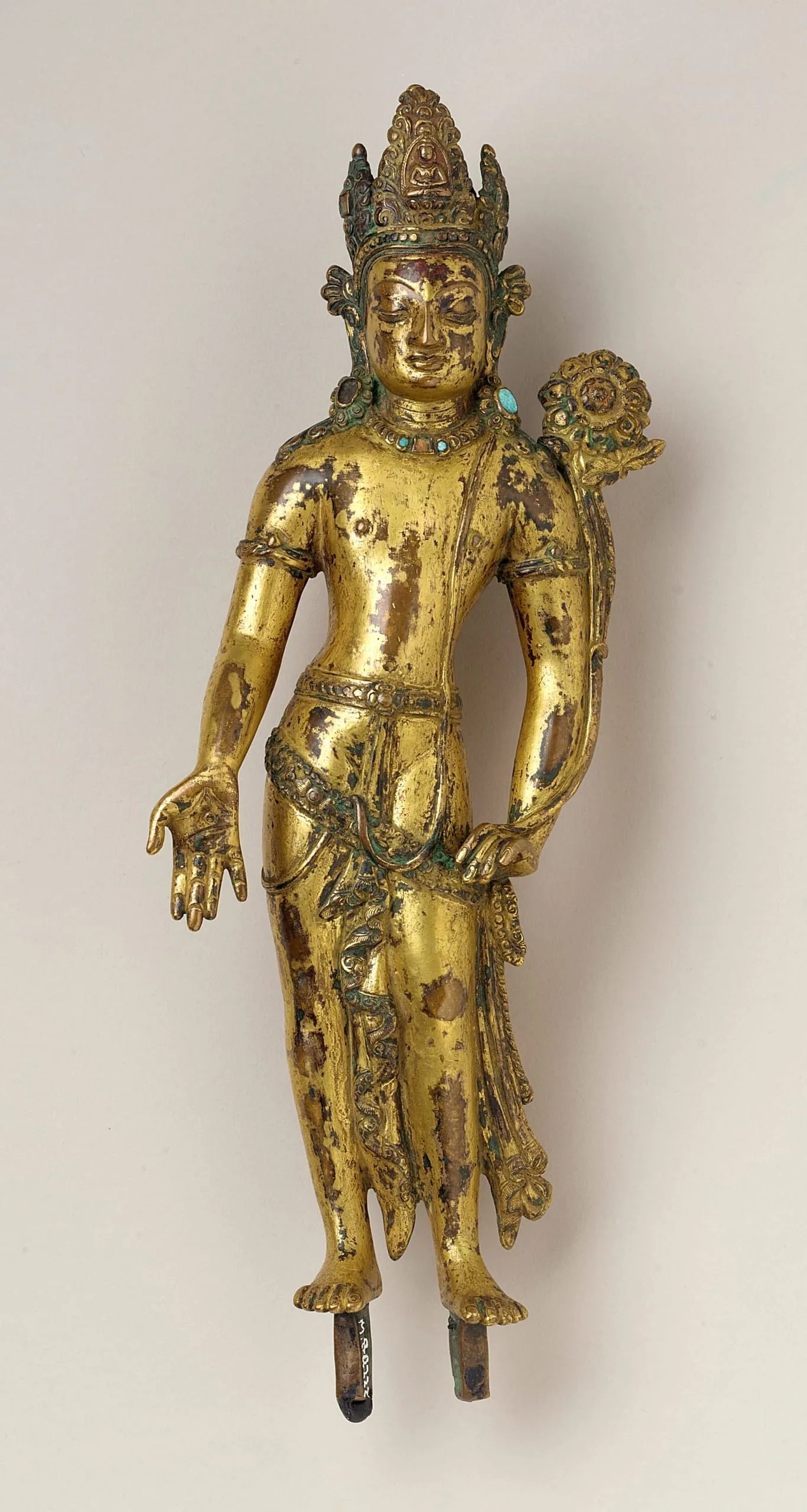
Gilt bronze standing figure with tiered crown, turquoise inlay, open right hand, and lotus stem in left hand; mounted on cylindrical foot pegs

Unknown, The Bodhisattva Avalokiteshvara, 12th century, Los Angeles County Museum of Art, Gift of Mr. and Mrs. Sidney E. Cohn, photo © Museum Associates/LACMA

Artist or Maker
Unknown
Title
The Bodhisattva Avalokiteshvara
Place Made
Nepal or Central Tibet
Date Made
12th century
Medium
Gilt brass inlaid with gemstones; traces of paint
Dimensions
10 3/4 x 4 3/8 x 1 3/8 in. (27.31 x 11.11 x 3.5 cm)
Credit Line
Gift of Mr. and Mrs. Sidney E. Cohn
Accession Number
M.80.222
Classification
Sculpture
Collecting Area
South and Southeast Asian Art
Curatorial Notes

Avalokiteshvara, the Bodhisattva of Compassion, stands gracefully in the Triple-bend Posture (tribhanga sthanaka) with his head slightly inclined, the hips jutting to one side, and the shoulders leaning in the opposite direction, conveying dynamic movement and compassion. He has a tripartite crown with a diminutive identifying image (bimba) of the Jina Buddha Amitabha, who is the emanation source deity of Avalokiteshvara. He wears copious princely ornaments (bodhisattva abharana), including the Brahmanical sacred thread (yajñopavita) over his left shoulder. He is bare chested, barefooted, and wears a plain dhoti with decorated borders and a sash tied diagonally across his thighs. His left hand rests on his hip and holds the long stalk of a blossoming lotus. Accordingly, standing sculptures of Avalokiteshvara with two arms are commonly called Padmapani (lotus-bearer). His right hand is extended in the gesture of charity (varada mudra). A small lug on his upper back below his neck indicates that he originally had a separately cast nimbus. Long square pegs under his feet would have been inserted into a lotus base when the sculpture was displayed. See also M.81.8.1 and M.82.40.

Comparable Nepali images of Avalokiteshvara are in the Asia Society Museum, New York (1979.51 and 1979.47) and Rubin Museum of Himalayan Art, New York (C2005.16.8).
Selected Bibliography
  • Reedy, Chandra L. Himalayan Bronzes: Technology, Style and Choices. Newark: University of Delaware Press, 1997.
  • Pal, Pratapaditya. Art of Nepal. Los Angeles: Los Angeles County Museum of Art; University of California Press, 1985.

Related Unframed

A Quiet Moment: Himalayan Art Galleries
  • March 20, 2012