- Title
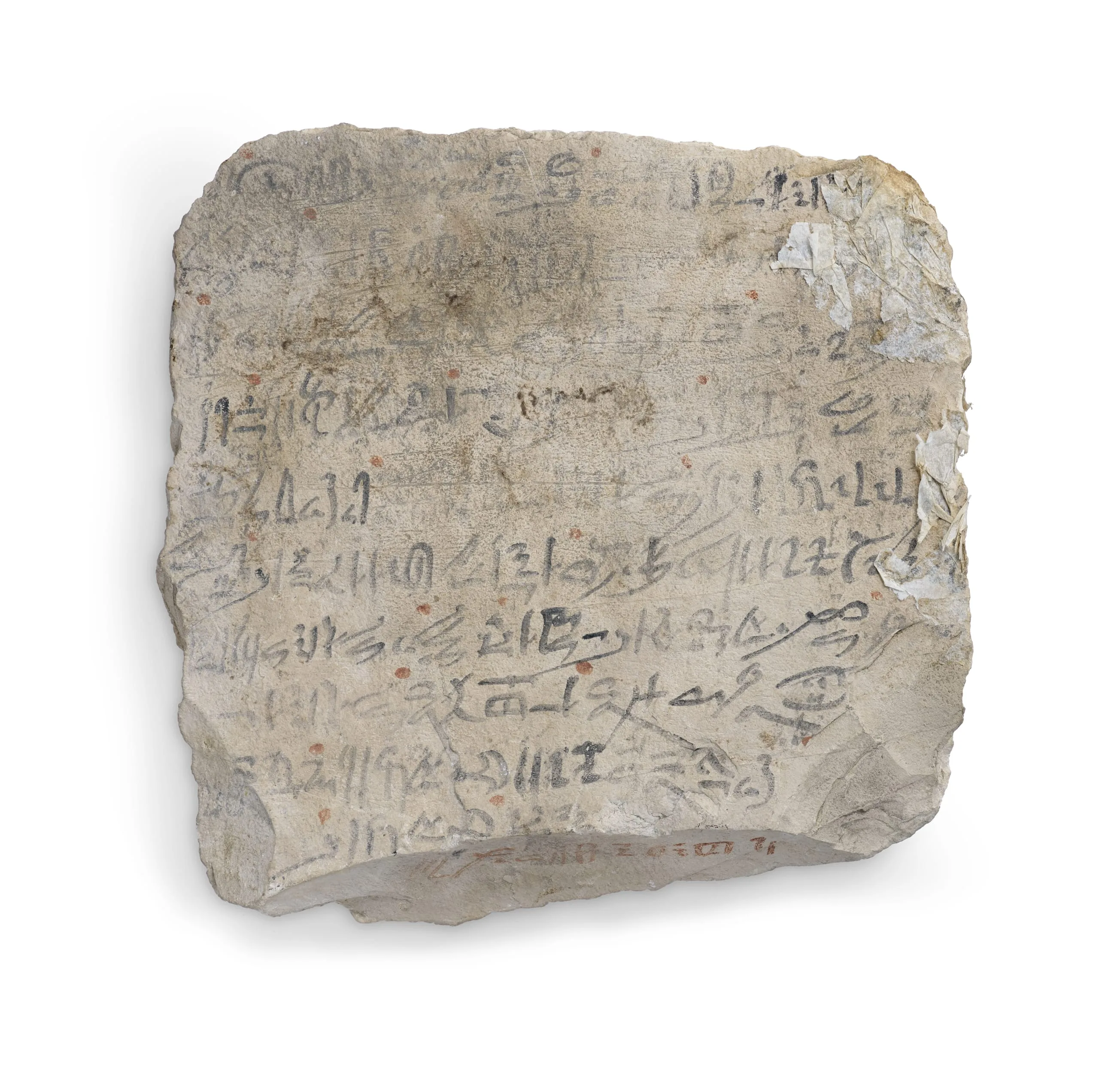
- Ostracon Inscribed with the Opening of the Mouth Ritual
- Date Made
- New Kingdom, 19th-20th dynasty (1292-1077 BCE)
- Medium
- Limestone and pigments
- Dimensions
- 7 1/2 × 7 1/2 × 1/4 in. (19.05 × 19.05 × 0.64 cm)
- Accession Number
- M.80.203.188
- Curatorial Notes
Large limestone flakes (ostraca) were used in ancient Egypt for a variety of written documents—sales receipts, letters, architectural plans, poetry, and religious texts. This medium-large ostracon is inscribed on one side in hieratic Late Egyptian script with text from the sixth chapter of the Opening of the Mouth ritual. This mortuary ceremony was used by priests to animate a statue or a mummy—allowing it to receive offerings and to breathe—and to restore its vision. Officiating priests used implements such as a pesesh-kef blade (AC1998.94.1), touching it to various body parts of the mummy or statue. The inscription is composed of eleven lines in black ink separated throughout by red verse points. The text refers to the deceased’s health, his ear, his heart, and his reproductive organs, indicating that the ritual takes place within a “hall of gold.”
Provenance: Collection of Georges Anastase Michaelidis (Cairo 1900-1973). Carl W. Thomas, gifted 1980 to; LACMA.
Publication
Goedicke, Hans, and Edward F. Wente. Ostraka Michaelides. Wiesbaden: Otto Harrassowitz, 1962, #67, pl. XXVI.