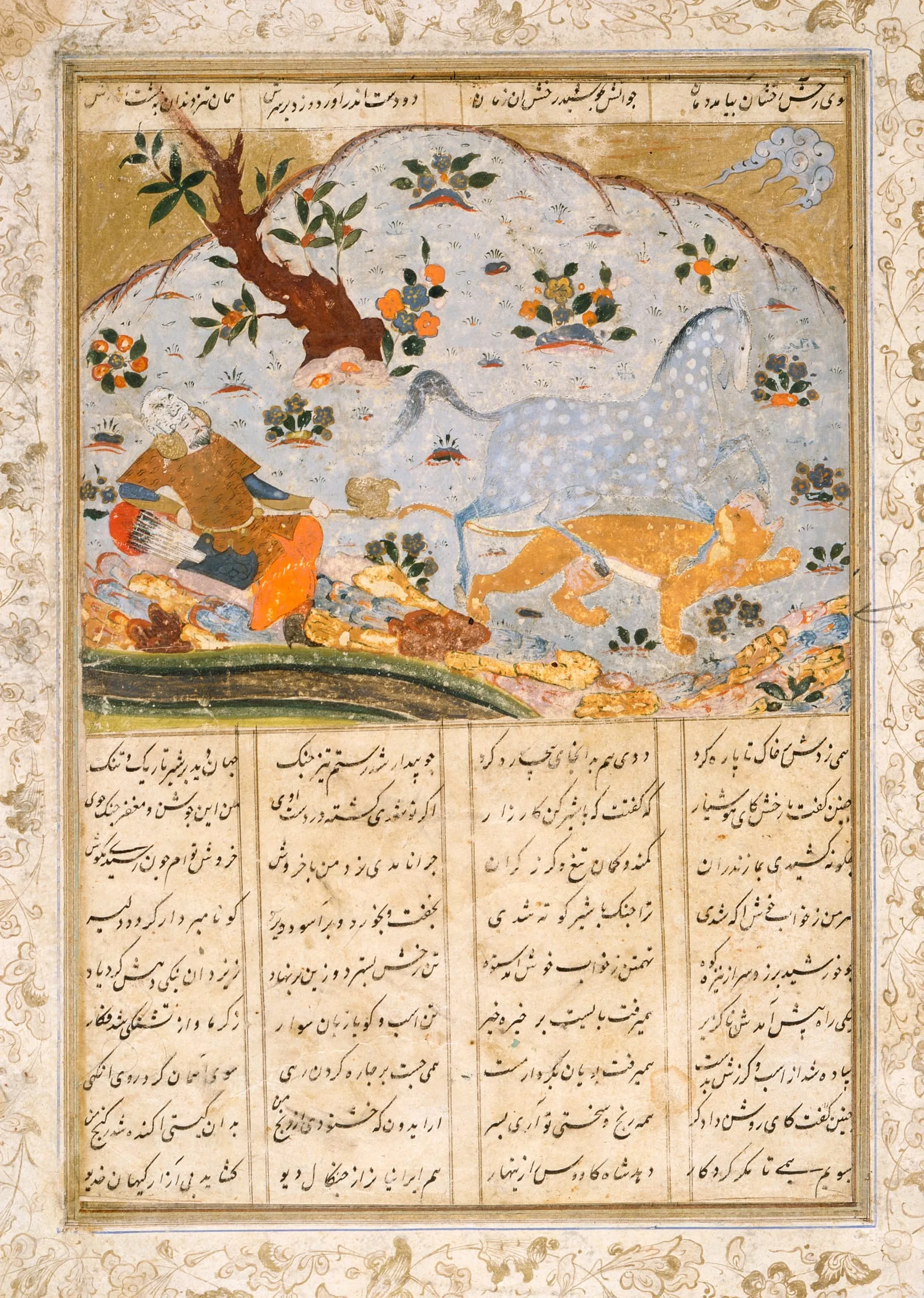
The Shahnama (Book of Kings), the Iranian national epic, was composed by Firdawsi and completed around 1010. It chronicles in verse the legendary and historical kings and heroes of the Persian Empire up to the Arab Muslim conquest in the seventh century. Illustrated manuscripts of the text were widely circulated as well as produced throughout the Persian-literate world, including South Asia, where it was admired at the Muslim courts for its grandeur and association with Persian kingship traditions. Indian copies of the Shahnama first appeared in the fourteenth century, increasing in production during the fifteenth century.
This folio depicts Rustam, the Shahnama’s greatest hero, during his first labor in the Haft Khan-i Rustam (Rustam’s Seven Labors). Clad in his iconic tiger-skin jacket and leopard-headed helmet, Rustam dozes in the lion’s lair, protected by his loyal horse Rakhsh, who kills the attacking lion. Stylistically, the painting aligns with other Shahnama illustrations attributed to sultanate India, including the use of bright orange pigment. As is typical, it also demonstrates a close relationship with the Shiraz style of painting, as in the high horizon, golden sky with scalloped cloud band, and mountainous landscape with clusters of flowers. The later gold-decorated border and, on the reverse, an attached page of text that appears to be from the same manuscript, suggest that this folio was added to an album.
2025