LACMA

ShopMembershipMyLACMATickets
LACMA
Los Angeles County Museum of Art
5905 Wilshire Blvd.
Los Angeles, CA 90036
info@lacma.org
(323) 857-6000
Sign up to receive emails
Subscribe
© Museum Associates 2025

Museum Hours

Monday

11 am–6 pm

Tuesday

11 am–6 pm

Wednesday

Closed

Thursday

11 am–6 pm

Friday

11 am–8 pm

Saturday

10 am–7 pm

Sunday

10 am–7 pm


  • About LACMA
  • Jobs
  • Building LACMA
  • Host An Event
  • Unframed
  • Press
  • FAQs
  • Log in to MyLACMA
  • Privacy Policy
© Museum Associates 2025
Collections

Unknown
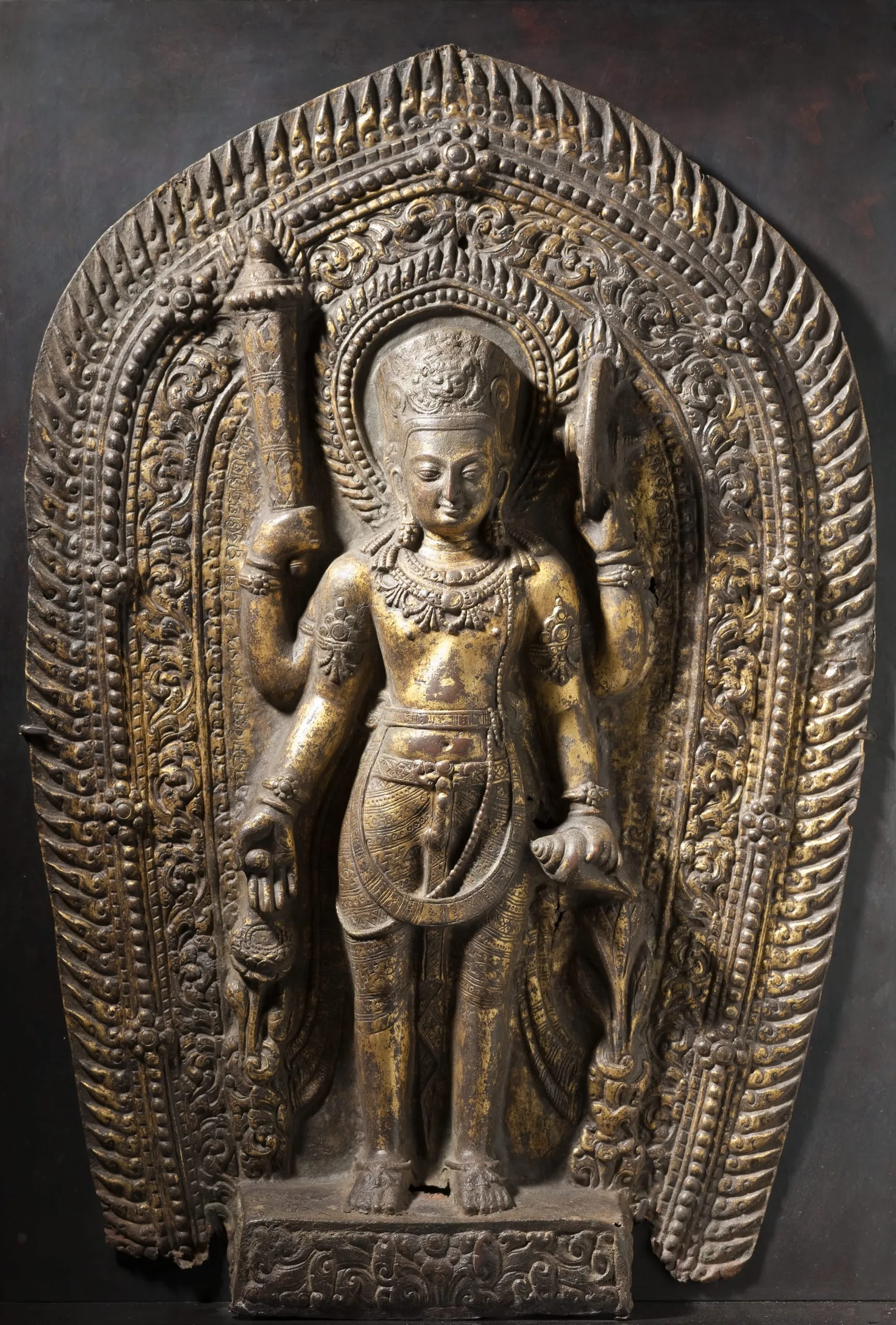
The Hindu God Vishnudated 1180

Not on view
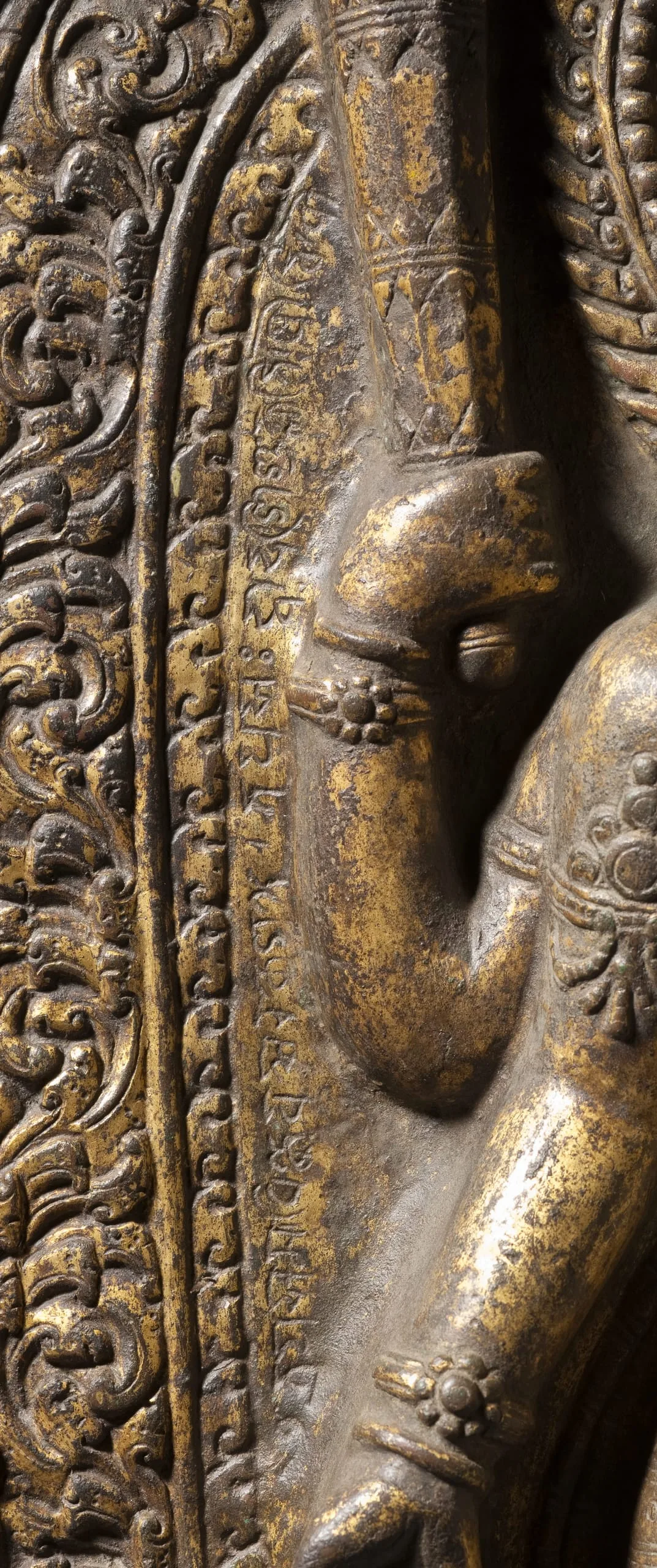
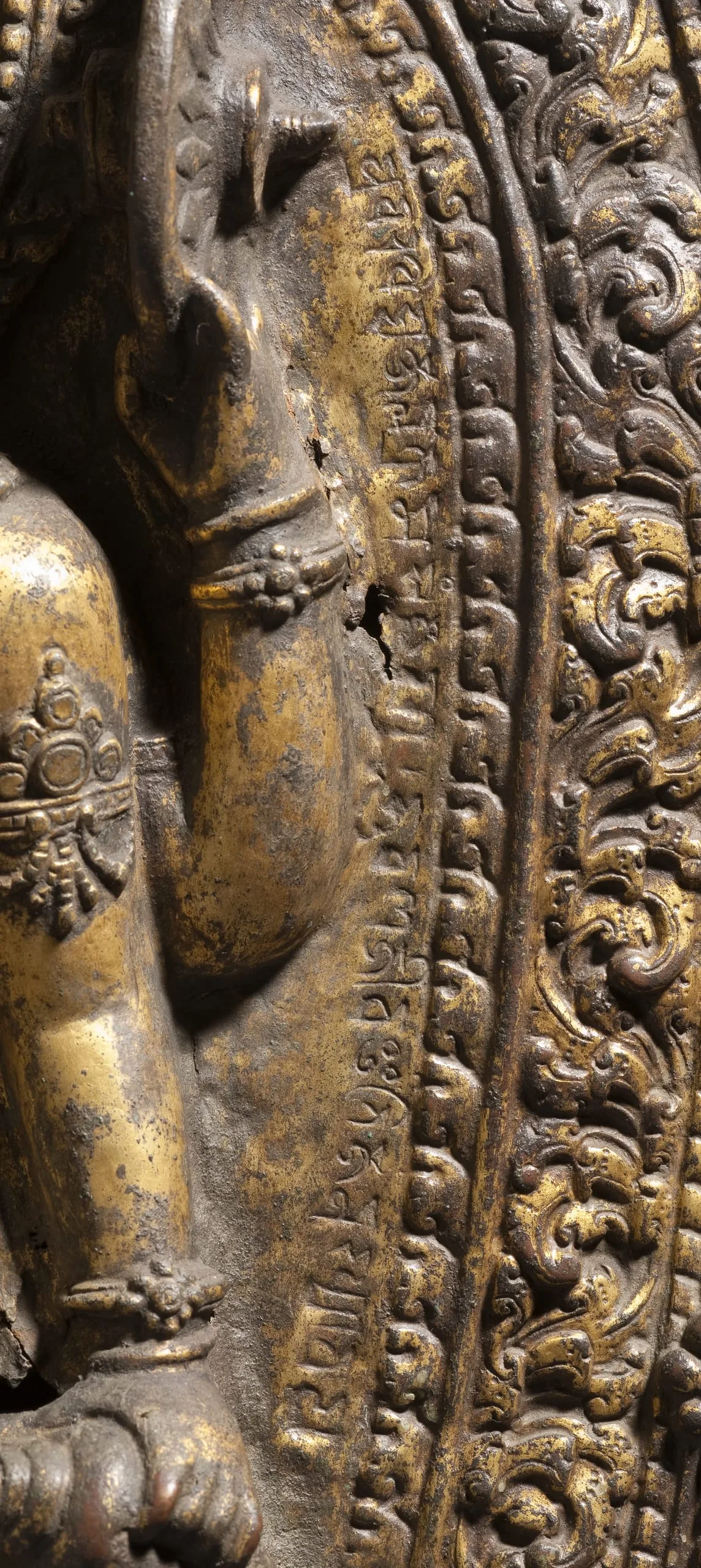
Bronze relief sculpture of a standing four-armed deity within an ornate arched frame, with gold gilding on the figure's torso, jewelry, and layered foliate arch
Close-up of a gilt bronze sculptural relief showing a crowned deity figure in profile against an ornately carved floral aureole border, with a vertical column of Indic script inscription; traces of gold gilding over dark patinated surface.
Close-up of a gilt bronze sculpture showing a deity figure in profile with ornate jewelry, beside an elaborate halo or aureole with scrolling foliate relief and a vertical column of Tibetan or Nepali script inscription.
Artist or Maker
Unknown
Title
The Hindu God Vishnu
Place Made
Nepal
Date Made
dated 1180
Medium
Repoussé gilt copper alloy
Dimensions
18 5/8 x 12 3/8 x 2 1/8 in. (47.3 x 31.43 x 5.39 cm)
Credit Line
Gift of The Ahmanson Foundation
Accession Number
M.80.187
Classification
Sculpture
Collecting Area
South and Southeast Asian Art
Curatorial Notes

This repoussé gilt copper alloy plaque was likely originally a metal sheath for a stone or wooden image (kosha or kavaca) of Vishnu, the Hindu god of preservation. It depicts the deity as nimbate and wearing a tall square crown (kirita mukuta) adorned with a "Face of Glory" (kirttimukha) and the Brahmanical sacred thread (yajnopavita) over his left shoulder. He stands in a stiff, frontal pose (samapada sthanaka). Vishnu has four arms bearing his standard attributes. In his upper right hand, he carries a mace (gada). In his upper left hand, he holds a flaming discus (chakra). In lower left hand, he grasps a conch (shankha). His lower right hand is extended in the gesture of charity (varada mudra) and holds the fruit of knowledge (jñana palam). An open lotus is beneath his lower right hand, while a closed lotus is under his lower left hand. Vishnu is atypically ithyphallic (urdhva linga), which Pratapaditya Pal suggests is because he is a yogi in control of his passions (Pal 1985, p. 95, no. S13). Vishnu is surrounded by a complex flaming aureole (prabhavali).

A devanagari inscription on the aureola’s inner border states, In the year of 300 [1180 CE] on Monday, the twelfth day of the bright fortnight of the month of Magha [January-February], Bhuvana Jiva of the most excellent Vaidya family, for this glory… The inscription continues under the base but is illegible. The inscribed date was formerly read as (Nepal samvat) 103, corresponding to 983 CE (Pal 1985, p. 235, no. S13), but was retranslated by Gautama Vajrachharya (see Ian Alsop, "Problems in Dating Nepalese Metal Sculpture: Three Images of Visnu (corrected)," https://www.asianart.com/articles/visnu/index.html).

See also M.84.124.1 and M.85.125.
Selected Bibliography
  • Reedy, Chandra L. Himalayan Bronzes: Technology, Style and Choices. Newark: University of Delaware Press, 1997.
  • Pal, Pratapaditya; Dehejia, Vidya; Slusser, Mary Shepherd; Fisher, Robert E.; Brown, Robert L. Arts of Asia 15 (6): 68-125 (November- December 1985).
  • Pal, Pratapaditya. Art of Nepal. Los Angeles: Los Angeles County Museum of Art; University of California Press, 1985.