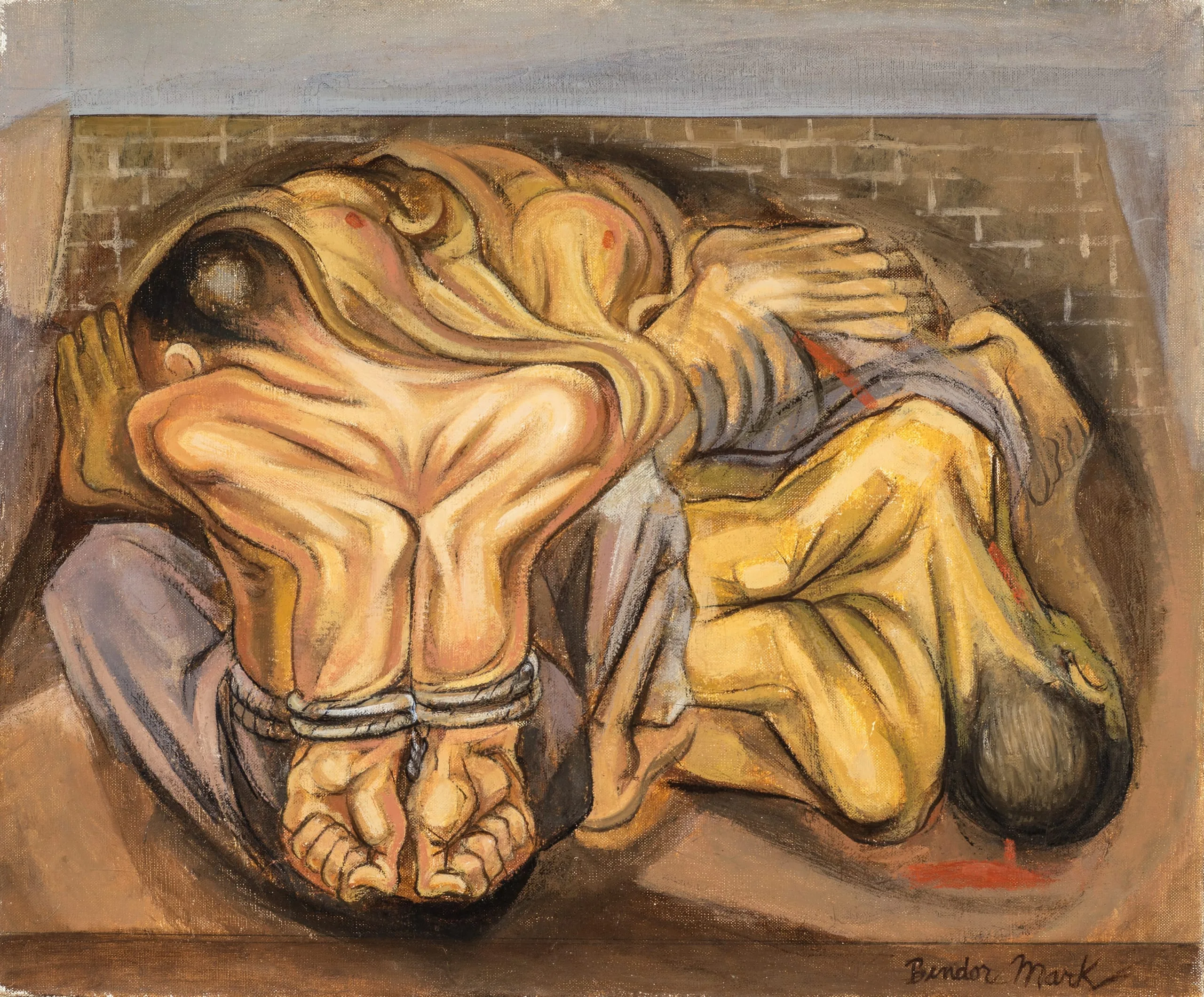
Mark created several paintings expressing his horror and anger over the atrocities inflicted by the Japanese on the Chinese when they invaded the mainland in 1937. The artist read newspaper accounts of the war, and Execution may have been directly inspired by newspaper photographs or motion-picture newsreels. Bound Man, 1939 (Smithsonian American Art Museum, Smithsonian Institution, Washington, D.C.), and Execution are concerned with the brutal killing of defenseless victims and reveal Mark’s spiritual debt to Francisco Goya (1746-1828). Mark conveyed the brutality of murder by his forceful brushstrokes, inspired by the surfaces and thick muscular style of Mexican muralists such as David Alfaro Siqueiros (1896-1974). In Execution the entire image points to the unseen murderer. What appears to be several bodies is actually only one man, who, in the agony of excruciating pain and death, gyrates from side to side until he collapses to the ground. The man’s constricted, bound body has been compressed into the shape of a sack. Human life had become worthless; as if to suggest that the victim has lost his humanity, Mark portrayed him faceless, devoid of any individuality. Such treatment also suggests that Mark intended this image to have universal application, a pictorial condemnation of all inhuman barbarism.