- Title
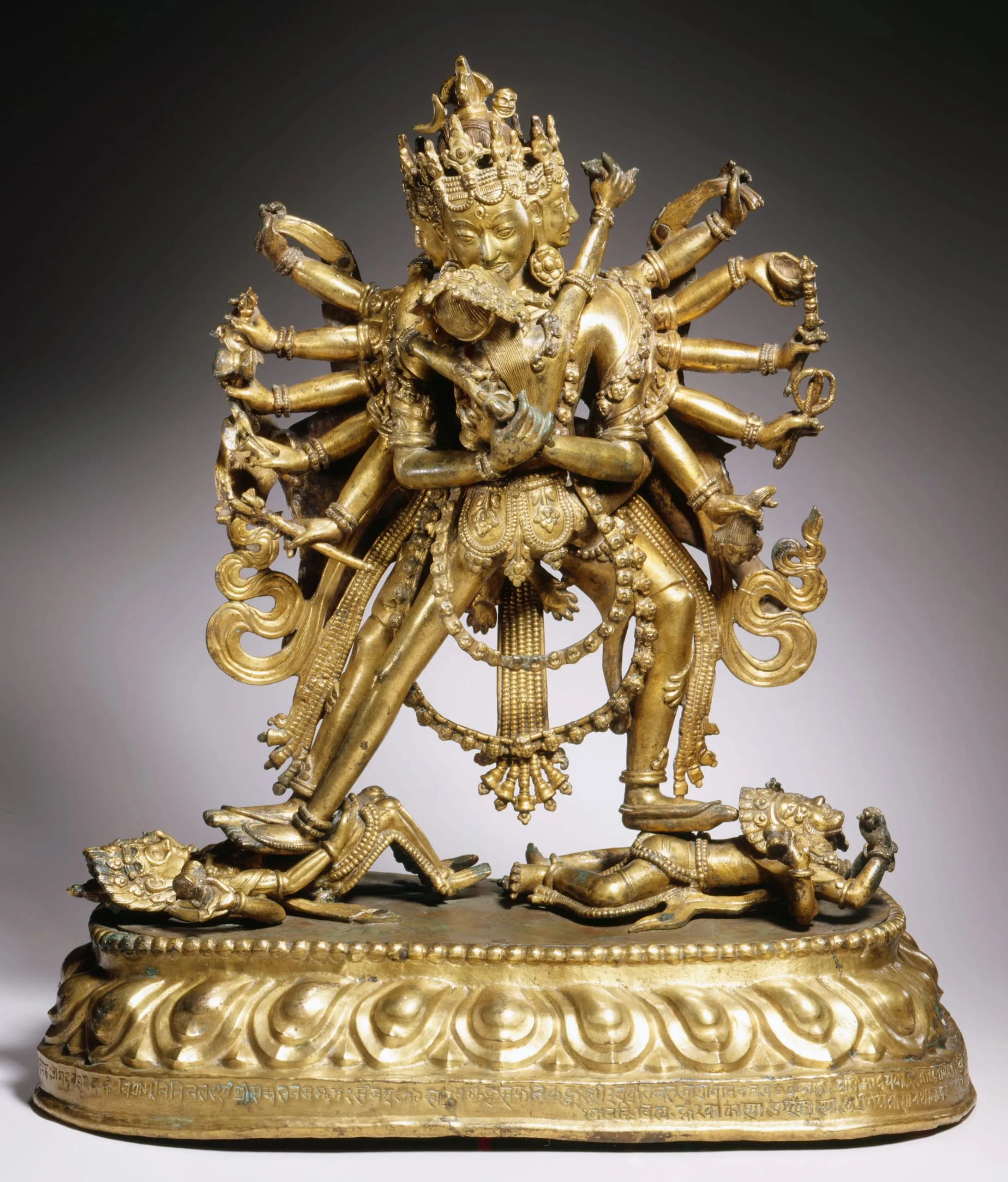
- The Buddhist Deities Chakrasamvara and Vajravarahi
- Date Made
- Dated 1759
- Medium
- Gilt brass
- Dimensions
- 16 1/4 x 14 x 6 1/2 in. (41.28 x 35.56 x 16.51 cm)
- Accession Number
- M.80.110
- Curatorial Notes
This complex sculpture of the Buddhist Vajrayana deities Chakrasamvara (Circle of Bliss) and his consort Vajravarahi (Diamond Sow) perfectly captures the bliss of the enlightened mind. Chakrasamvara is shown with his standard iconography of twelve arms, indicating the twelve-fold chain of causation in the phenomenal world. Vajravarahi blissfully looks up into Chakrasamvara’s face, offering him a skull-cup (kapala) filled with purified ambrosia (amrita) with her left hand, and holding a flaying knife (kartrika), symbolizing the severing of conceptual thought with her right hand. Their dynamic, passionate energy in perfect union is further articulated by their lunging stance (pratyalidha asana) as they dance entwined atop the bodies of the emaciated Kalaratri and the fierce Bhairava. In the traditional Newari iconographic convention, Vajravarahi embraces Chakrasamvara with only her right leg rather than both legs as in the Tibetan fashion. On a conceptual level this dramatic image of Chakrasamvara and his spouse, Vajravarahi symbolizes the union of Wisdom and Compassion. See also M.70.1.3.
Sanskrit and corrupt Newari inscriptions are inscribed around the bottom of the lotus base. The Sanskrit inscription contains a eulogy in honor of Chakrasamvara and the image’s consecration date in the bright half of the month of Phalguna (March–April) in 1759 (N.S. 879). The Newari inscription records several donor names and the goddesses Kakasya (raven faced) and Ulukasya (owl faced).
- Selected Bibliography
- Pal, Pratapaditya. Art of Nepal. Los Angeles: Los Angeles County Museum of Art; University of California Press, 1985.
- Huntington, John C. and Dina Bangdel. The Circle of Bliss: Buddhist Meditational Art. Columbus: The Columbus Museum of Art; Chicago: Serindia Publications, 2003.
- Reedy, Chandra L. Himalayan Bronzes: Technology, Style and Choices. Newark: University of Delaware Press, 1997.