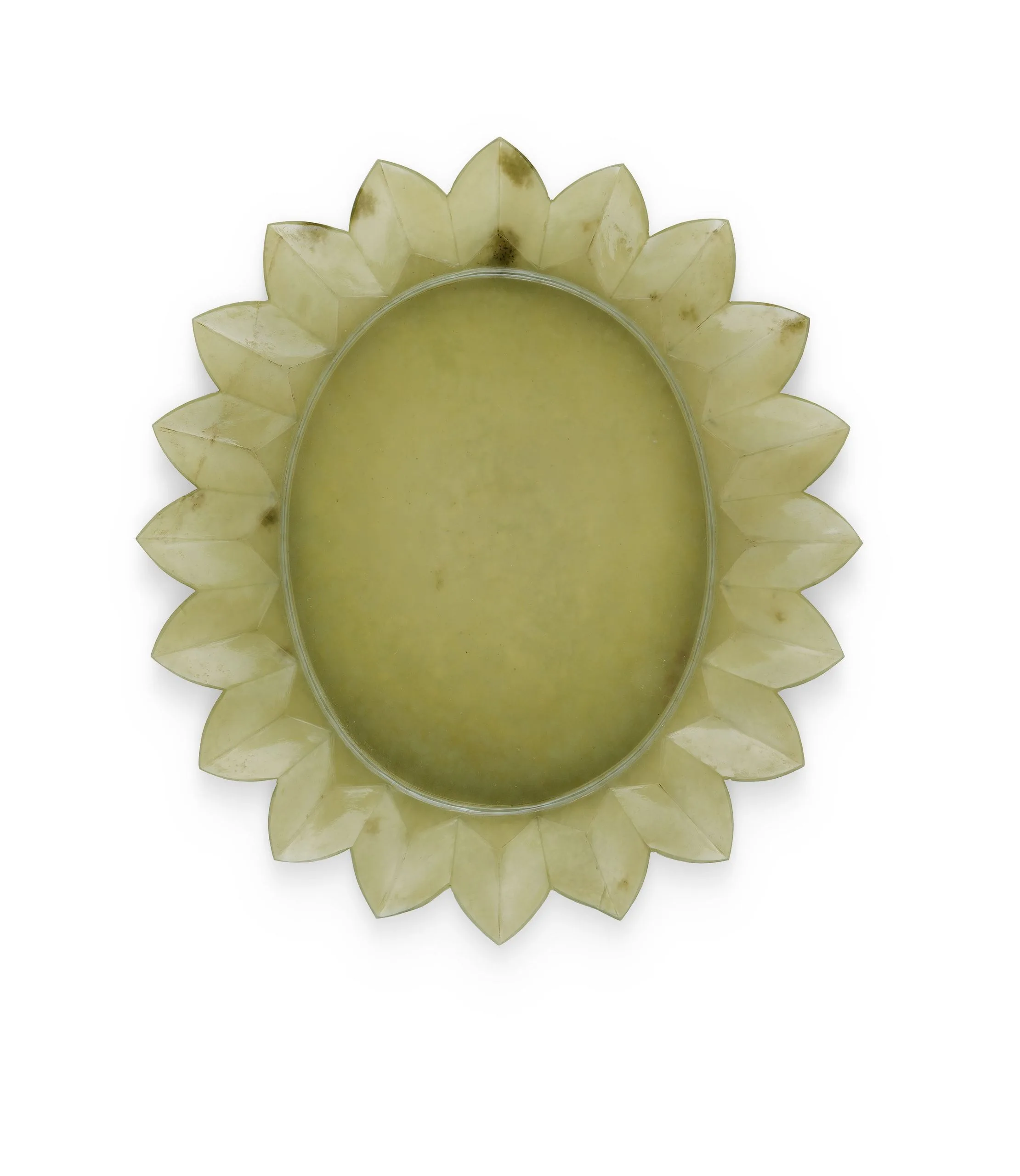
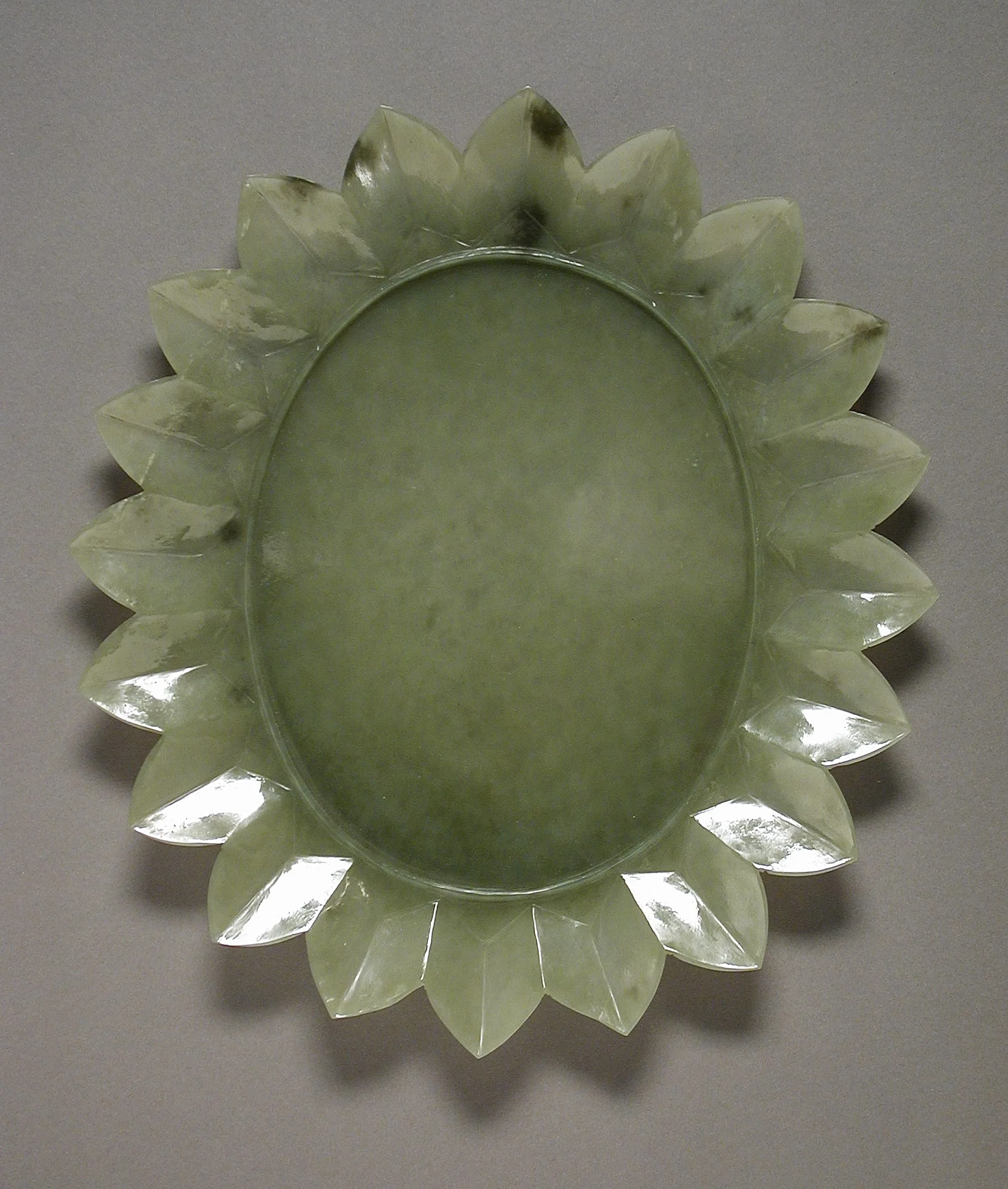
Deftly fashioned out of light green nephrite jade, this shallow plate for serving delicacies has an unadorned flat ovular center demarcated by a raised ring. The sophisticated outer border rises from horizontal triangular interstices to an accordion-fold pleated edge of pointed lotus petals.
The eggshell thinness of the plate suggests it was made in the late 18th century, when the Chinese Emperor Qianlong (r. 1735-96) praised contemporaneous Mughal jades for their technical expertise and amazing thinness that he likened to the transparent wings of a cicada.
Mughal jade serving plates and trays came in a variety of shapes, including round, oval, rectangular, triangular, and in the form of a leaf. Their edges are frequently scalloped, but rarely pleated like the LACMA plate. They were created both with or without feet. A pleated plate closely related to LACMA’s example is in the Salar Jung Museum, Hyderabad (XLIX-135). Made of white jade rather than green nephrite, it is embellished on the major axis of the ellipse with opposing handles in the form of kissing fish. The LACMA plate exhibits some minor damage in one of the areas corresponding to where the Hyderabad plate’s handles are connected to the body, so it is conceivable that the LACMA plate was originally enriched with similar handles that were lost over time. The remaining three points of correspondence are undamaged, however, so either those three broken edges were ground flush or the handles never existed.