- Title
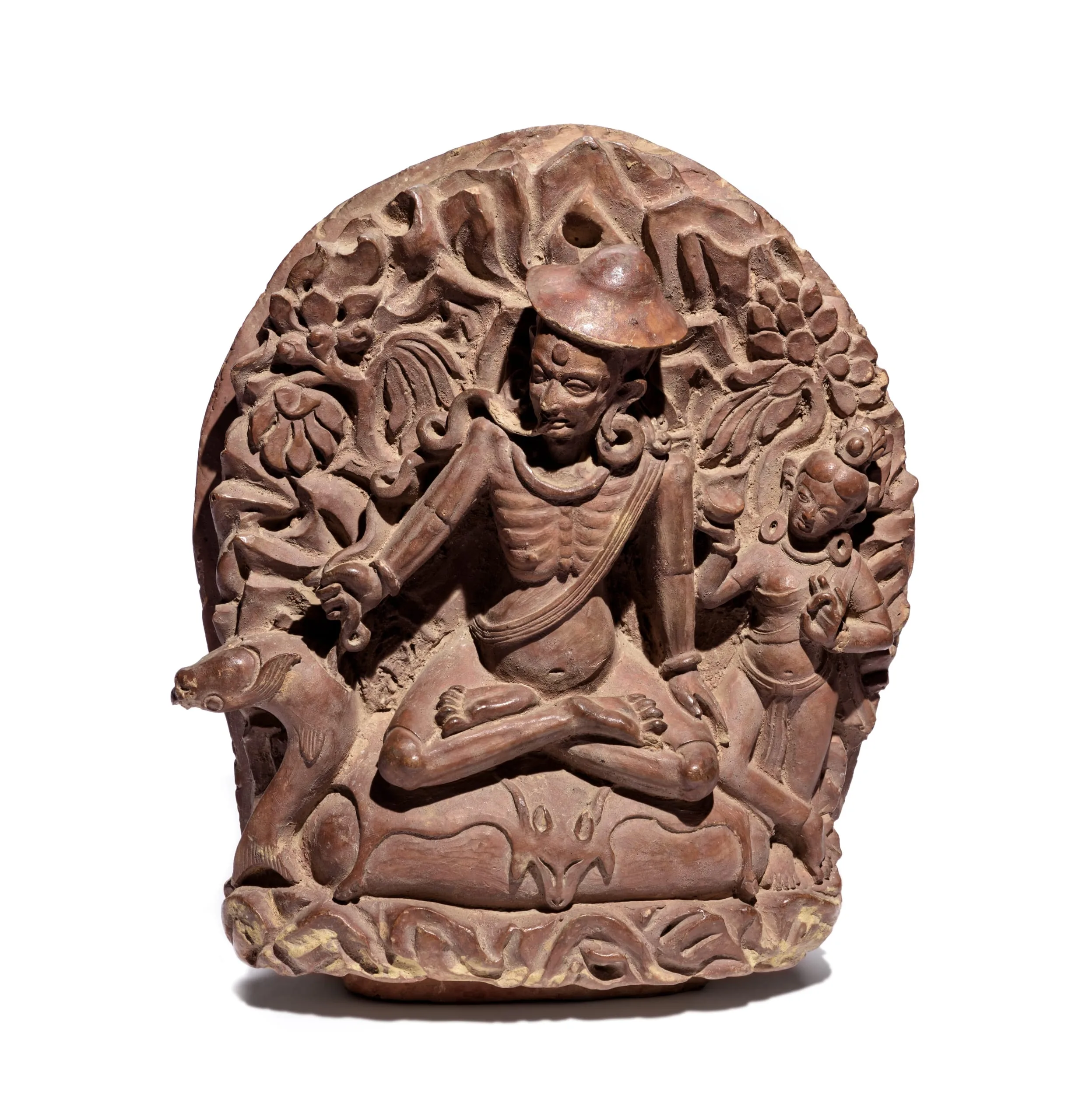
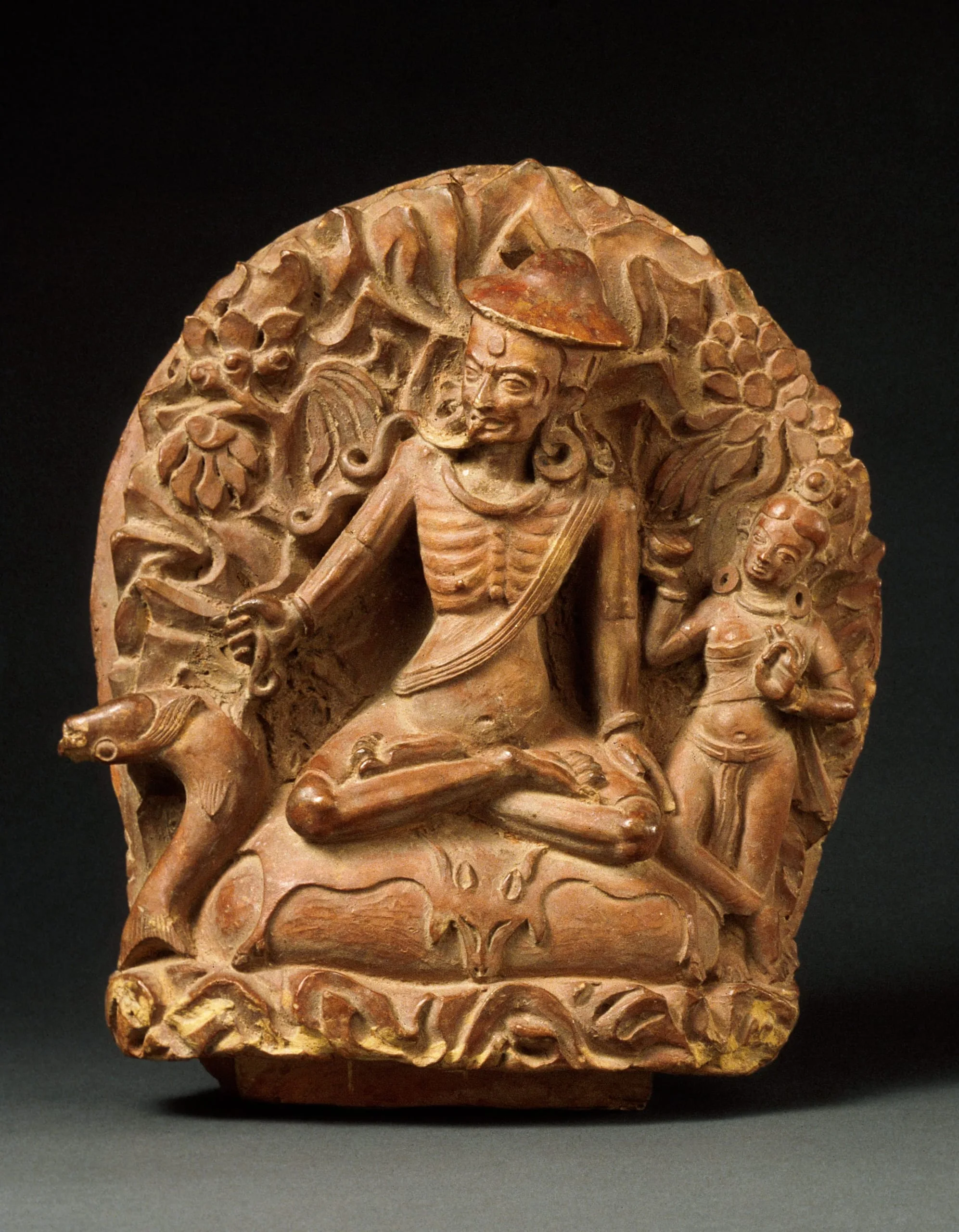
- The Mahasiddha (Great Adept) Luipa
- Date Made
- early 17th century
- Medium
- Earthenware
- Dimensions
- 8 3/4 x 7 1/2 x 2 5/8 in (22.2 x 19 x 6.7 cm)
- Accession Number
- M.80.97.1
- Curatorial Notes
The Mahasiddha (Great Adept) Luipa (also known as Luiypa or Luipada, circa 9th or 10th century) was an enlightened Vajrayana Buddhist master and composer of religious texts. He was a great adept who gave up his life of royalty in Eastern India to live as a wandering mendicant. After realizing that true enlightenment could only be attained by relinquishing ideas of what was and was not suitable to eat, he took up residence on a riverbank of the Ganges River and forced himself to subsist on fish intestines discarded by the fisherwomen. Dubbed Luipa or “Fish Eater” by a fisherwoman, he eventually came to experience fish guts as no different from divine ambrosia and thus attained enlightenment.
In this animated earthenware plaque, Luipa is shown in the act of eating a fish intestine that twists and curls along his right arm while his hand pulls the entrails from a large fish to his right. He is emaciated, wears a Tibetan-style hat, has a meditation band (yoga banda) draped over his left shoulder, and sits in the meditation posture (padma asana) on an antelope skin. On his left, is likely the female tantric practitioner (dakini) who offered him a cup of rotten fish to overcome his dualistic notions of suitability and unsuitability.
This plaque may have originally been part of a series of mahasiddhas commissioned by a Newari Buddhist who was particularly influenced by Tibetan Buddhism.
- Selected Bibliography
- Pal, Pratapaditya; Dehejia, Vidya; Slusser, Mary Shepherd; Fisher, Robert E.; Brown, Robert L. Arts of Asia 15 (6): 68-125 (November- December 1985).
- Pal, Pratapaditya. Art of Nepal. Los Angeles: Los Angeles County Museum of Art; University of California Press, 1985.
- Huntington, John C. and Dina Bangdel. The Circle of Bliss: Buddhist Meditational Art. Columbus: The Columbus Museum of Art; Chicago: Serindia Publications, 2003.
- Little, Stephen, Tushara Bindu Gude, Karina Romero Blanco, Silvia Seligson, Marco Antonio Karam. Las Huellas de Buda. Ciudad de México : Instituto Nacional de Antropología e Historia, 2018.
- Little, Stephen, and Tushara Bindu Gude. Realms of the Dharma: Buddhist Art across Asia. Los Angeles: Los Angeles County Museum of Art, 2025.