- Title
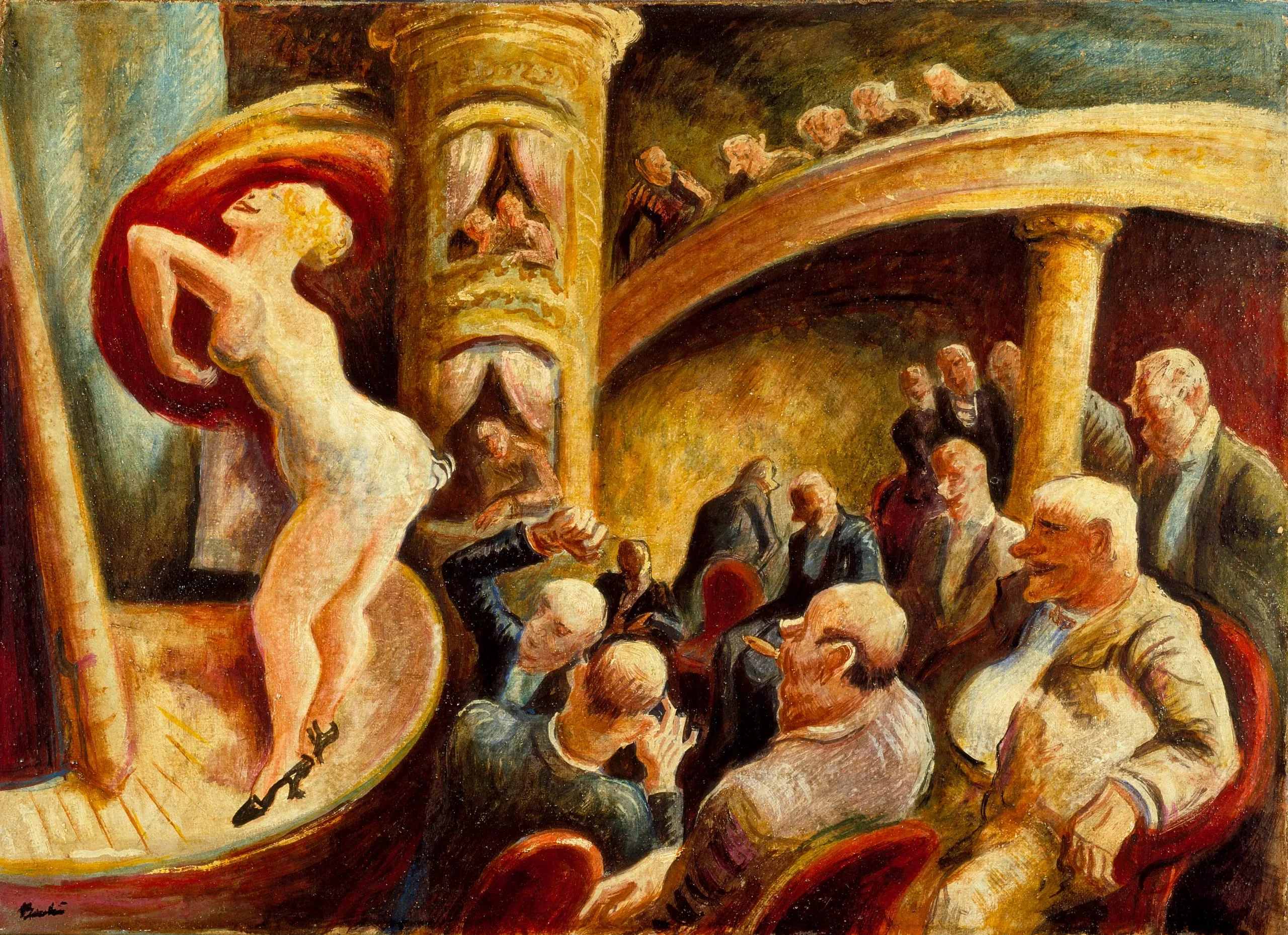
- Burlesque
- Date Made
- circa 1930
- Medium
- Tempera with oil glazes on canvas, mounted on pressboard
- Dimensions
- 18 3/16 x 25 1/8 in. (46.20 x 63.82 cm)
- Accession Number
- M.80.104
- Provenance
Crosby Gaige, New York, to 1932 § George Gershwin, 1932 § Mr. and Mrs. Ira Gershwin (by descent), Beverly Hills, Calif., 1952-80, as Burlesque Theater.
Crosby Gaige (1882–1949), New York, sold 1932 to; George Gershwin (1898–1937), by descent to his brother; Ira Gershwin (1896–1983) and Leonore Gershwin (née Strunsky, 1900–1991), Beverly Hills, as
Burlesque Theater; gifted 1980 to; LACMA
- Selected Bibliography
- Fort, Ilene Susan and Michael Quick. American Art: a Catalogue of the Los Angeles County Museum of Art Collection. Los Angeles: Los Angeles County Museum of Art, 1991.
- Dini, Jane, ed. Dance: American Art, 1830-1960. Detroit: Detroit Institute of Arts, 2016.
- Copyright
- © T.H. and R.P. Benton Trusts/Licensed by Artists Rights Society (ARS), New York