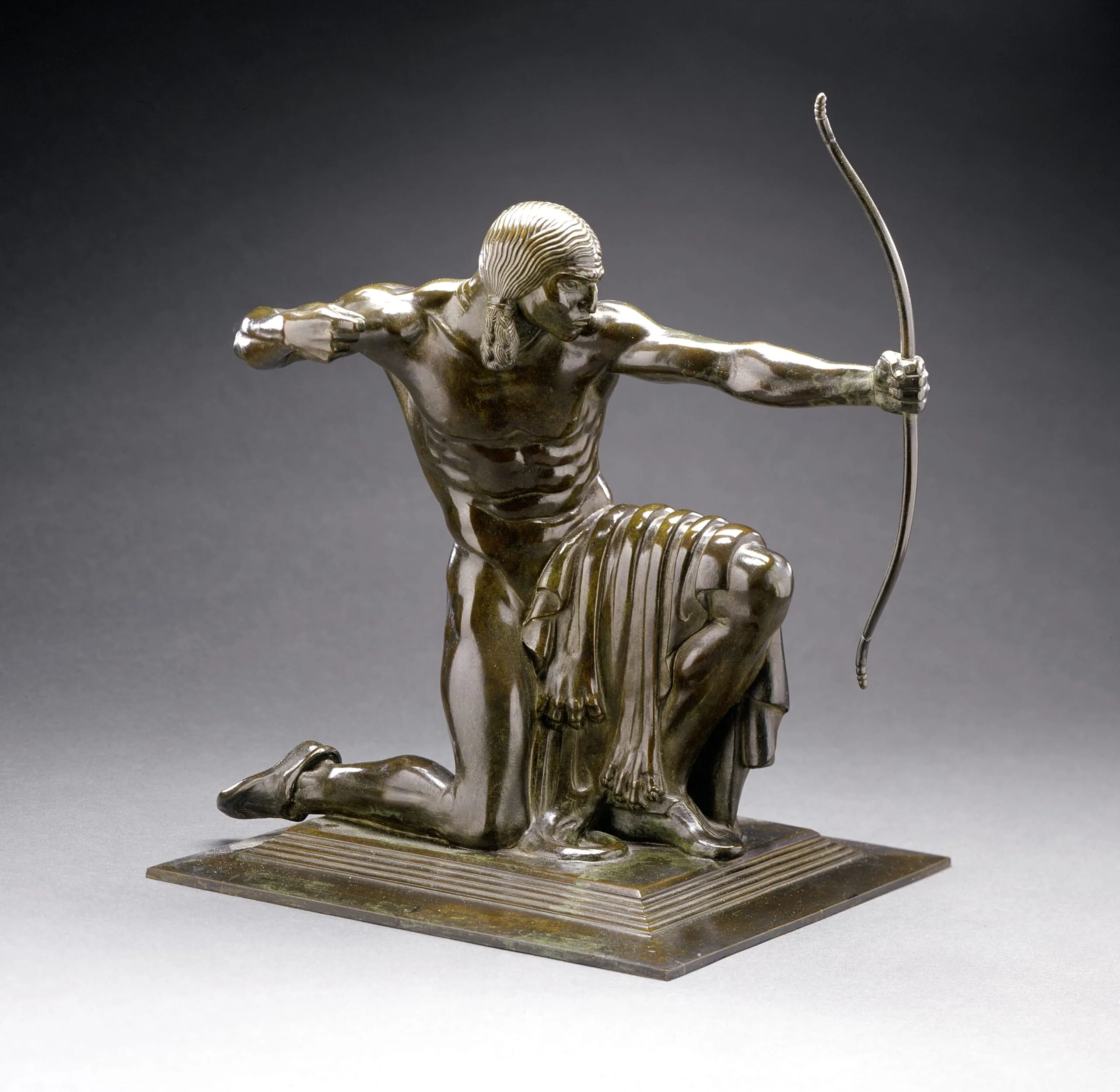
Although Indian apparently was sold separately, it and Pronghorn Antelope, 1914, were designed as companion pieces (examples of both in Saint Louis Art Museum and Smithsonian American Art Museum, Smithsonian Institution, Washington, D.C.). Manship originally created the pair of sculptures for his own use, to occupy places at either end of a mantlepiece in his apartment in New York.
The antelope’s side is pierced by the arrow, in low relief, that has just left the Indian’s bow. The release of tension in the bow is answered by the tensing of the animal’s body in pain and surprise; the pair of sculptures relate to each other across distance in terms of sequence and causeand-effect. Formally they offer a contrast between the heavy, stable, and angular body of the Indian and the light, unstable, and curving form of the antelope.
Like the antelope and like many of Man, ship’s earlier sculptures, Indian is relatively flat and meant to be viewed principally from one side. The sculptor stated that his primary objective was to create decorative arrangements of form. The strong silhouette allowed him to develop long, elegant contour lines and to achieve contrast and balance of form and space, both within each figure and between the two. While at the American Academy in Rome he had developed a great admiration for the formal qualities of archaic Greek sculpture, as well as Gothic and East Indian sculpture. Although his subject is a Native American, Manship developed it in terms of Greek models in the way the simple, clear form of the man’s body is set off by the areas of stylized, decorative detail in the hair and in the drapery. Although it must be the skin of a wild beast, the flat folds and meandering edge of the drapery emulate Greek examples. The essential quality of Manship’s sculpture is that it formalizes nature to achieve a pleasing, decorative effect in which rich patterns balance austere purity of outline. Manship was one of the first American sculptors to reject the Rodinesque style of conspicuous modeling, seen in the work of ARTHUR PUTNAM, for example. There are no accidents of modeling in his smooth, compact, very carefully calculated, and exquisitely adjusted forms.
The statuette was cast by Roman Bronze Works, New York, in an edition of fifteen (see Murtha, Manship, p. 152, for partial list of locations), and a unique example of heroic size was made in 1917, originally for the garden of Herbert Pratt, Glen Cove, N.Y.