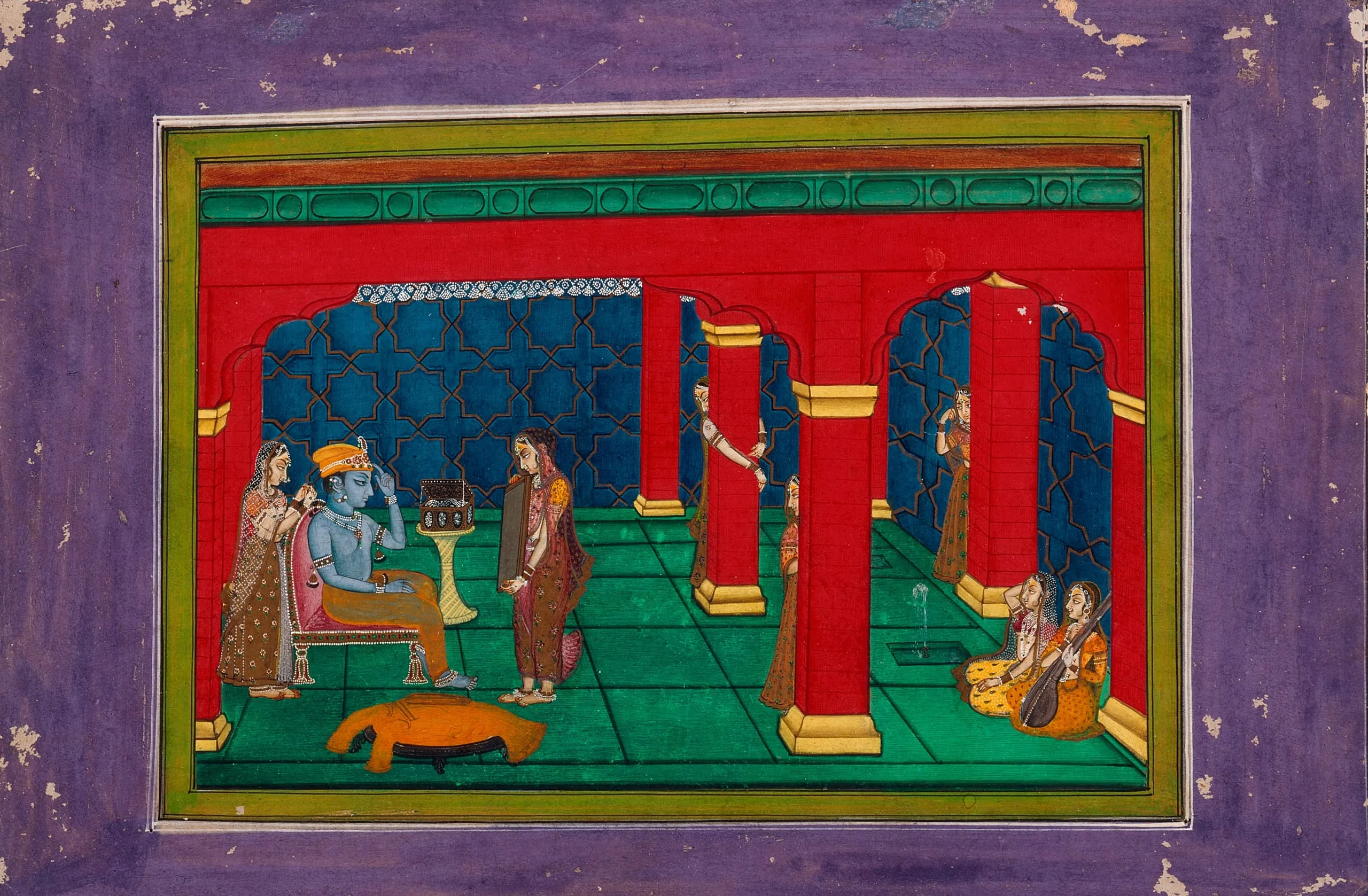
This richly painted ceremonial scene exemplifies the loving dressing and adornment (shringara) that is being performed for Krishna by his devoted servitors as an act of ritualistic service (seva) in the Pushtimarg Sampradaya (Path of Nourishing Spiritual Lineage) founded by Vallabhacharya (1479–1530) and centered in Nathdwara. Images portraying a relatable intimate moment, like the LACMA painting, help Krishna’s devotees experience a sense of sweet personal devotion (madhurya bhava) to their Lord.
Seated on an ornate low throne in a palace chamber, the blue-skinned Krishna raises his left hand to his turban (pagdi) to adjust his bejeweled feather plume turban ornament (jigha) and horizontal tripartite ornament (sarpati). He is richly ornamented with golden jewelry inlaid with pearls, emeralds, and rubies. He wears a saffron-orange dhoti that matches his turban and his upper garment draped on a nearby footstool. A young female attendant (manjari [flower bud]) ties the strings of his turban ornaments. Another handmaiden holds a mirror so Krishna can admire his reflection. Beside him is a chic contemporaneous tepoy (tipoi) side table with a turned baluster stem and flared circular foot. It supports an open jewelry casket (shringar-dan) filled with dazzling ornaments. Modeled upon contemporaneous teak or sandalwood caskets featuring intricate carving (see M.2012.63), it is inlaid with simulated mother-of-pearl floral motifs in ebony cartouches. Three more handmaidens peep shyly at the divine lord from behind columns. In the lower right corner beside a small fountain, a female singer and tanpura player entertain him.
An analogous devotional portrait of Krishna combing Radha’s hair while a maiden holds a mirror for them is in Amit Ambalal, Krishna as Shrinathji: Rajasthani Paintings from Nathdvara (Ahmedabad: Mapin Publishing, 1987), p. 130.