- Title
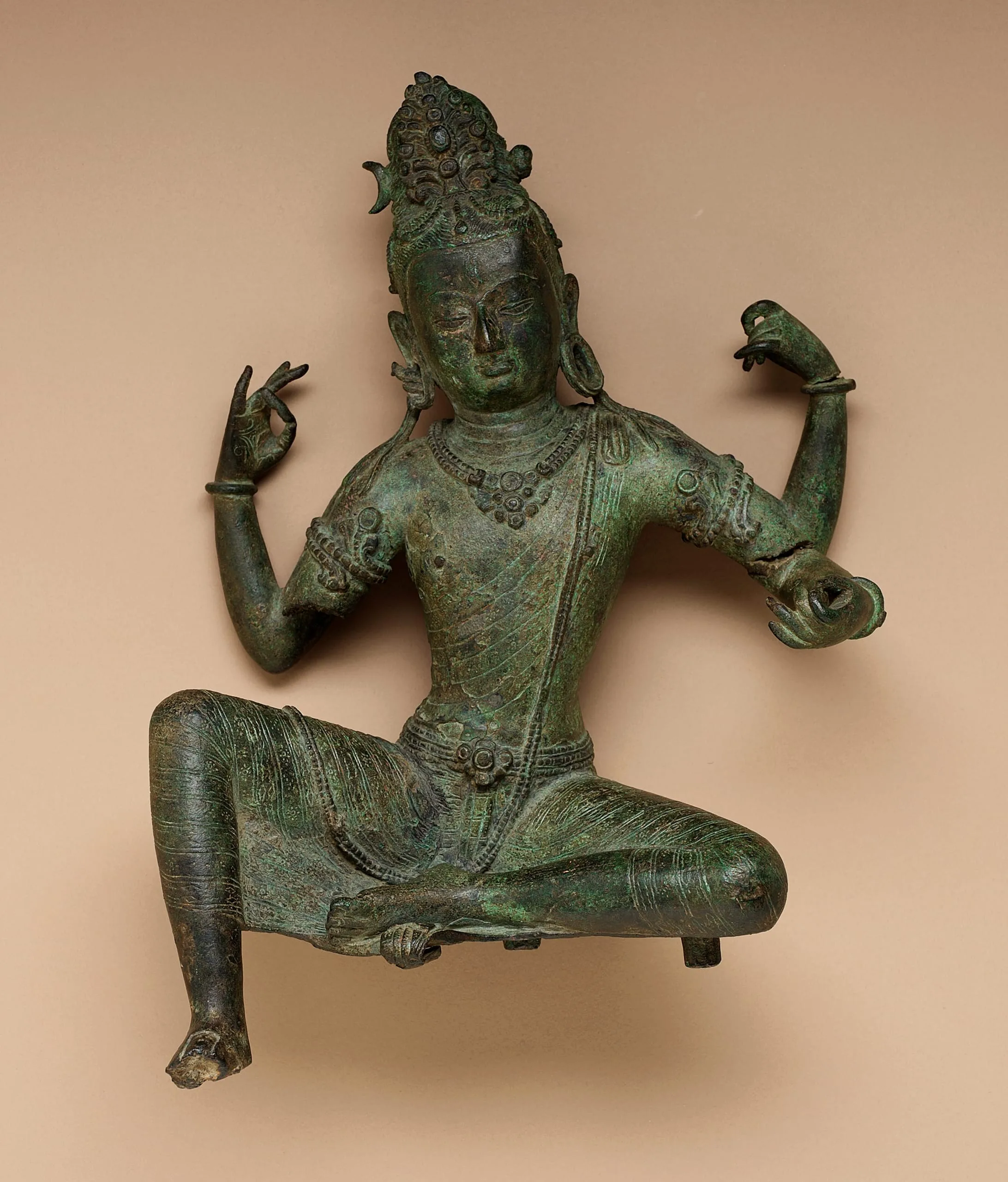
- The Hindu God Shiva, From an Uma-Maheshvara composition
- Date Made
- 11th century
- Medium
- Copper alloy
- Dimensions
- 15 1/2 x 12 x 6 1/2 in. (39.37 x 30.48 x 16.51 cm)
- Accession Number
- M.80.6.1
- Curatorial Notes
One of the most characteristic Nepalese representations of the Hindu god Shiva is his iconic form as Maheshvara (The Great Lord) seated regally in lalita asana with his arm around his consort Uma (known also as Parvati). Although the divine pair is often depicted in a single bronze (copper alloy) sculpture, this solid-cast image of Shiva was made separately, perhaps due to its substantial size. A now-lost image of Uma would have been originally placed beside Shiva so as to appear that she was leaning sensuously against her beloved while he caressed her breast with his lower left hand (see M.81.23). A closely comparable Nepalese image of Uma is now in the Metropolitan Museum of Art, New York (1987.142.327). A physical examination was conducted in 2004 to determine if the New York Uma was the original Uma for the LACMA Shiva, but their respective sizes do not match.
Shiva holds his upper right hand in the gesture of teaching (vitarka mudra). His upper left hand likely once held his trident attribute.
- Selected Bibliography
- Pal, Pratapaditya. Art of Nepal. Los Angeles: Los Angeles County Museum of Art; University of California Press, 1985.
- Rosenfield, John. The Arts of India and Nepal: The Nasli and Alice Heeramaneck Collection. Boston: Museum of Fine Arts, Boston, 1966.
- Reedy, Chandra L. Himalayan Bronzes: Technology, Style and Choices. Newark: University of Delaware Press, 1997.
- Pal, Pratapaditya; Dehejia, Vidya; Slusser, Mary Shepherd; Fisher, Robert E.; Brown, Robert L. Arts of Asia 15 (6): 68-125 (November- December 1985).