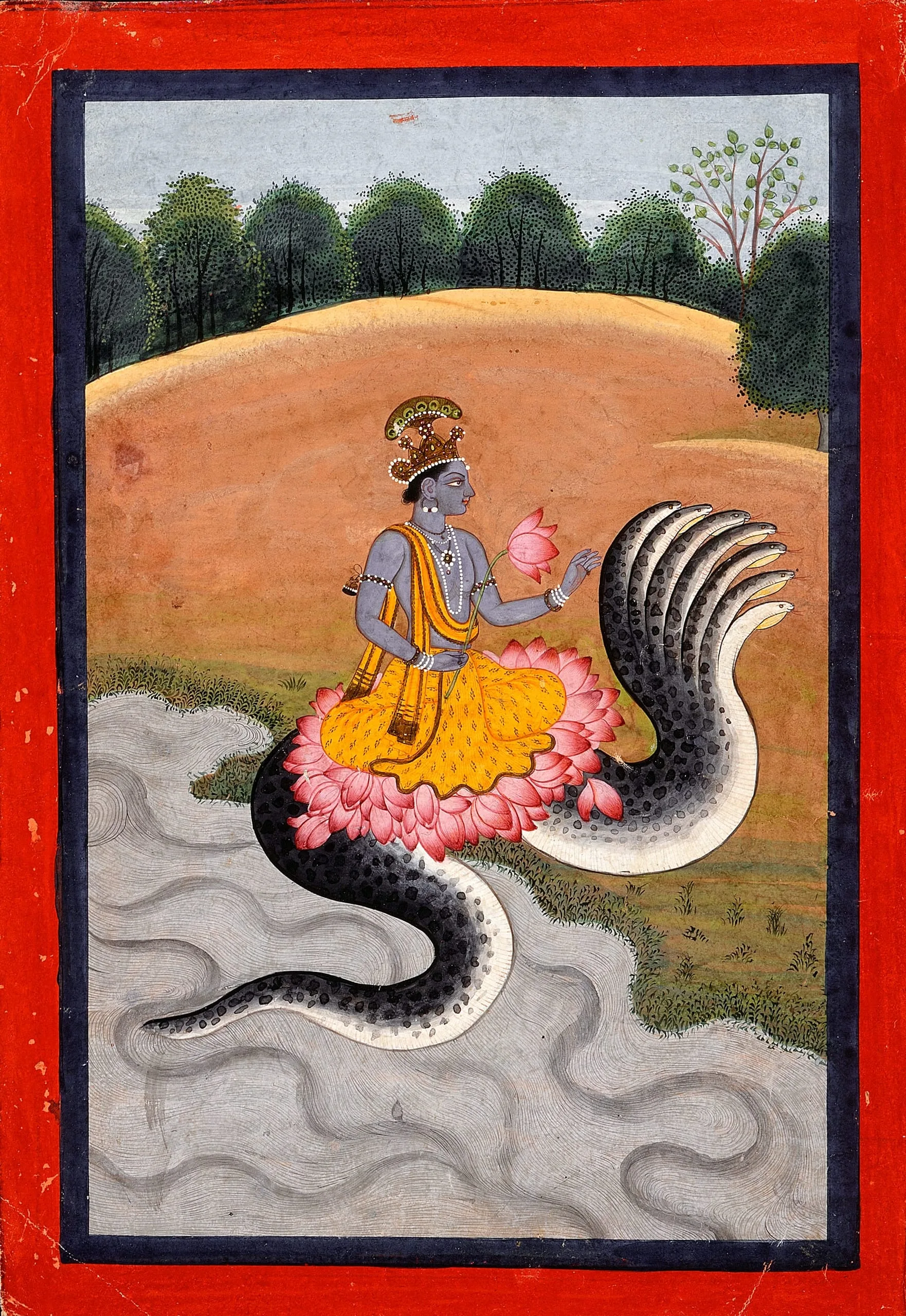
Kalinga Ragaputra is the fifth son of Dipak Raga in the variant ragamala (garland of melodies) classification system known as Meshakarna’s system (developed by Meshakarna, a court priest from Rewa, Madhya Pradesh, in his Ragamala of 1570), which was followed in Pahari ragamalas. Meshakarna’s system has six males (ragas), each of whom who has five or six wives (raginis) and eight or nine sons (ragaputras). Meshakarna compares the melodies to a sound in nature or a human activity. Kalinga Ragaputra is likened to the sound of a murmur of a crowd and envisioned as a white-skinned man in a colorful garment, chewing betel nut quids (pan) and carrying a sword and dagger. In this and commonly in other Pahari ragamalas, however, the melody is personified as Krishna riding on the serpent Kaliya, who terrorized villagers living by the Yamuna River in present-day Uttar Pradesh. For example, see a Kalinga Ragaputra attributed to Bilaspur, Himachal Pradesh, circa 1710 in the San Diego Museum of Art (1990.1173).
Here, the blue-skinned Krishna with his distinctive peacock feather crown and customary yellow garb is seated on a lotus pedestal on the back of the seven-headed cobra Kaliya rising out of the Yamuna River. He holds a lotus blossom in his right hand and his left hand is held in a gesture similar to ‘fear-not’ (abhaya mudra).
This folio from a dispersed series relates stylistically to an extensive Kangra ragamala series in the National Museum, New Delhi (eighty folios bought in 1954).