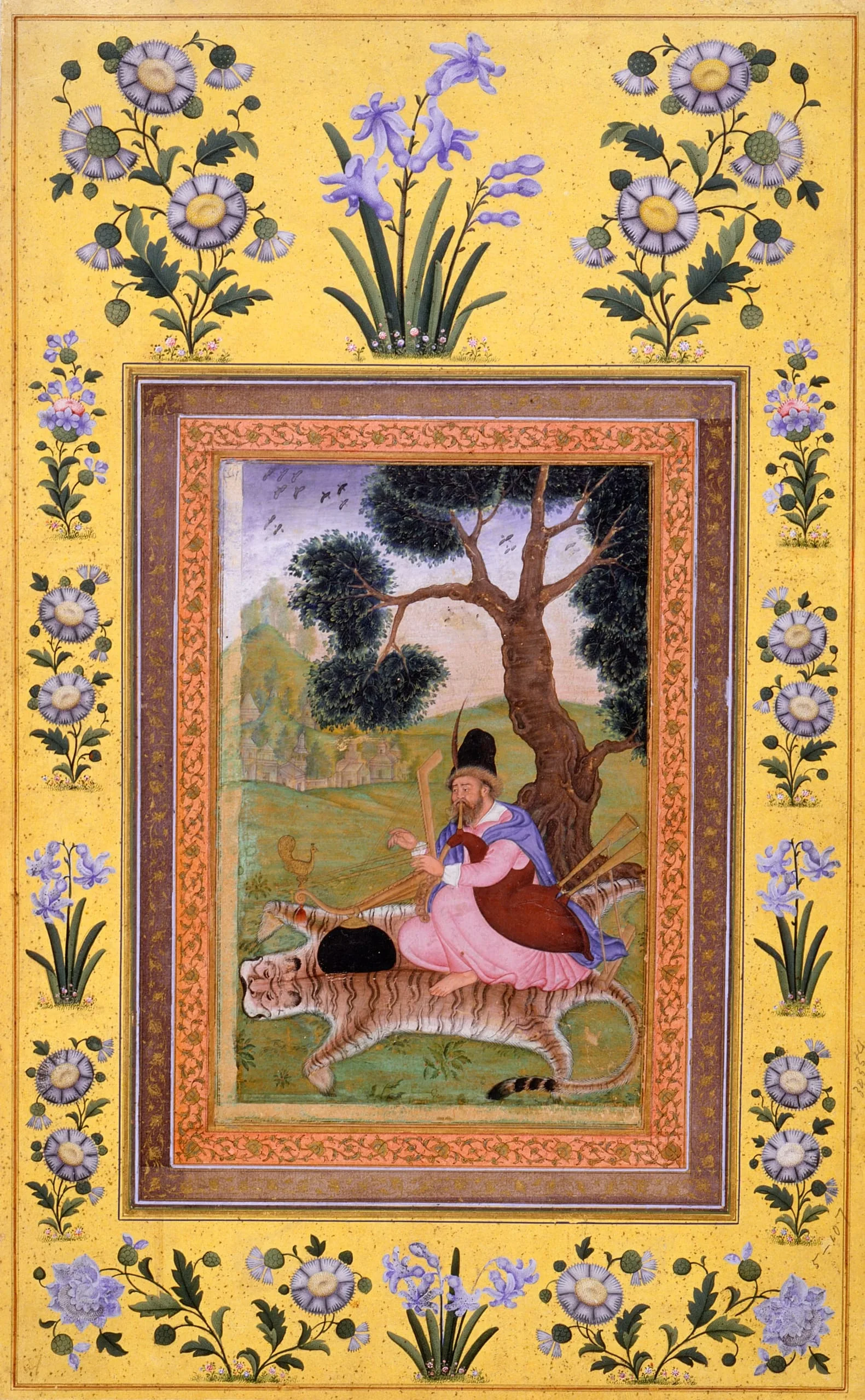
- Title
- Plato as a Musician
- Date Made
- circa 1600; border: Iran, Qajar, 19th century
- Medium
- Opaque watercolor, gold, and ink on paper
- Dimensions
- Image: 6 1/8 x 3 7/8 in. (15.6 x 9.8 cm); Sheet: 13 x 8 1/16 in. (33.0 x 20.5 cm)
- Accession Number
- M.80.6.7
- Curatorial Notes
This allegorical figure of a musician dressed in European garb and playing bagpipes and an Indianized harp probably derives from earlier Mughal and Islamic images of Plato (Arabic name: Aflatun) playing esoteric melodies to tame wild animals on a special organ he constructed and took into the wilderness. Whereas other compositions of this theme can include the pacified animals, particularly stereotypical predators and prey such as tigers and gazelles, in this painting and its descendent versions Plato has been isolated for emphasis and set in a European-style landscape devoid of animals apart from the birds flying overhead. Plato wears a silk or velvet toque-style hat with a fur brim.
Inspired by the imagery of Western divinity and sovereignty in the European prints brought to India by emissaries and traders, the Mughals and other Islamic dynasties of India soon appropriated the visual attributes of the divine and the regal for their own glorification. They commissioned paintings allegorically equating themselves with the famous just monarchs of the Judeo-Christian tradition, such as Solomon and David, kings of ancient Israel (see M.89.51.1), and certain luminaries of Greco-Roman literary traditions, such as Orpheus and Plato, legendary musicians and poets of ancient Greece. The unifying thread in the stories of these influential personalities was that each was graced with the ability to tame and control animals by means of his musical ability and/or spiritual authority.
- Selected Bibliography
- Pal, Pratapaditya. Indian Painting, vol.1. Los Angeles: Los Angeles County Museum of Art, 1993.
- Heeramaneck, Alice N. Masterpieces of Indian Painting : From the Former Collections of Nasli M. Heeramaneck. New York: A.N. Heeramaneck, 1984.
- Rosenfield, John. The Arts of India and Nepal: The Nasli and Alice Heeramaneck Collection. Boston: Museum of Fine Arts, Boston, 1966.
Markel, Stephen. "The Enigmatic Image: Curious Subjects in Indian Art." Asianart.com, July 28, 2015. http://asianart.com/articles/enigmatic.