LACMA

ShopMembershipMyLACMATickets
LACMA
Los Angeles County Museum of Art
5905 Wilshire Blvd.
Los Angeles, CA 90036
info@lacma.org
(323) 857-6000
Sign up to receive emails
Subscribe
© Museum Associates 2025

Museum Hours

Monday

11 am–6 pm

Tuesday

11 am–6 pm

Wednesday

Closed

Thursday

11 am–6 pm

Friday

11 am–8 pm

Saturday

10 am–7 pm

Sunday

10 am–7 pm


  • About LACMA
  • Jobs
  • Building LACMA
  • Host An Event
  • Unframed
  • Press
  • FAQs
  • Log in to MyLACMA
  • Privacy Policy
© Museum Associates 2025
Collections

Reginald Marsh
Third Avenue El1931

On view:
Geffen Galleries, Labor and Leisure in the American Metropolis
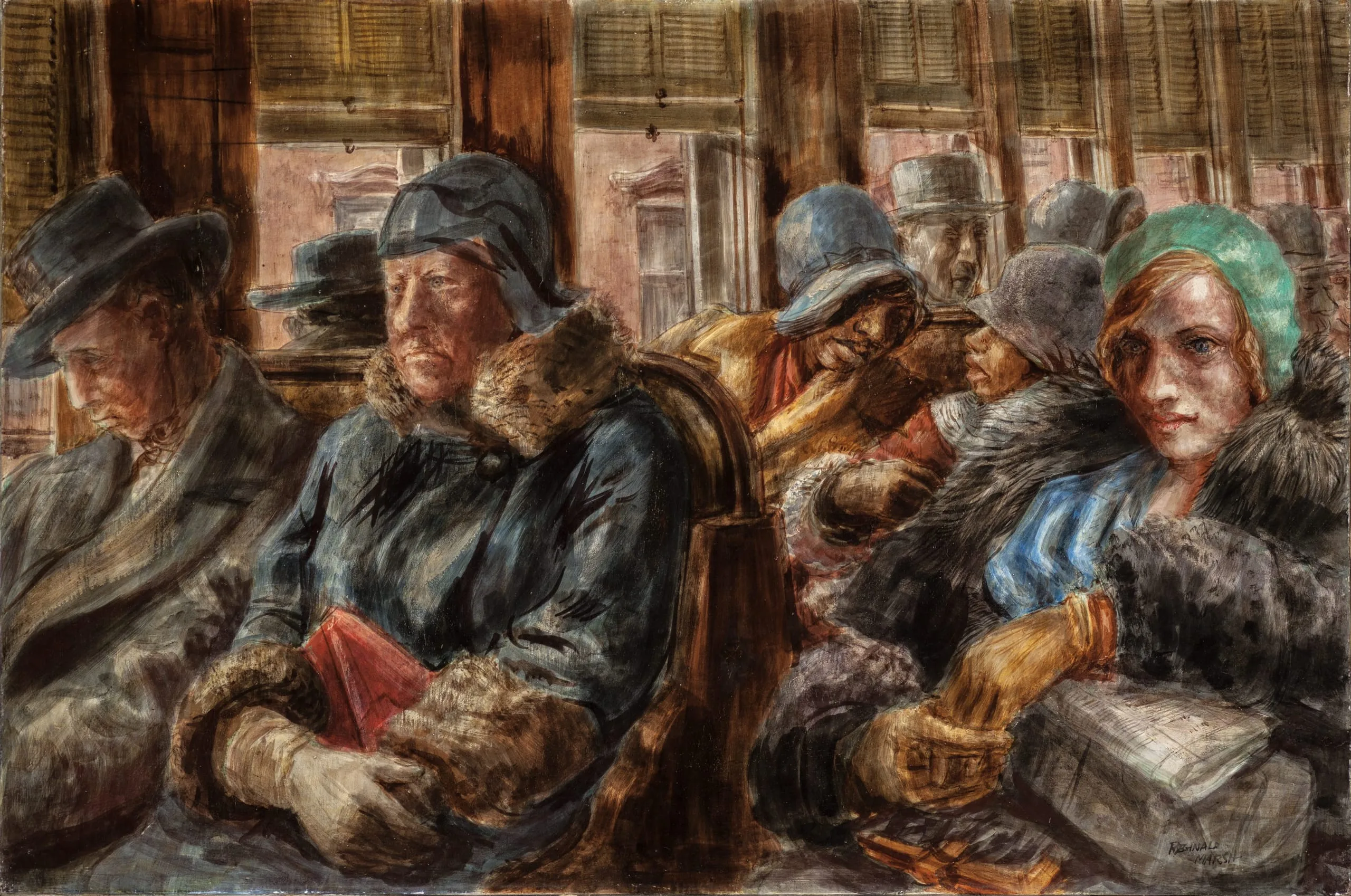
Narrative painting of seven figures, mostly women in winter hats and fur-collared coats, seated closely together in a row, with wooden shuttered windows behind them
Artist or Maker
Reginald Marsh
France, active United States, 1898-1954
Title
Third Avenue El
Place Made
United States
Date Made
1931
Medium
Egg tempera, watercolor, and ink on paper backed by canvas and Masonite
Dimensions
Frame: 32 3/4 × 44 7/8 × 3 1/2 in. (83.19 × 113.98 × 8.89 cm)
Credit Line
Gift of the American Art Council, Mr. and Mrs. Alan D. Levy, Mr. and Mrs. Willard G. Clark, Mr. and Mrs. Will Richeson, Jr., Mr. and Mrs. William D. Witherspoon, and Mr. and Mrs. J. Douglas Pardee
Accession Number
M.82.146
Classification
Drawings
Collecting Area
American Art
Curatorial Notes
Fascinated by the activity of city life, Marsh set much of his work in buses, subways, trains, and stations. Third Avenue El illustrates the crowded conditions of the New York elevated trains but does not give a sense of the extreme congestion often experienced by the daily passenger. This is somewhat surprising since Marsh delighted in the hustle and bustle of urban crowds, but his depictions of buses and trains lack the raucous quality of his other New York images. They are quieter and more serious. By focusing on a few figures and presenting them as physically and psychologically separated-as in Second Avenue El, 1929 (formerly Frank K. M. Rehn Galleries, New York), and Why Not Use the "L"? 1930 (Whitney Museum of American Art, New York) -- he demonstrated how those who live in a large, crowded city could feel alone. Although the passengers in Third Avenue El sit close together, they remain isolated from each other.
The obvious source of Marsh’s painting is Third Class Carriage, c. 1860-70 (Metropolitan Museum of Art, New York), by Honoré Daumier (1808-1879), a work that he could have known through any one of several painted and lithographed versions or through reproductions, which were numerous. Marsh not only borrowed the composition of this well-known image, he shared the French master’s appreciation of the dignity and worth of working-class people. Each passenger is a large, statuesque figure with a monumental presence. Marsh painted Third Avenue El in his characteristic, thin tempera wash, drawing in many details, such as the facial features and fur collars and cuffs. Deep colors, transparent washes, opaque passages, and drawing describe the solid forms.
Based on various inscriptions in more than one hand on the stretcher, the museum’s painting has been dated to both 1930 and 1931 and at times referred to as Second Avenue El. According to the artist’s own detailed records in his notebook however, this painting was created during January 1931 and titled Third Avenue El.
A number of drawings and an etching are related to the painting. Drawing was essential to Marsh’s art, and he felt that the print medium aided the development of his painting. The related print was probably created after the painting. Art historian Norman Sasowsky dates the etching to 1930, but according to records the artist kept of the states of his etchings, he first executed states of the print sometime between January and March 1931.
Marsh made a major change in the print, substituting a black man for the white woman in the center foreground. Marsh had included blacks in the painted scene, as two female figures in the near background. Perhaps by giving a black a more prominent position in the print, the most important position in fact, Marsh felt he was updating Daumier’s image. It is not clear when in the evolution of the related images Marsh changed the figure from a woman to a man. The female figure in the painting has a masculine appearance despite her fox-trimmed coat and handbag. Such ambiguity of gender is present in a number of related drawings. Marsh carried a sketch pad wherever he went, and in several drawings there are jottings of figure groupings and scenes similar to the painting Third Avenue El. Despite the sketchy nature of the drawings, in one in sketchbook 130 (Archiv. Am. Art, Reginald Marsh Papers, microfilm roll NRM8, fr. 583) Marsh so reworked the head of the center figure that its sex cannot be conclusively determined.
Selected Bibliography
  • Kim, Woollin, Jinmyung Kim, and Songhyuk Yang, eds. Art Across America. Seoul: National Museum of Korea, 2013.
  • Miller, Angela, and Chris McAuliffe, eds. America: Painting a Nation. Sydney: Art Gallery of New South Wales, 2013.