LACMA

ShopMembershipMyLACMATickets
LACMA
Los Angeles County Museum of Art
5905 Wilshire Blvd.
Los Angeles, CA 90036
info@lacma.org
(323) 857-6000
Sign up to receive emails
Subscribe
© Museum Associates 2025

Museum Hours

Monday

11 am–6 pm

Tuesday

11 am–6 pm

Wednesday

Closed

Thursday

11 am–6 pm

Friday

11 am–8 pm

Saturday

10 am–7 pm

Sunday

10 am–7 pm


  • About LACMA
  • Jobs
  • Building LACMA
  • Host An Event
  • Unframed
  • Press
  • FAQs
  • Log in to MyLACMA
  • Privacy Policy
© Museum Associates 2025
Collections

Unknown
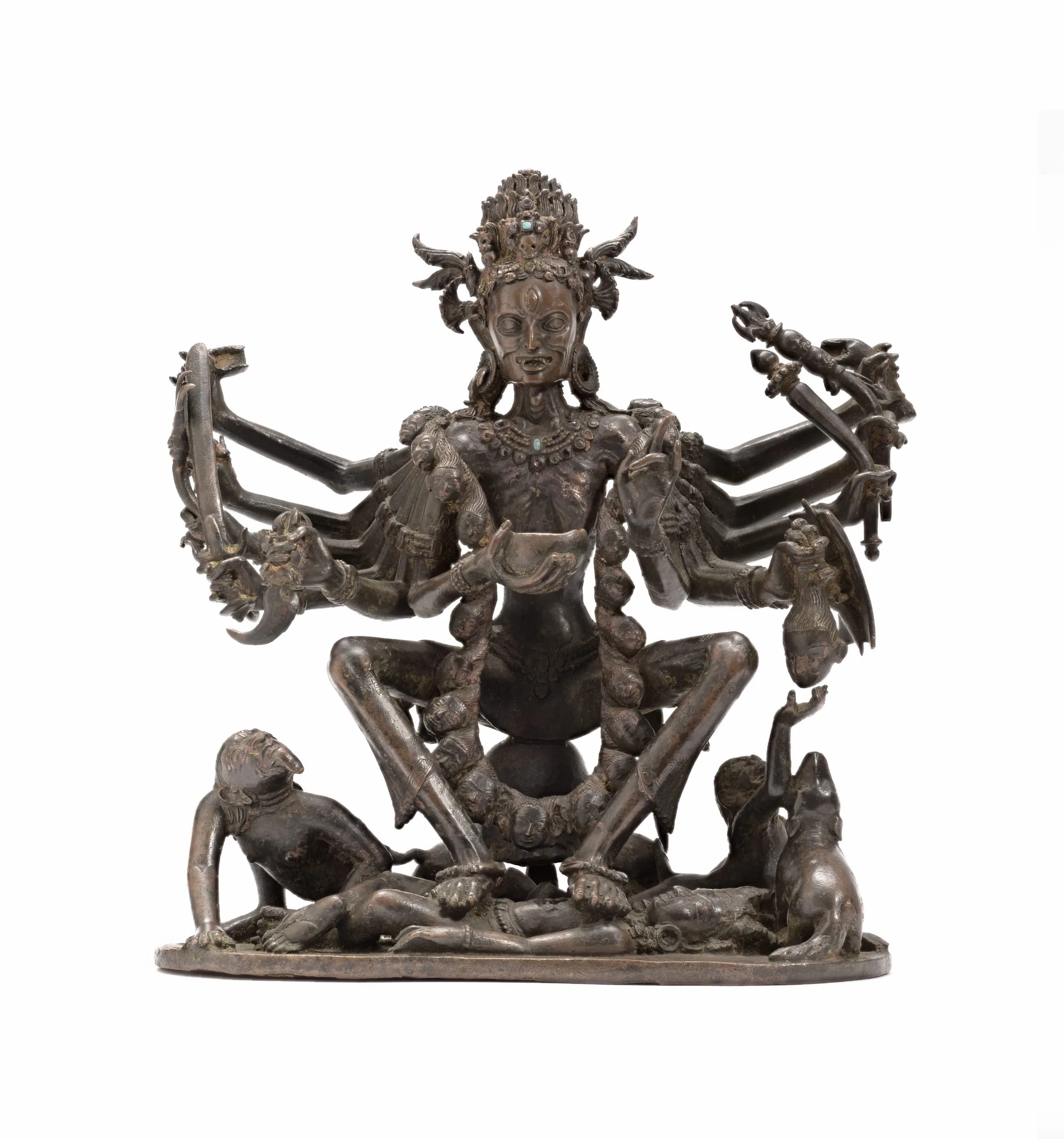
The Hindu Goddess Chamunda14th century

Not on view
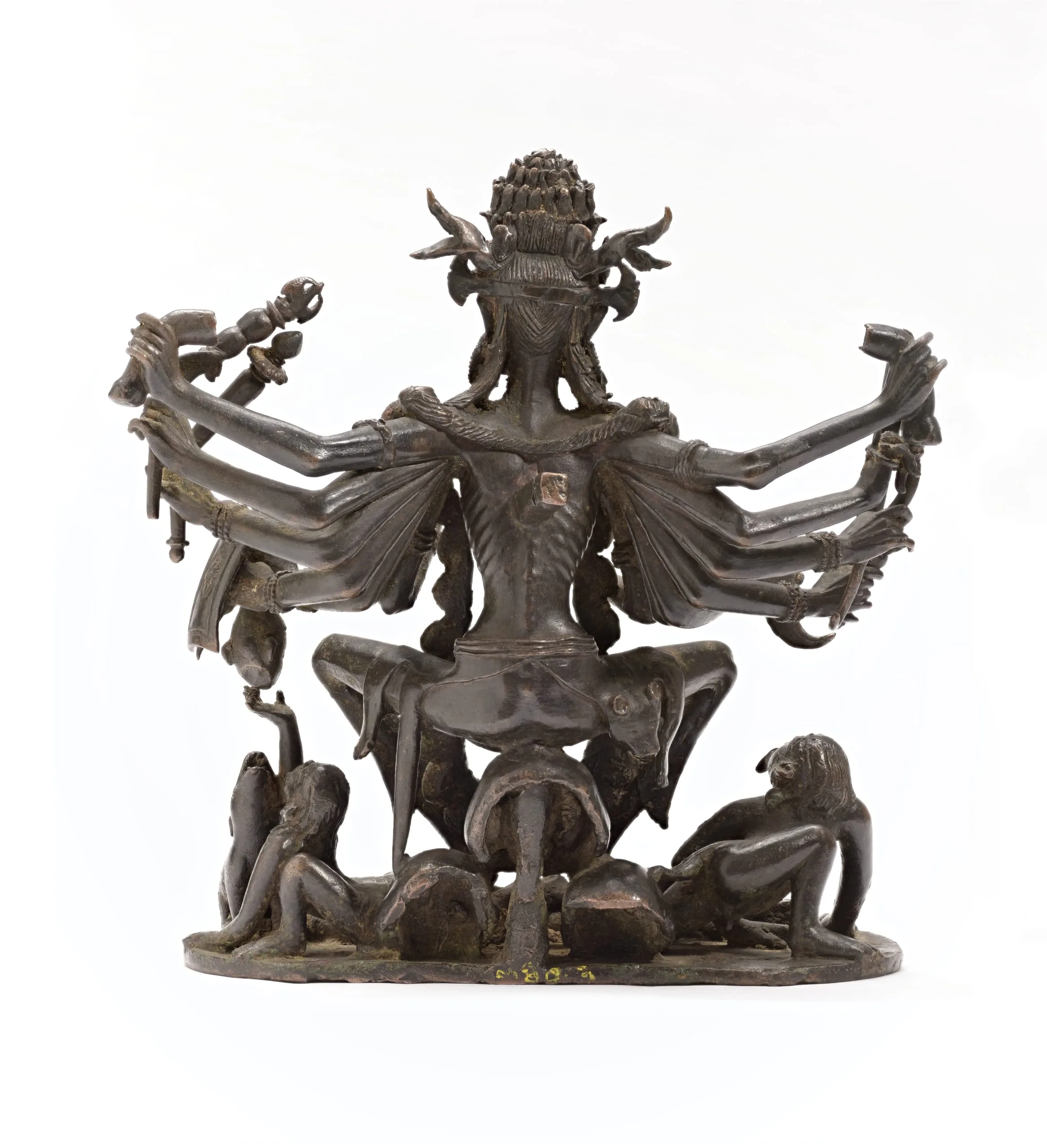
Dark bronze sculpture of a multi-armed Hindu deity seated in a wide stance with ten radiating arms, each holding ritual objects, atop a base with four smaller prostrate figures, with turquoise stone inlay in the crown
Bronze sculpture of a multi-armed deity in a wide-legged stance, wearing an elaborate crown, holding ritual attributes in eight arms; three smaller figures crouched at the base on an oval platform; dark patinated surface with fine cast detailing.
Artist or Maker
Unknown
Title
The Hindu Goddess Chamunda
Place Made
Nepal
Date Made
14th century
Medium
Copper with traces of gilding and paint; inlaid with gemstones
Dimensions
8 x 8 1/4 x 4 in. (20.32 x 20.96 x 10.16 cm)
Credit Line
Museum Associates Acquisition Fund
Accession Number
M.80.3
Classification
Sculpture
Collecting Area
South and Southeast Asian Art
Curatorial Notes

This tour de force of Nepalese bronze casting depicts Chamunda, one of the fiercest forms of the Great Goddess, Durga, the Hindu goddess of death and destruction. Her name is a contraction of the names of the demon generals Chanda and Munda, whom she slew in battle (see M.70.70). She is also one of the Mother Goddess (matrikas), the female creative aspects (shaktis) of the Hindu gods (see M.71.110.2 and M.80.157).

The emaciated Chamunda is naked with desiccated breasts and bony limbs. She has fangs, a lolling tongue, and a third eye in her expressive face. She wears a tiara of skulls with fanlike fillets, a bear-skin loin cloth, and a long garland of severed skulls (mundamala). Chamunda has sixteen arms mainly holding various weapons. Beginning with the uppermost left hand and continuing clockwise, they are an elephant’s foot, trident with skulls, club, shield, severed head, the gesture of flicking drops of wine or blood as a tantric offering (bindu mudra), skull cup, chopper (also known as a flaying knife), sword, trident, noose (?), and another elephant’s foot. Originally, she held a flayed elephant’s skin behind her like a cape (only the elephant skin’s support lug remains on her back). She sits with her legs spread wide apart on a seat formed by three skulls, perhaps symbolic of the three ages: past, present, and future. Her legs are supported by her prostrate corpse (mritaka) mount. Flanking her are two carnivorous ghouls (pishacas) with lolling tongues and a hungry jackal representing the charnel grounds.

See Vidya Dehejia, et al, Devi: The Great Goddess: Female Divinity in South Asian Art (Washington: Arthur M. Sackler Gallery, Smithsonian Institution in association with Mapin Publishing, Ahmedabad and Prestel Verlag, Munich, 1999), pp. 232-233, no. 11.
Selected Bibliography
  • Larson, Gerald et al. In Her Image: The Great Goddess in Indian Asia and the Madonna in Christian Culture. Santa Barbara: UCSB Art Museum, University of California, 1980.
  • Reedy, Chandra L. Himalayan Bronzes: Technology, Style and Choices. Newark: University of Delaware Press, 1997.
  • Pal, Pratapaditya. Himalayas: An Aesthetic Adventure. Chicago: The Art Institute of Chicago, 2003.
  • Pal, Pratapaditya. Art of Nepal. Los Angeles: Los Angeles County Museum of Art; University of California Press, 1985.