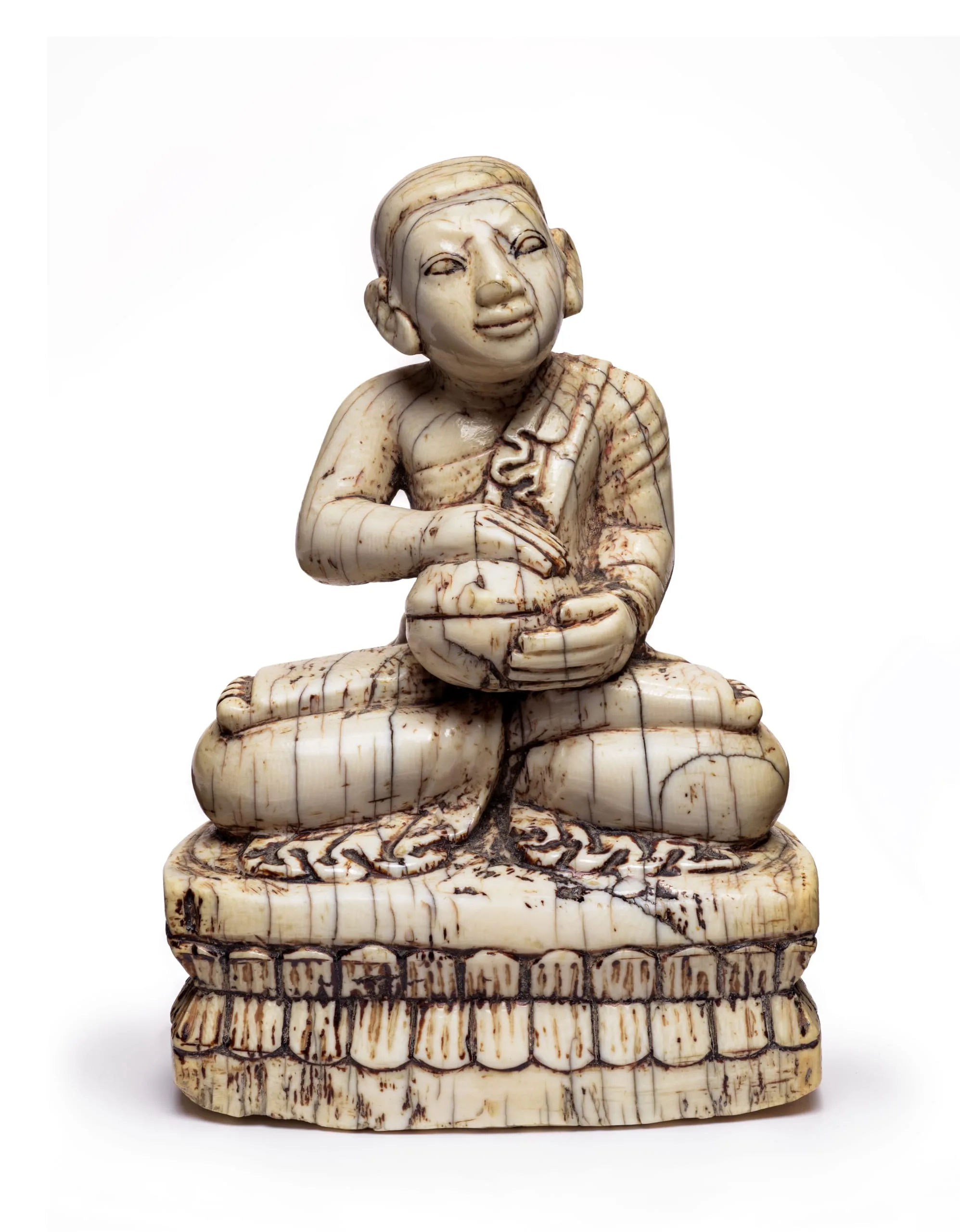
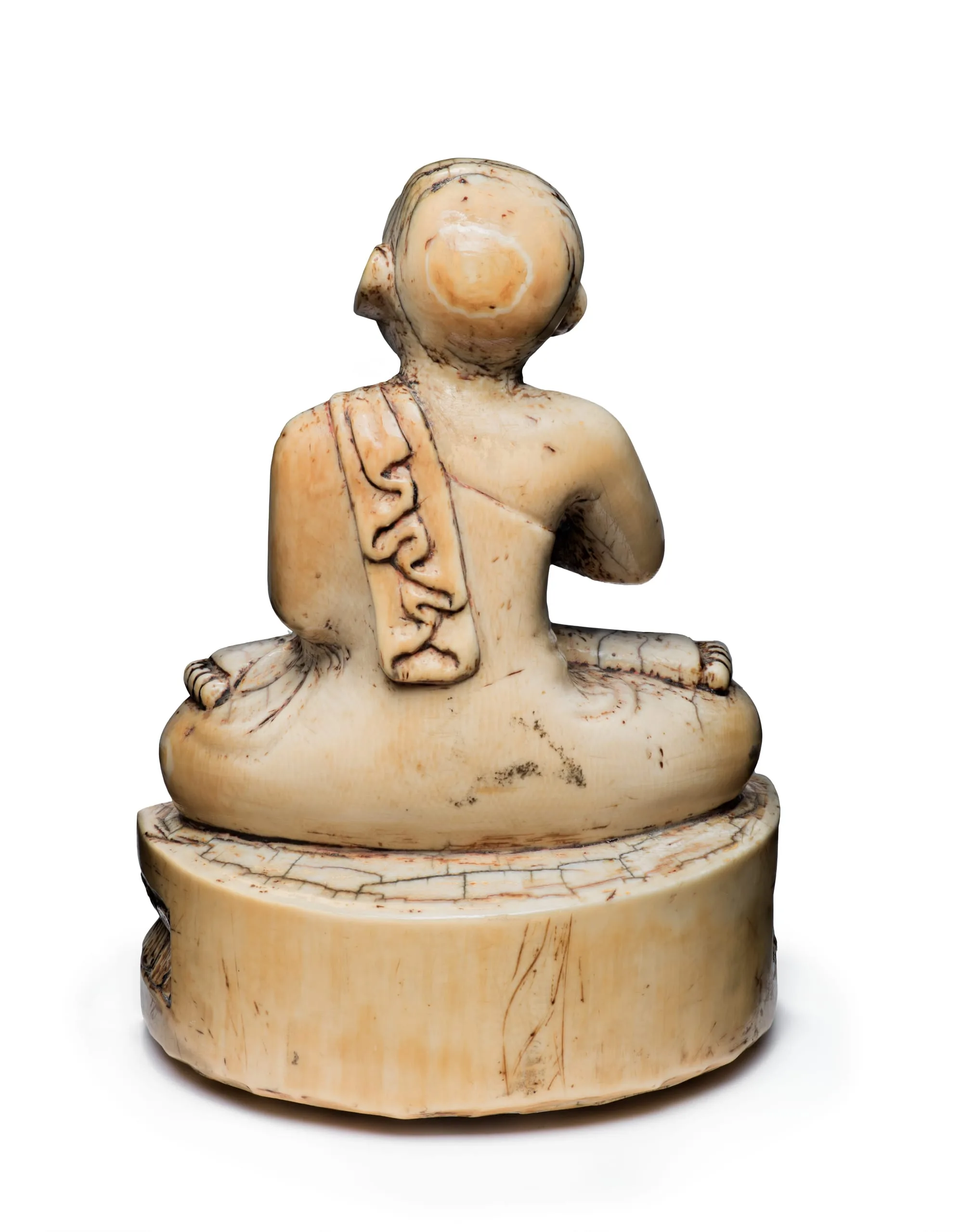
Shin Upagutta (or Upagok, from Sanskrit: Upagupta) was born in 265 or 182 BCE in Mathura, Uttar Pradesh, India to his mother Missa Dewi (Macchadevi) and his father Prince Dawtha Kumara (Dosakumara). He was prophesied by the Kassapa Buddha (the Buddha before Buddha Shakyamuni) to become a Buddhist saint (arhat) 218 years after the death of Buddha Shakyamuni (traditionally dated to 483 BCE). He became the fifth Buddhist patriarch. Upagutta is renowned for converting the demon king Mara by placing a garland made of the corpses of a man, a dog, and a snake around Mara’s neck, which could only be removed after Mara promised to do no harm and follow the Buddhist Dharma. He is believed to reside in a brass pavilion in the southern ocean, from where he is evoked in Pali rituals to protect the Burmese from rain storms and floods. Upagutta sits in the meditation posture (padma asana) on a lotus base. He has shorn hair and wears a Buddhist robe over his left shoulder. He cradles his alms bowl in his lap and has his head cocked to his right. See Sylvia Fraser-Lu and Donald M. Stadtner, Buddhist Art of Myanmar (New York: Asia Society Museum in association with New Haven and London: Yale University Press, 2015), pp. 182-183, no. 48.
See also M.83.254 and M.89.101.1.