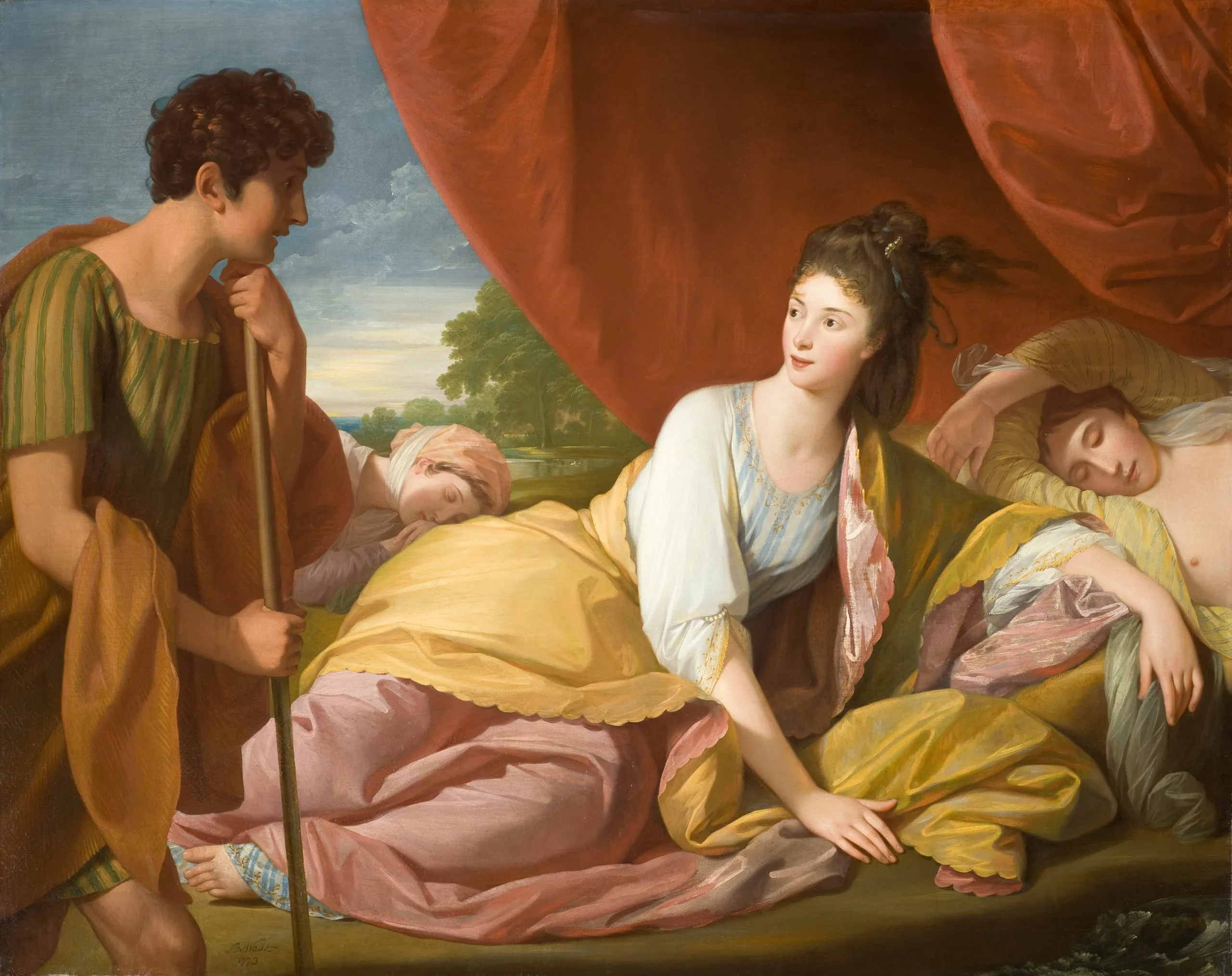
When this painting was first exhibited and in early lists of West’s works, the subject was given as Rinaldo and Armida, from a scene in Torquato Tasso’s Gerusalemme Liberata (1575), in which Rinaldo is most often represented holding a mirror to Armida’s face, as in West’s version of 1766 (Rutgers University Art Gallery, New Brunswick, NJ.). Few details of the painting support that identification, however, whereas many coincide with the story of Cymon and Iphigenia, which West may have known either from the original tale by Boccaccio in The Decameron (1353) or from the version by John Dryden (1700). Cymon was the handsome son of a nobleman of Cypress who was so crude and stupid that he was sent to work on the land. One morning he happened on the camp where Iphigenia (not the daughter of Agamemnon) was sleeping among her slaves. Transfixed by her beauty, he remained leaning on his staff. When she awoke and spoke, he continued to stare at her. His love for Iphigenia fired Cymon with such desire for learning that he quickly advanced to become an exemplary young man and after some military adventures, won her. All the elements in this painting correspond to the story, with the exception that Iphigenia is here clothed, whereas in most representations she is sleeping nearly nude, with her breasts uncovered. A reference to this detail is made by the partial dress of the sleeping slave on the right.
The museum’s picture and West’s Isaac’s Servant Tying the Bracelet on Rebecca’s Arm, 1775 (Yale Center for British Art, New Haven, Conn.), dated two years later and of identical size, were painted for John Hobart, the second earl of Buckinghamshire, and exhibited at the Royal Academy in 1776. The theme shared by these otherwise dissimilar subjects is the finding of the ideal wife. It would have been entirely characteristic of West to have painted these pictures, with their similar central female figures, as allegorical portraits, in this case of Lord Buckinghamshire’s second wife, whom he had married in 1770. The fact that they were inherited by the daughter from this marriage would seem to support this conjecture. If Iphigenia is a portrait of the countess, perhaps this explains her modestly covered bosom.
In his well-known works of the mid-1760s West continued to develop his somewhat dry and stiff neoclassical style. By the early 1770s he had arrived at a truly grand style: the forms are simpler and larger, colors richer, technique more expert and elegant. The large forms, heavy drapery, and slow rhythms recall the classicism of the Italian seventeenth-century artists Guercino (1591-1666) and Guido Reni (1575-1642).