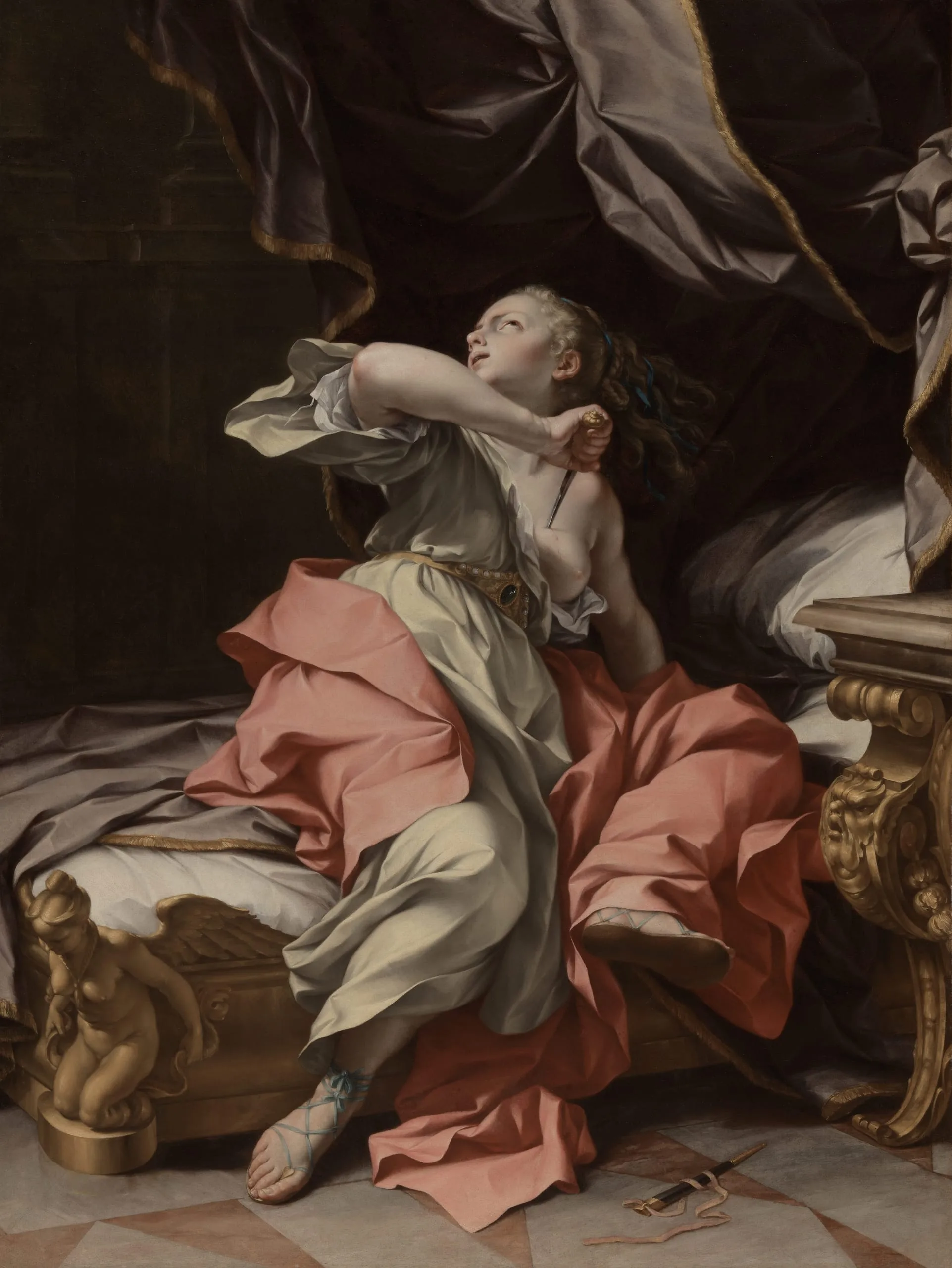
Lucretia was a legendary Roman noblewoman whose rape by Sextus Tarquinius, the son of Rome’s last king, and subsequent suicide provoked a popular uprising that led to the overthrow of the monarchy and the founding of the Roman Republic in 509 BCE. Given the circumstances of her death, she was embraced by European artists as an anti-monarchical symbol, a tribute to republicanism and resistance to tyranny. Mazzanti depicts her death on an epic scale. Lucretia’s monumental figure, posed in dramatic contrapposto, dominates the composition. She twists in agony, turning her head to the heavens as she plunges the dagger into her breast. Yet in Mazzanti’s rendering, the tragedy of Lucretia’s violation and death is hidden beneath a veneer of sexual allure. The artist eroticizes the story by painting Lucretia in a provocative setting of billowing robes and plump pillows (and a female nude adorning the bedframe). Rather than emphasizing her personal trauma or its social and political ramifications, the painting treats her as an object of desire for the viewer’s gaze.
Born in Rome, Mazzanti was apprenticed at a young age to the decorative painter Giovanni Battista Gaulli, also known as Il Baciccia. Mazzanti worked primarily in Rome but also fulfilled commissions elsewhere in Italy, including Ovieto, Viterbo, and Naples, where he worked with the painter Francesco Solimena. He was successful and esteemed enough to have been granted the papal title of cavaliere (knight), awarded to only the most outstanding artists, as well as the title of conte (count), possibly by the grand duke of Tuscany. In 1744, he was elected a member of the Academy of Saint Luke, the guild and training academy for artists in Rome.
The LACMA painting was unknown in scholarly literature before its appearance on the art market and acquisition by the museum. Mazzanti’s notebook of 1770, preserved in the archive in Orvieto, lists a “Suicide of Lucretia” in the collection of the prince of Aragon, as well as a second painting of Lucretia, “painted in Naples,” belonging to the Sciviman family in Venice. If the prince of Aragon commissioned the painting now in Los Angeles, it may have been during Mazzanti’s second sojourn in Naples. The crisp, fluttering draperies, upraised elbow of Lucretia, and difficult perspective of her head closely relate to figures in The Expulsion of Heliodorus, which Mazzanti painted in the Neapolitan Church of the Girolamini in 1736.